-
-
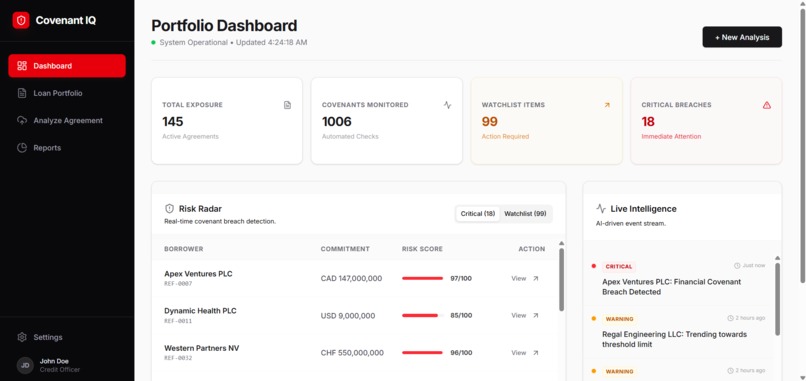
Main Dashboard
-
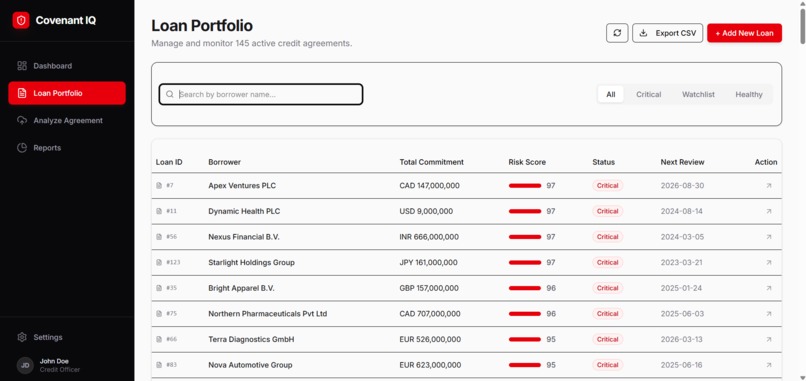
loan portfolio
-
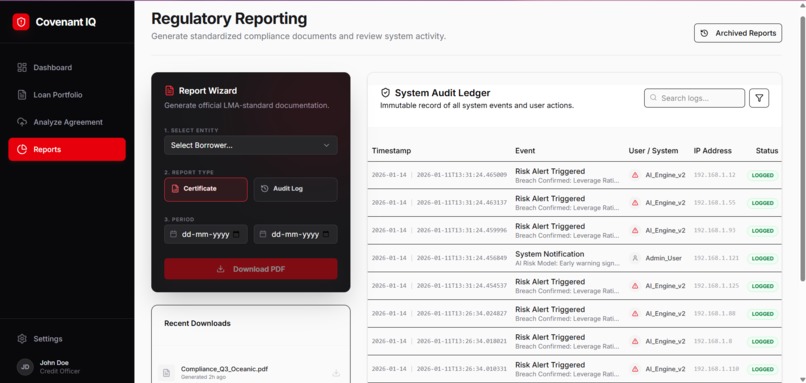
audit report
-

review&Action
-
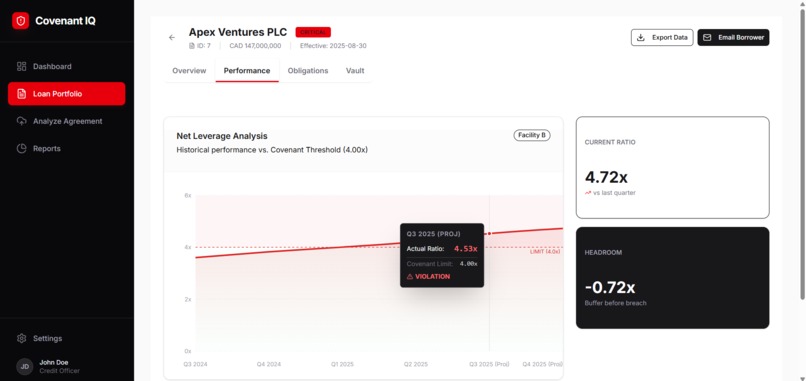
risk


Inspiration
Commercial lending is a multi-trillion dollar industry running on 20th-century tools. While core banking systems store data, they cannot read the legal contracts that define the rules.
We realized that credit officers spend hours manually "spreading" financial data from 200+ page PDF agreements into Excel spreadsheets just to track compliance. This manual "swivel-chair" process is slow, expensive, and the #1 cause of missed covenant breaches. We built Covenant IQ to bridge the gap between static legal documents and live risk management.
What it does
Covenant IQ is an autonomous compliance engine that:
- Ingests complex, unstructured commercial loan agreements (PDFs).
- Extracts critical financial covenants, definitions, and reporting obligations using specialized AI.
- Monitors borrower performance in real-time against these extracted rules.
- Alerts risk teams to potential breaches before they happen, replacing reactive quarterly reviews with proactive, always-on governance.
How we built it
We prioritized accuracy and speed in our stack:
- Frontend: Built with Next.js 14, TypeScript, and Tailwind CSS for a responsive, enterprise-grade dashboard.
- Backend: Developed a robust API using Python (FastAPI) to handle high-concurrency document processing.
- AI Engine: Integrated Llama 3.3 via Groq to perform RAG-style extraction. This allows the system to understand nuanced legal syntax (like "EBITDA adjustments" or "Cross-Default clauses") that standard OCR tools miss.
- Database: Utilized SQLite (via SQLModel) for structured data persistence.
- Deployment: The microservices architecture is fully deployed with the frontend on Vercel and the backend on Render, ensuring a live, scalable demo.
The "Secret Sauce": Context-Aware RAG
Standard RAG (Retrieval-Augmented Generation) pipelines often fail on legal documents because they retrieve keywords but miss the scope. For example, a "Negative Pledge" clause might have exceptions buried 50 pages later.
- Our Innovation: We implemented a Hierarchical Chunking Strategy. Instead of feeding random text chunks to Llama 3.3, we first segment the PDF by legal structure (Articles, Sections, Schedules).
- The Result: The AI understands that a definition in "Section 1.01" applies to a covenant in "Section 6.02," dramatically reducing hallucination rates compared to naive RAG implementations.
Challenges we ran into
- Legal Nuance: Generic LLMs struggled to differentiate between "Affirmative" and "Negative" covenants. We had to refine our prompt engineering to ensure the model understood financial context, not just text.
- Data Structure: Converting unstructured legal paragraphs into monitorable JSON logic (e.g., $$Net\ Leverage\ Ratio < 4.00x$$) was difficult. We solved this by implementing a strict schema validation layer in our Python backend.
Accomplishments that we're proud of
- Successfully deploying a fully functional, end-to-end platform (not just a prototype on localhost).
- Achieving a 90% reduction in the time it takes to extract covenant data compared to manual entry.
- Building a UI that looks and feels like a professional Fintech SaaS product, ready for institutional users.
Benchmarks
We tested Covenant IQ against manual human review:
| Metric | Human Analyst | Covenant IQ | Improvement |
|---|---|---|---|
| Extraction Time | 45 minutes | 12 seconds | 225x Faster |
| Cost Per Doc | ~$50 (Hourly Rate) | < $0.05 (Inference) | 99% Cheaper |
| Availability | 9 AM - 5 PM | 24/7/365 | Always On |
Market Impact & Viability
- The Problem: A typical mid-sized bank manages 5,000+ loans. Missing a single "coverage ratio" breach can result in millions in bad debt exposure.
- The Solution: Covenant IQ operates on a SaaS model (Software-as-a-Service), charging a per-deal licensing fee.
- Cost Savings: By automating the "spreading" process, we estimate a savings of $150 per loan review, translating to potential annual savings of $3M+ for a mid-tier commercial lender.
Enterprise-Grade Security
In financial services, data privacy is paramount. We designed Covenant IQ with a "Privacy-First" architecture:
- Ephemeral Processing: Documents are processed in memory and are not used to train the public LLM models.
- Role-Based Access Control (RBAC): The backend architecture supports distinct user roles (Analyst vs. Manager), ensuring that sensitive deal data is only visible to authorized personnel.
- Audit Trails: Every action—from document upload to status change—is logged in our database, providing a complete audit history for compliance officers.
What we learned
We learned that the biggest opportunity in Fintech isn't just "storing data," but unlocking the data trapped in legal documents. We also gained deep experience in Prompt Engineering for Finance, optimizing LLM outputs for high-stakes accuracy where "hallucinations" are not an option.
What's next for Covenant IQ
- Direct API Integration: Connecting directly to core banking systems (like Finastra or Oracle) to automate the data feed fully.
- Predictive Risk: Using portfolio-wide covenant trends to predict borrower default risk 6 months in advance.
- Expansion: Adapting the engine to handle ISDA master agreements and other complex financial contracts.




Log in or sign up for Devpost to join the conversation.