-
-
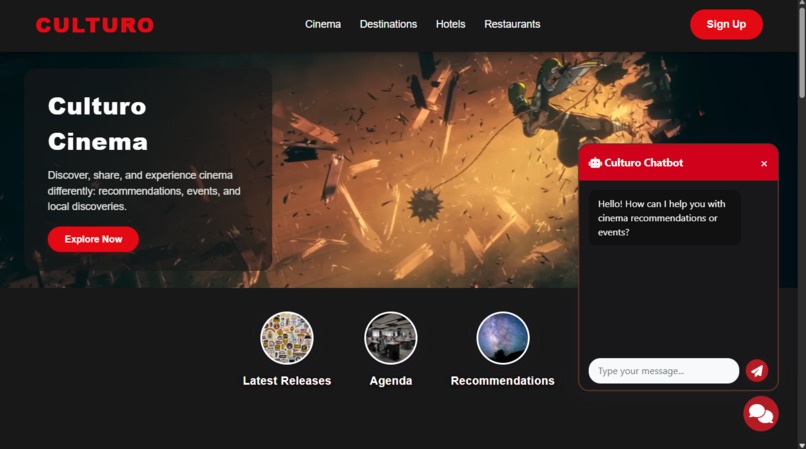
Culturo Cinema

Inspiration
The inspiration behind Culturo was born from a common frustration: most cultural and travel recommendation platforms are either too generic or too commercial. We realized that people often discover restaurants, hotels, and destinations not because they match their personality, but because they are popular.
We asked ourselves:
"What if cultural discovery could be as personal and intelligent as a Spotify playlist?"
That single idea led us to envision a platform where every user could explore the world based on their own tastes, interests, and preferences.
With the growing power of AI and the availability of platforms like Qloo and Gemini, we saw the opportunity to create something that bridges the gap between technology and culture.
Culturo was inspired by:
- Our personal passion for culture, travel, and gastronomy.
- The belief that technology can enrich human experiences when used thoughtfully.
We wanted a solution where users don’t need to search endlessly — instead, they get meaningful, intelligent recommendations, powered by AI, presented on a beautiful and interactive interface.
What it does
Culturo is a web platform that redefines how people discover culture around the world. It combines AI-powered chatbots, taste-based recommendations, and interactive maps to deliver a truly personalized cultural experience.
Here’s what Culturo offers:
Destination Explorer: Get travel suggestions tailored to your interests whether you love destinations, hotels, food, or cinema. Discover cities that match your vibe using Qloo’s cultural intelligence.
Restaurant Recommender: Find restaurants based on your preferences (cuisine, budget, location) and even receive personalized suggestions through a conversational chatbot.
Hotel Finder: Get hotel recommendations adapted to your travel style, complete with filtering options (price, location, amenities) and map-based discovery.
Cinema Discovery: Browse movie suggestions that match your taste in film genres. Explore the latest releases and cinema events, all in an elegant, Netflix-inspired UI.
AI Chatbot Integration: Powered by Gemini, the chatbot gives smart, dynamic, and personalized responses to user queries — whether you're looking for restaurants in Rome or a film to watch in Tokyo.
Interactive Maps: Every recommendation comes with real-time location support using Leaflet.js, so users can see and explore nearby places effortlessly.
In short, Culturo is your cultural assistant helping you discover the world based on what you love, not just what's trending.
How we built it
We built Culturo as a full-stack web platform using a combination of modern backend and frontend technologies, along with multiple third-party APIs for intelligent cultural recommendations.
Backend
- Django 5.2 – Used as the core web framework to handle routing, user authentication, and database models.
- Django REST Framework – Created custom API endpoints to handle chatbot communication and recommendation responses.
- Gemini API (Google) – Integrated as the main AI engine for natural language understanding and conversation flow.
- Qloo API – Provided cultural and taste-based recommendation data for destinations, restaurants, and movies.
- Unsplash API – Used to fetch high-quality images dynamically for the UI.
- SQLite – For storing user data, preferences, and recommendation metadata.
Frontend
- HTML5 / CSS3 – Structured the user interface with a mobile-first and responsive layout.
- Vanilla JavaScript – Managed interactivity, dynamic chatbot logic, and API request handling.
- Leaflet.js – Integrated for displaying interactive maps with dynamic markers for hotels, restaurants, and destinations.
- Font Awesome & Google Fonts – Enhanced the design and readability with modern icons and typography.
Architecture & Tools
- Modular Django app structure (
users,chatbot,recommendations,maps) - Environment variables and secrets handled securely using
.envandsettings.py - GitHub for version control and collaboration
- Designed with a clean, modern UI inspired by Netflix and Google Material Design
Development Flow
- Backend setup: Django configuration, database models, API integration
- Frontend build: Designed custom HTML/CSS layout and integrated interactive components
- Map integration: Added Leaflet.js with dynamic data binding
- Chatbot logic: Connected Gemini API with custom conversational prompts
- Testing & error handling: Ensured graceful fallback when APIs fail or return empty data
The result is a lightweight yet powerful platform that brings cultural exploration to life through personalized recommendations and interactive AI experiences.
Challenges we ran into
Building Culturo involved integrating multiple systems each with its own limitations. Here are the key challenges we encountered during development:
1. URL Design for Personalized Recommendations
Creating clean and dynamic URLs for recommendation endpoints (e.g. /recommend/restaurant/paris) required careful planning.
We had to handle:
- Query parameters for preferences (cuisine, price, etc.)
- URL routing logic in Django with fallback for non-authenticated users
- API-safe formatting of user queries for Qloo and Gemini integration
2. Chatbot Orientation and User Flow
Designing a conversational AI that can guide users contextually (without predefined buttons) was a major challenge.
We had to:
- Fine-tune prompt templates for Gemini to guide the tone and scope of responses
- Handle misunderstandings or generic replies by redirecting users with clear follow-up options
- Sync chatbot outputs with the recommendation engine while keeping UX fluid
3. Response Delays from Qloo API
The Qloo API is powerful but occasionally slow or unstable.
We ran into:
- Long response times (2–5 seconds in some cases), affecting real-time interactivity
- The need for loading indicators and fallback messages
- Rate limits and error responses that required robust error handling and retry logic
4. Map Synchronization
Synchronizing Leaflet maps with real-time chatbot outputs wasn't trivial:
- We had to dynamically create markers based on new API responses
- Ensure smooth updates without reloading the map container
- Handle overlapping data from different categories (e.g. restaurants and hotels)
These challenges helped us grow as developers. We had to balance design, performance, and user experience, especially while working with multiple APIs and asynchronous components.
What we learned
AccomplishmWorking on Culturo was an intense and rewarding learning experience. Throughout the hackathon, we deepened our understanding of several key areas:
1. Working with Recommendation APIs (Qloo)
We learned how to authenticate, query, and structure responses from a powerful AI recommendation API. Qloo's system is vast, but we managed to extract meaningful insights by carefully designing URL queries and managing entity types like places, movies, and cuisines.
2. Prompt Engineering with Gemini
Using Gemini AI as a conversational layer taught us the importance of prompt clarity, context management, and error fallback. The way we structured prompts and parsed answers directly impacted the relevance of the responses.
3. Mapping Real-Time Results
Integrating Leaflet.js and syncing it with backend data helped us understand how to connect geospatial visualization with cultural data. It pushed us to build real-time interactions between the frontend and APIs.
4. Designing Clean UI/UX with Constraints
With limited time and resources, we focused on delivering a sleek, responsive interface that feels familiar yet modern. We learned how small design choices — spacing, hover effects, animations — greatly affect user engagement.
5. Managing API Delays and Failures
Not all API calls responded on time, especially Qloo. We learned how to handle delays gracefully, cache responses when possible, and show user-friendly loading indicators or fallback messages.
6. Team Collaboration Under Pressure
Perhaps the most valuable lesson was about working together under pressure. We learned how to divide tasks efficiently, merge work smoothly using GitHub, and support each other through technical blockers.
In the end, Culturo taught us not just how to build a platform but how to craft an experience, where technology enhances culture instead of replacing it.ents that we're proud of
What's next for Culturo
Culturo is just getting started. This hackathon version proved the value of culturally intelligent recommendations but there’s much more ahead:
1. Expand Recommendations Beyond Qloo
We plan to integrate additional APIs to enrich our recommendation engine with more localized data, event listings, and niche cultural content. This includes traditional festivals, local art exhibitions, and underground music scenes.
2. Smarter Chatbot with Memory & Multi-turn Conversations
We aim to enhance the chatbot by adding persistent memory, multi-turn capabilities, and better context understanding so users can have natural, flowing conversations with Culturo across multiple topics and sessions.
3. Geolocation & Cultural Personalization
Future versions will use real-time location and language preferences to personalize recommendations helping travelers, locals, and curious minds explore cultures around them more intuitively.
4. Mobile App & Offline Mode
We envision building a mobile-first version with offline capabilities, making cultural exploration accessible even without internet — especially in regions with limited connectivity.
5. Partnerships with Local Cultural Institutions
Culturo could become a bridge between users and local museums, cinemas, artists, and venues by partnering with cultural institutions and creatives worldwide.
Our goal is to turn Culturo into a digital cultural companion one that helps people explore, connect, and grow through culture, wherever they are.
Built With
- bootstrap
- canva
- css
- django
- djangorestframwork
- figma
- gemini-api
- gemini-api-(google-ai)
- github
- html
- javascript
- leaflet.js
- qloo-api
- rapidapi
- unsplash-api


Log in or sign up for Devpost to join the conversation.