-
-
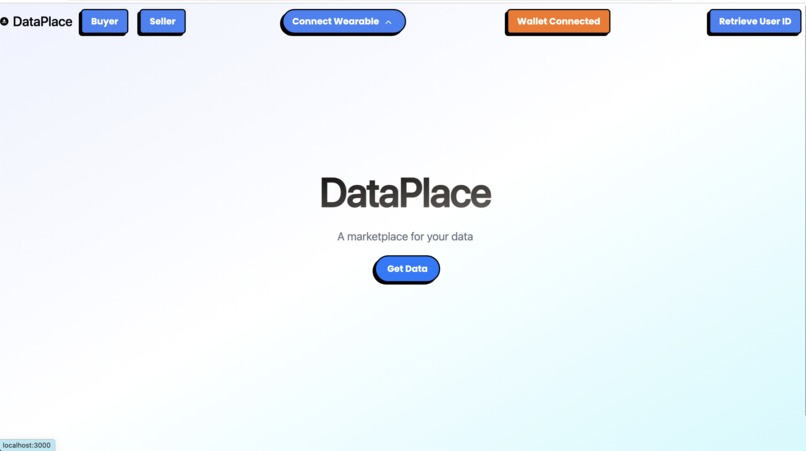
Main Page
-
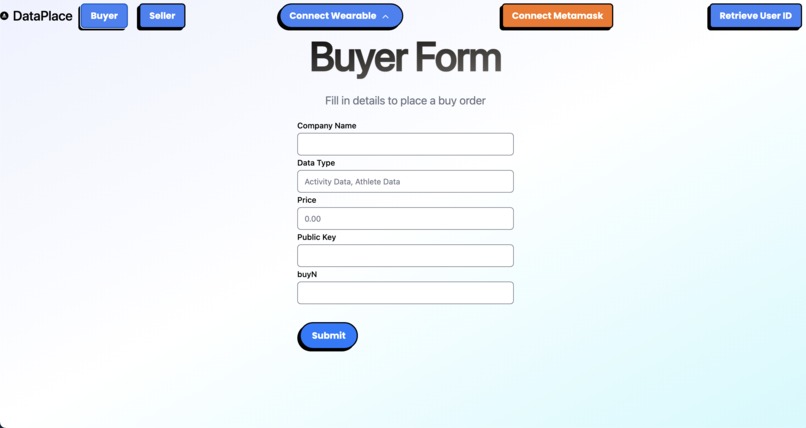
Buyer Form


Inspiration
Health data is centralized into various hospital and research system. Its very costly for research institutions to get access to wide swathes of data to further humanity. Additionally, every day people do not have an incentive to pull health data from their hospitals or devices and share them with researchers doing good work. What if we could give users the ability to own their data safely and securely?
What it does
DataPlace gets wearable health data from users through the Terra API. DataPlace then encrypts their health data they want to sell, and place it on an open order on the blockchain. There is then an ML recommender system that aids users in making the choice choice for their data - ensuring it goes to a safe organization and has a fair price.
Buyers can make a buy order specifying a kind of data that they would like, along with their RSA public keys that the data should be encrypted to. Upon receiving the data, the buyer can decrypt the data and ensure that the associated signature actually came from Terra data. If the data was forged, then the buyer can submit a proof of this to the smart contract and receive their funds back.
How we built it
Addison built the smart contract marketplace and the cryptography systems. This involved lots of RSA research to find an optimized implementation and fine-tune in.
Khalid built off existing SoTa recommender systems to adjust and retrain a movie recommender system to build the unified representation of the health data that Terra has.
Full details: https://drive.google.com/file/d/1_mKa-Qgq-atugsNB53zVRvtdABsaZh26/view?usp=share_link
David and Aaryan integrated Terra API into our backend, designed the front-end and connected the smart contract and ML model to the full-stack app.
Challenges we ran into
The cryptography didn't originally work out how we intended, so we pivoted to using an RSA approach for the cryptography verification.
Accomplishments that we're proud of
Our cryptography scheme is innovative. We had to re-implement RSA so that it could perform in the low throughput blockchain environment and increase its efficiency.
Our ML model provides great insight for recommendations, boasting a vast 92% accuracy on data.
Our full-stack app successfully integrates a high level of complexity from our cryptography and ML solutions, with a high-quality front-end.
What we learned
Design choices are incredibly important in projects with high levels of complexity when dealing with different tech stacks.
What's next for DataPlace
Using Terra API as a proof of concept is the first step but the next after is to see if we can extend this to multiple data sources and continue to develop intelligent systems as well as exploring more cryptographic approaches for the marketplace.
So you think you can do it better?
Our product DataPlace is a solution that we believe we have done better than other data marketplace startups such as Caden.io, as we have a security focused product that ensures that all data is fully verifiable throughout transactions, unlike other data marketplaces. Beyond that we intend to expand this by building advanced recommender systems to curate dataset development and sale to provide more value to our end users.
Built With
- crypto
- hugging-face
- machine-learning
- natural-language-processing
- nextjs13
- pandas
- python
- typescript


Log in or sign up for Devpost to join the conversation.