-

Decoy
-
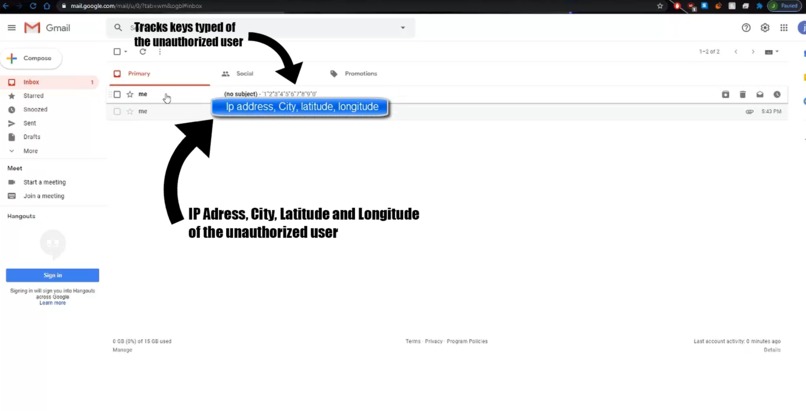
Decoy - Unauthorized user's information sent to laptop's owner


Inspiration
Theft is a large issue that plagues the economy. In a modernized society where technology is rapidly advancing, laptop theft is prominent now more than ever. Businesses and individuals alike use laptops on a daily basis, thus making them an easy target for criminals. Decoy aims to eliminate this by concealing itself as an everyday browser and fool criminals into revealing their location and face after they have stolen a laptop.
What it does
Decoy runs as soon as the browser is opened. The user then must state "close program" or "stop program" to authorize themselves as the owner of the laptop/computer within 8 seconds. Once 8 seconds has passed, Decoy takes a picture of the unauthorized user via webcam and retrieves the location (IP Address, City, Latitude, Longitude), sending the information to the owner of the laptop/computer via email. Lastly, Decoy will track anything the unauthorized user types and sends this information via email every 100 letters.
How we built it
We utilized Python to build Decoy, incorporating the libraries pynput, webbrowser, speech_recognition, requests, cv2, smtplib, ssl and email.mime.
Challenges we ran into
We had difficulties incorporating the part where an email is sent to the owner of the laptop due to there being an attachment required. We mitigated this issue by importing MIMEMultipart from the email.mime library.
Accomplishments that we're proud of
The fact that we were able to come together as a team and finish this project within the span of the hackathon with little prior knowledge is an accomplish we are proud of.
What we learned
We learned that creating a program from scratch is no easy feat and that it takes a large amount of effort to incorporate multiple libraries in order to create a fully functioning program. Furthermore, we also learned that creating a program requires hundreds of test cases to ensure the program does not crash due to unexpected events.



Log in or sign up for Devpost to join the conversation.