-
-

DevSpot Logo
-

Hero Page
-
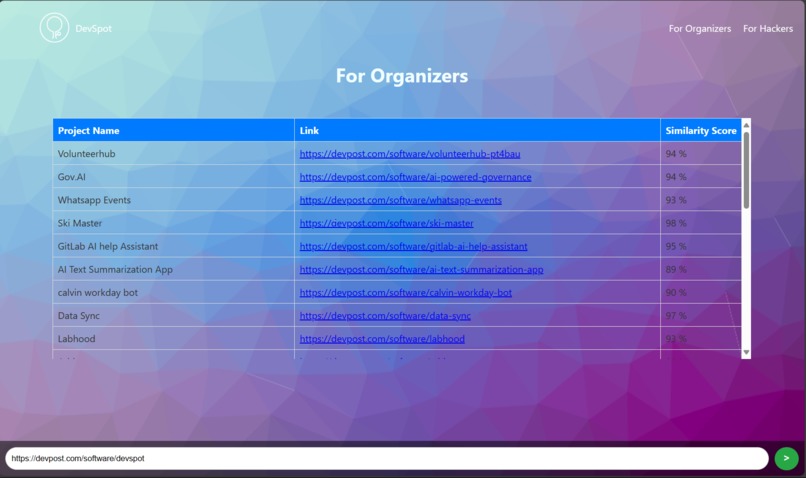
Organizers Screen
-
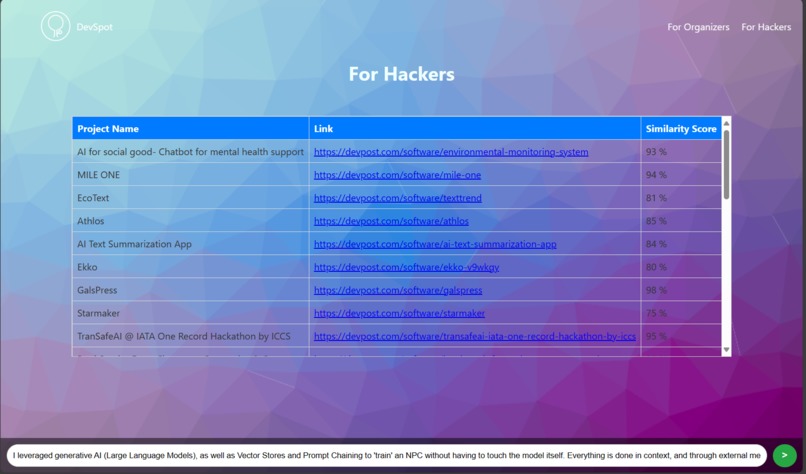
Hacker Page


Inspiration
While browsing through countless project ideas on Devpost, a thought struck me: "What if there was a swift way to gauge the potential of my hackathon ideas?" This seed of curiosity grew into a compelling quest to create something not just for participants but also for the backbone of any hackathon - the organizers. Conversations with various hackathon organizers revealed a shared vision; they were in search of a tool that could streamline the ideation process, making it easier to validate and enhance project concepts. Thus, DevSpot was born - a platform designed to bridge the gap between initial idea and actionable insight, ensuring every participant could quickly assess the uniqueness and viability of their projects while providing organizers a lens into the innovative potential brewing within their events.
What it does
🌐 DevSpot
Description: DevSpot is a pioneering platform designed to enhance the hackathon experience. Leveraging the power of ChatGPT-4, it offers hackers and organizers a unique toolset to check the originality of hackathon ideas, find open-source resources, and explore Devpost submissions for inspiration.
DevSpot aims to foster innovation and collaboration within the hackathon community by providing instant access to a wealth of resources and insights. Built with React for the frontend and Flask for the backend, it integrates cutting-edge AI to streamline the ideation process and support the development of groundbreaking projects.
🌟 Features
- Idea Originality Check: Utilize ChatGPT-4 to evaluate the uniqueness of your hackathon idea.
- Open-Source Resource Finder: Get recommendations for open-source tools and resources relevant to your project idea.
- Devpost Analysis: Compare your idea against existing Devpost submissions to ensure originality and find inspiration.
- Interactive UI: Enjoy a seamless user experience with a responsive design tailored for hackers and organizers alike.
📊 Idea Originality Check
Organizers can use this feature to ensure that hackathon submissions are original and innovative. By inputting project ideas or descriptions, DevSpot leverages ChatGPT-4 to analyze the concept's uniqueness against a vast database of existing projects, including past hackathon submissions stored on platforms like Devpost. This not only helps in maintaining the quality and integrity of the competition but also encourages participants to think creatively.
🔍 Open-Source Resource Finder
This tool aids organizers in guiding participants towards useful open-source resources relevant to their project ideas. It can be used during ideation workshops or as a part of the submission process, where organizers provide tailored recommendations for tools, libraries, and frameworks that can help bring participants' ideas to life. This not only supports the development process but also fosters an environment of learning and discovery.
🤖 Integration with ChatGPT-4
By integrating ChatGPT-4, Organizers can automate several aspects of hackathon management, such as answering frequently asked questions, providing project feedback, and generating content for workshops or challenges. This AI-driven approach saves time and resources, allowing organizers to focus on creating a more impactful event experience.
🌐 Devpost Analysis
The Devpost Analysis feature offers organizers a way to compare current hackathon project ideas against a comprehensive database of previous submissions on Devpost. This functionality is key in identifying trends, popular technologies, and areas of innovation within the hackathon community. It also serves as a benchmarking tool, enabling organizers to position their hackathon in a way that encourages unique contributions.
📈 Analytics and Insights
DevSpot can provide organizers with valuable analytics and insights regarding the types of projects being developed, the technologies being used, and the sources of inspiration participants are drawing from. This data can inform future hackathon themes, workshops, and sponsorship opportunities, ensuring that each event is aligned with the latest trends and community interests.
🔄 Feedback Loop
Organizers can utilize DevSpot to create a continuous feedback loop with participants. This involves collecting ideas, providing resource recommendations, and then gathering feedback on the usefulness of those resources. This iterative process not only enhances the hackathon experience but also contributes to the continuous improvement of the DevSpot platform.
Customizable Integration
DevSpot is designed to be flexible, allowing organizers to integrate its features directly into their hackathon management systems or use it as a standalone tool. Whether it’s through API endpoints for automated checks and resource recommendations or embedding interactive tools on hackathon websites, DevSpot offers various integration options to meet organizers' needs.
How I built it
Frontend Development: I chose React for its robust ecosystem and flexibility. Our goal was to create an intuitive, responsive user interface that could adapt to both organizers' and participants' needs. Components were designed with reusability in mind, ensuring a seamless experience across the platform. Implementing hooks allowed us to manage state and side effects efficiently, making the application dynamic and interactive.
Backend Architecture: Flask stood out as the ideal choice for our backend framework due to its simplicity and versatility. I set up RESTful APIs to handle requests from the frontend, including idea submissions and requests for open-source resources. Flask's lightweight nature enabled us to focus on implementing logic without getting bogged down by unnecessary complexity.
Integration with ChatGPT-4: The integration of ChatGPT-4 was pivotal in automating the evaluation of hackathon ideas and sourcing open-source resources. By crafting specific prompts and leveraging the OpenAI API, I was able to generate insightful responses that added significant value to the user experience. This integration required careful management of API requests and responses to ensure efficiency and accuracy.
Keyword Extraction and Devpost Analysis: To enhance the platform's utility, I implemented keyword extraction from project descriptions, using these keywords to query Devpost submissions. This feature was developed using natural language processing techniques, which allowed us to automate the comparison process and provide users with a clear view of how their ideas stood against existing projects.
Challenges I ran into
One of the biggest challenges was ensuring seamless communication between the frontend and backend, especially when integrating with the OpenAI API. I learned the importance of meticulously planning our requests and structuring our application to handle asynchronous operations effectively. Additionally, fine-tuning our keyword extraction algorithm to yield relevant results was a rewarding challenge that pushed us to explore various NLP libraries and techniques for prompt engineering and seeding.
Accomplishments that we're proud of
Building DevSpot has been a journey marked by milestones that I hold in high esteem. Here are some of the accomplishments that fill us with pride:
Seamless Integration of ChatGPT-4: Successfully integrating ChatGPT-4 to automate the evaluation of hackathon ideas and source open-source resources was a game-changer. This not only enhanced the functionality of DevSpot but also demonstrated the potential of AI in streamlining the hackathon ideation process.
Innovative Idea Validation Process: Developing a unique system that checks the originality and validity of hackathon project ideas against a vast database of existing projects was a significant achievement. This feature stands as a testament to our commitment to fostering innovation within the hackathon community.
User-Centric Design: Crafting a user interface that is intuitive, responsive, and accessible was paramount. We're proud to have created an experience that caters to both organizers and participants, making the process of managing and participating in hackathons more efficient and enjoyable.
Effective Use of Natural Language Processing (NLP): Implementing NLP for keyword extraction and Devpost analysis was a challenging yet rewarding endeavor. This allowed us to automate comparisons with existing projects, providing users with valuable insights into their ideas' uniqueness and potential overlap.
What I learned
The journey of developing DevSpot was as much about discovery and growth as it was about coding and design. Here are the key lessons that I took away from this experience:
The Power of AI and NLP: Integrating ChatGPT-4 and utilizing natural language processing (NLP) opened our eyes to the transformative potential of these technologies. I learned how to effectively leverage AI to automate complex tasks, such as evaluating the originality of project ideas and extracting keywords for analysis. This not only enhanced the functionality of DevSpot but also provided us with valuable insights into the practical application of AI and NLP in software development.
Frontend and Backend Synchronization: Developing a seamless interaction between the React frontend and the Flask backend was crucial for the success of DevSpot. I gained a deeper understanding of how to structure API calls, manage state across components, and ensure that the user interface reacts dynamically to backend processes. This experience underscored the importance of a well-coordinated frontend and backend for creating a smooth user experience.
Handling Asynchronous Operations: Working with asynchronous operations, especially in the context of API requests to OpenAI and processing responses, taught us valuable lessons in patience and precision. I learned how to effectively use async/await in JavaScript and manage asynchronous tasks in Python, ensuring that our application remains responsive and efficient.
User Experience Design: Designing an intuitive, accessible, and engaging user interface for both organizers and participants highlighted the importance of user-centered design principles. I learned that understanding the user's needs and behaviors is crucial for creating an interface that is not only visually appealing but also easy to navigate and use.
What's next for DevSpot
As we look to the future, our vision for DevSpot is both ambitious and strategic. We aim to transform the hackathon experience not just for participants, but also for organizers and sponsors. Here’s what we envision for the next phases of DevSpot:
Monetization through Integration with Hackathons and Partnerships with MLH and DevPost: We're exploring opportunities to monetize DevSpot by integrating it directly into hackathon platforms and forging a partnership with Major League Hacking (MLH). Our goal is to make DevSpot an indispensable tool for hackathon organizers worldwide, providing them with a suite of features that streamline the ideation and project validation process. By offering premium features, such as advanced analytics on submission originality and trend insights, we plan to introduce a subscription model that delivers value to both large and small hackathon events.
Enhancing Open Source Resource Recommendations: To make the open-source resource recommendations more relevant and actionable, we are committed to improving our AI models. The challenge of computing power has been a bottleneck in achieving the desired efficiency and depth of analysis. We are considering partnerships and grants to access more robust computational resources, enabling us to refine our algorithms for even more precise recommendations tailored to the specific needs and context of each hackathon idea.
Expanding the Dataset for Better Comparisons and Insights: We recognize the importance of a comprehensive dataset in providing accurate comparisons and insights. Therefore, we plan to expand our database of projects and open-source resources by including more hackathon platforms and open-source repositories. This expansion will improve the depth and breadth of our analysis, offering users more nuanced feedback on their project ideas.
Community Building and User Engagement: Engaging with the hackathon community is crucial for our growth. We plan to launch a series of webinars and workshops aimed at hackathon organizers and participants, focusing on how to leverage DevSpot for a more productive hackathon experience. Additionally, we will introduce community-driven features, such as user ratings for resources and user-generated content, to foster a collaborative environment.
Exploring Machine Learning Enhancements: With better computing resources, we aim to explore more sophisticated machine learning techniques to analyze project ideas and open-source resources. These enhancements will improve the accuracy of our recommendations, making DevSpot an even more powerful tool for hackathon participants.
Sustainability and Scalability: As DevSpot grows, ensuring the platform's sustainability and scalability will be key. We are dedicated to implementing best practices in software architecture and cloud services to manage increased user load and data processing demands efficiently.
In summary, the future of DevSpot is geared towards creating a more connected, innovative, and efficient hackathon ecosystem. By monetizing through strategic partnerships, enhancing our AI capabilities, and fostering a vibrant community, we aim to make DevSpot the go-to platform for hackathon success.
DevSpot Business Model Plan
1. Value Proposition For Hackathon Organizers: DevSpot offers a comprehensive suite of tools to streamline the evaluation process of project submissions, ensuring uniqueness and quality. It saves time and resources while enhancing the overall quality of hackathon entries. For Participants (Hackers): Provides real-time feedback on project ideas by comparing them against existing projects and suggesting open-source resources, significantly increasing the chance of success and innovation in their projects.
2. Customer Segments
Hackathon Organizers: Universities, tech companies, and community groups looking to host hackathons. Participants: Students, professionals, and hobbyists seeking to participate in hackathons.
3. Channels
Direct Sales: Directly approaching universities and corporations planning hackathons. Online Marketing: Through social media, SEO, and content marketing to reach participants and organizers. Partnerships: With hackathon platforms like Devpost and major tech companies.
4. Customer Relationships
Personalized Support: Offering dedicated support to organizers for setting up and using the platform. Community Building: Creating forums and discussion boards for participants to share ideas and resources.
5. Revenue Streams
Subscription Model: Monthly or annual subscriptions for hackathon organizers to access premium features. Freemium Model: Basic access for participants with the option to subscribe for premium features such as advanced project insights and personalized resource recommendations. Sponsorships and Advertisements: Partnering with tech companies to feature their tools and services as recommended resources.
6. Key Resources
Technology: Advanced AI and ML algorithms for analyzing projects and providing recommendations. Talent: A skilled team of developers, data scientists, and customer support specialists. Partnerships: Relationships with hackathon platforms, educational institutions, and tech companies.
7. Key Activities
Platform Development and Maintenance: Continuous improvement of the AI algorithms and user interface. Marketing and Sales: Activities to attract new users and convert them into paying customers. Customer Support and Community Management: Providing support and fostering a community around hackathon innovation.
8. Key Partnerships
Educational Institutions: To introduce DevSpot as a tool in their hackathon events. Tech Companies: For sponsorships, advertisements, and including their tools in resource recommendations. Hackathon Platforms: To integrate DevSpot’s features, providing a seamless experience for users.
9. Cost Structure
Development Costs: Ongoing development of the platform and AI capabilities. Marketing and Sales: Costs associated with acquiring new customers and retaining existing ones. Operational Expenses: Hosting, support, and administrative expenses.


Log in or sign up for Devpost to join the conversation.