-
-
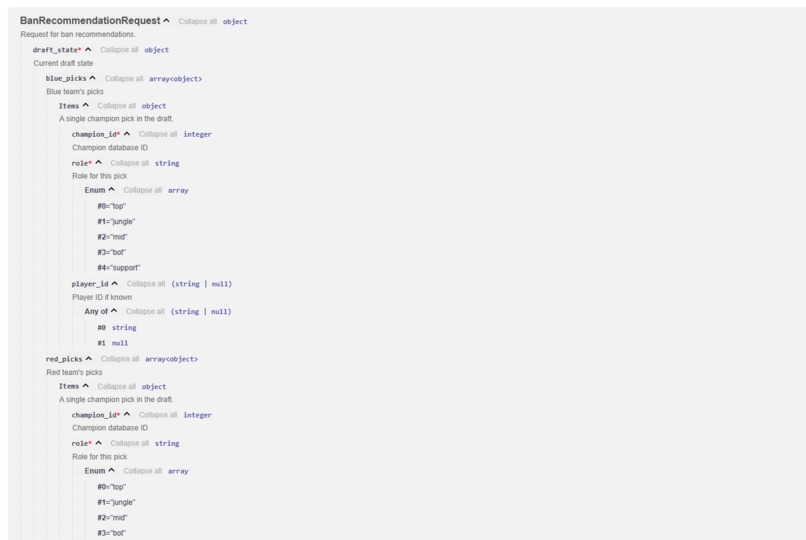
api
-
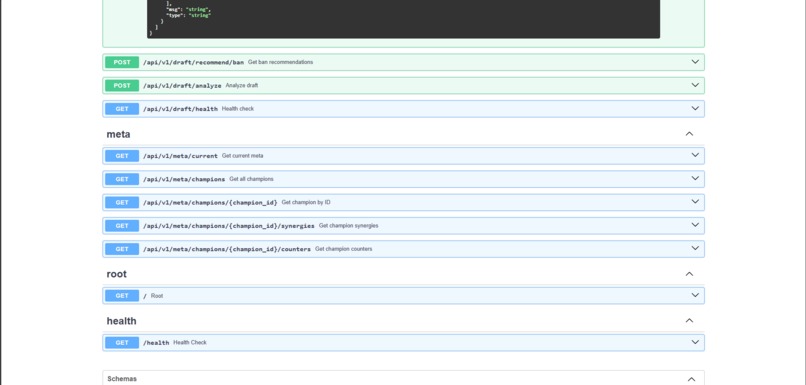
api
-
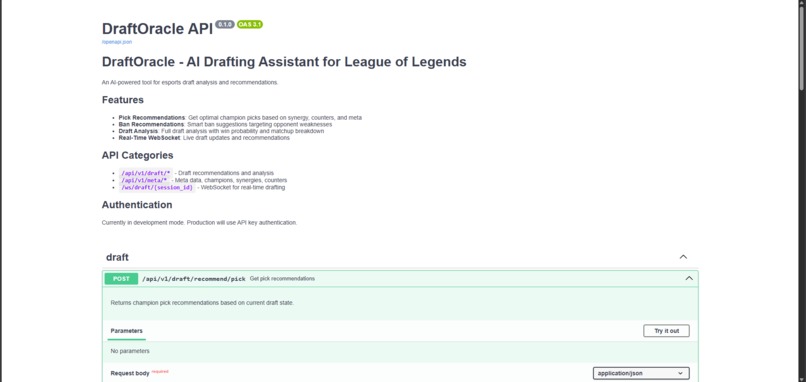
api test
-
-


Inspiration
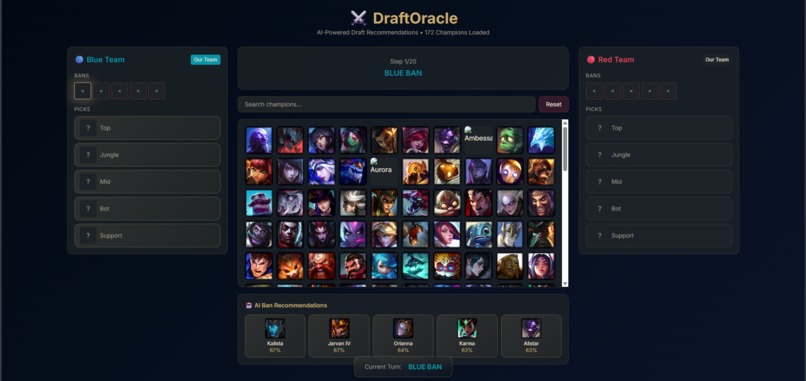
In professional League of Legends, the draft phase is a high-stakes puzzle with 167+ champions, complex synergy interactions, and lane-specific counter matchups. Coaches have ~30 seconds per pick to process thousands of data points mentally. We asked: what if AI could augment those decisions in real-time?
DraftOracle was born from this challenge—building a system that transforms historical match data into actionable intelligence under time pressure.
What It Does
DraftOracle is an AI-powered drafting assistant that provides:
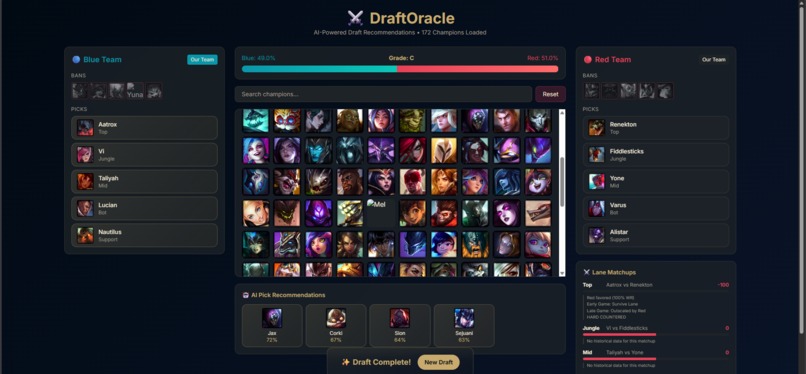
- Pick Recommendations: Optimized suggestions based on synergy + counter + meta + player comfort
- Ban Recommendations: Targeted bans that exploit opponent weaknesses
- Draft Analysis: Win probability estimation with lane-by-lane matchup breakdowns
- Real-Time WebSocket: Live updates during the pick/ban phase
How We Built It
Architecture
GRID API → Data Ingestion → PostgreSQL → Analysis Engines → FastAPI → Swagger UI
Backend Stack:
- FastAPI for async REST endpoints and WebSocket connections
- PostgreSQL + Redis for persistent storage and caching
- Celery for background data processing tasks
Core Engines:
- SynergyEngine — Computes pairwise champion synergies using Wilson score intervals for statistical confidence:
$$\text{Synergy} = \text{WinRate}_{\text{together}} - \mathbb{E}[\text{WinRate}]$$
CounterEngine — Analyzes matchups with phase-specific advantages (early/mid/late) using gold differential normalization
DraftOptimizer — Combines all signals with configurable weights:
$$S_{\text{total}} = w_1 \cdot S_{\text{synergy}} + w_2 \cdot S_{\text{counter}} + w_3 \cdot S_{\text{meta}} + w_4 \cdot S_{\text{comfort}}$$
Development Environment:
- Built entirely in PyCharm with type hints throughout
- Structured logging via
structlogfor debugging - Pydantic schemas for request/response validation
Challenges We Faced
Sparse Data Problem: Many champion pairs have <30 games together. We addressed this with Wilson confidence intervals that penalize low sample sizes.
Phase-Specific Matchups: A champion winning lane ≠ winning the game. We introduced gold differentials at 15-minute and 25-minute marks to capture early vs. late game dynamics.
Real-Time Constraints: Draft decisions happen fast. We optimized database queries with indexed lookups and Redis caching for sub-100ms response times.
What We Learned
- Statistical rigor matters—simple win rates are misleading without confidence intervals
- Domain expertise (understanding why Sylas counters Ahri) validates that the math is working
- FastAPI's async architecture is perfect for real-time esports applications
What's Next
- ML Embeddings: Learn latent champion representations via contrastive learning
- Win Probability Predictor: Transformer-based model using draft sequences
- Frontend Dashboard: Real-time visualization for coaching staff
Built With
- celery
- docker
- fastapi
- grid-esports-api
- jetbrains
- pandas
- postgresql
- pydantic
- python
- redis
- riot-games
- scikit-learn
- sqlalchemy


Log in or sign up for Devpost to join the conversation.