-
Team Green Lie Detectors
-
Sustainability claims report on Pepsico company


Inspiration
The rise of greenwashing—false or misleading sustainability claims—has made it difficult for consumers, regulators, and investors to trust corporate sustainability reports. We were inspired to build an AI-driven solution that uncovers deceptive claims and promotes transparency in corporate sustainability efforts.
What it does
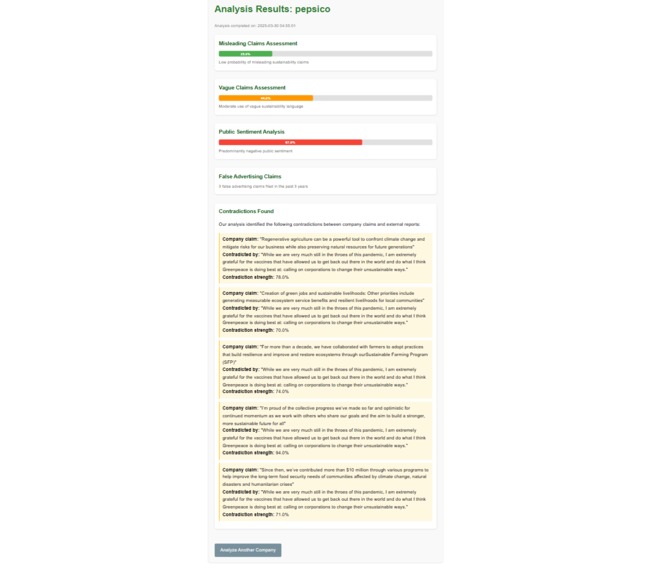
Eco Guard is a tool designed to assess and verify the sustainability claims made by companies. It analyzes various sources of data, including company websites, social media, news articles, environmental reports, and public court records, to determine the accuracy and reliability of sustainability statements. ESG Risk Score: Evaluates a company's sustainability efforts and assigns an ESG risk score, incorporating data from reputable sources like Sustanalytics and potentially others like Open Food Facts and EcoVadis to ensure comprehensive and accurate results. Misleading Claims: Scrapes company websites and social media to identify sustainability-related claims, filtering them based on relevance. Claims are then assessed to determine whether they are misleading or not. Vague Claims: Scrapes company websites and social media for sustainability claims, filtering them for relevance. The claims are evaluated to identify vague or non-specific statements about sustainability. Public Sentiment: Gathers news articles and tweets related to a company's sustainability practices to analyze the public sentiment. A score is provided to indicate whether the sentiment towards the company’s sustainability practices is positive or not. Claim Contradiction: Studies third-party environmental reports to compare and match the claims made by companies. Similarity scores between the claims and reports are analyzed to check for contradictions, ensuring that companies are not making conflicting statements about their sustainability efforts. False Advertising Violations: Examines public databases of court records for false advertising cases related to sustainability claims. The number of lawsuits filed in the past three years is counted to identify any legal issues with the company’s claims.
How we built it
Data Collection and Integration: We began by identifying and collecting relevant data sources such as company websites, social media, news articles, public court records, and third-party environmental reports. We implemented web scraping tools and APIs to gather data in real-time. Public databases like ESG scores, Open Food Facts, and EcoVadis were integrated to ensure accurate sustainability assessments. Content Filtering and Analysis: We developed algorithms to filter and process sustainability claims from company websites and social media. The content was analyzed for relevance, and we used Natural Language Processing (NLP) techniques to identify misleading or vague claims related to sustainability. Sentiment Analysis: To assess public sentiment, we scraped news articles and tweets related to the companies and analyzed the data using advanced transformer models for sentiment analysis. This helped us understand whether the public perception of the company’s sustainability practices was positive or negative. Sustainability Scoring Algorithm: We built a proprietary sustainability scoring system that combined ESG scores with trusted certifications like Fair Trade, B Corp, and USDA Organic. The score is updated continuously with data from third-party reports and user-generated inputs to reflect the company's ongoing sustainability practices. Claim Contradiction Analysis: We incorporated a feature that checks for contradictions between sustainability claims and environmental reports. This was achieved by comparing the company’s claims to reports using similarity scores and Natural Language Inference (NLI) models to ensure that there are no conflicting statements. Legal Monitoring for False Advertising: We analyzed public court records to detect any lawsuits related to false advertising in sustainability claims. By counting the number of lawsuits filed in the past three years, we gained insights into the legal standing of the company's claims. User Interface (UI): For the user experience, we built an intuitive dashboard using Flask that allows users to view company sustainability scores, read detailed reports, and track changes over time. This interface is simple and accessible for both consumers and businesses to use. Technology Stack: We used Python for data scraping and backend processing. For data analysis, we relied on NLP models, including BERT and RoBERTa for claim analysis, and transformer models for sentiment analysis. The platform is hosted on Flask, which provides a robust backend framework for our web application. Testing and Optimization: After the initial prototype was built, we performed several rounds of testing to ensure the accuracy of the sustainability scores and the reliability of the sentiment and contradiction models. Feedback from early users was crucial in optimizing the platform for real-world use.
Challenges we ran into
API Hit Rate Limitations: Encountering issues with API hit rate limits, which restricted the volume of data we could fetch within a given time frame, impacting the scalability of the tool. Website Scraping Restrictions: Some company websites did not allow scraping, which limited the availability of data for verifying sustainability claims directly from their online presence. Flask Backend Integration: Integrating Flask with the backend was challenging, particularly in terms of ensuring smooth communication between the user interface and the data processing layers. Finding Reliable Data Sources: Identifying and securing reliable third-party data sources, such as environmental reports and sustainability scores, was a critical challenge to ensure the accuracy of our analyses. Unstable Barcode Scanning: The barcode scanning functionality proved to be unstable, causing issues in accurately collecting product-related sustainability data for verification purposes.
Accomplishments that we're proud of
Comprehensive Plan and Report: Developed a detailed plan and a full-fledged report covering all key metrics, ensuring a structured approach to tackling sustainability claim verification. Live Demo: Successfully built and deployed a live demo showcasing the functionality of the project, offering a tangible demonstration of its potential to analyze sustainability claims. Learning Flask: Gained valuable experience with Flask, allowing for seamless backend development and integration with the front-end interface for smooth user interactions. Exploring Open Source NLP Models: Gained deep insights into the capabilities of open-source NLP models, enhancing the project’s ability to analyze and classify sustainability-related content. Scalable Solution Design: Designed a scalable system that can process large datasets efficiently, ensuring the project can handle future growth and additional data sources.
What we learned
The Importance of Data Quality: We learned that accurate and high-quality data is crucial for ensuring reliable sustainability claim analysis. Filtering out irrelevant data is just as important as obtaining the right sources. API and Web Scraping Challenges: We gained experience in overcoming challenges with API rate limits, website restrictions, and issues with scraping, highlighting the need for alternative methods and resilient data collection techniques. Integration of Third-Party Data: We learned how essential it is to incorporate trusted third-party sources (like EcoVadis, Open Food Facts) for a more holistic and comprehensive assessment of sustainability claims. Model Fine-Tuning for Accuracy: Through experimenting with different models, we realized the importance of fine-tuning the NLP models and continuously evaluating their performance to ensure they provide accurate results. Practical Application of NLP Models: We learned how powerful NLP models can be for real-world applications like sentiment analysis, claim verification, and contradiction detection, but also how they need to be adapted and improved for specific use cases. Interdisciplinary Collaboration: Collaboration between various expertise—data science, sustainability experts, legal advisors—was key to creating a robust and meaningful product. We saw how combining knowledge from different domains creates a well-rounded solution.
What's next for Eco Guard
AI Enhancements: We'll refine AI algorithms to improve claim verification and sustainability scoring accuracy. Business Growth: Expanding partnerships with third-party organizations and offering subscription-based services for continuous monitoring. Customizable Scores: Launching a customizable sustainability score for businesses to benchmark against industry standards. Global Expansion: Integrating regional data sources to enhance accuracy and scalability. Regulatory Compliance: Using AI to help businesses stay compliant with sustainability regulations. Consumer Solutions: Empowering consumers to track and make informed decisions about companies' sustainability practices.
Built With
- flask
- natural-language-processing
- newsapi
- perac
- python


Log in or sign up for Devpost to join the conversation.