-
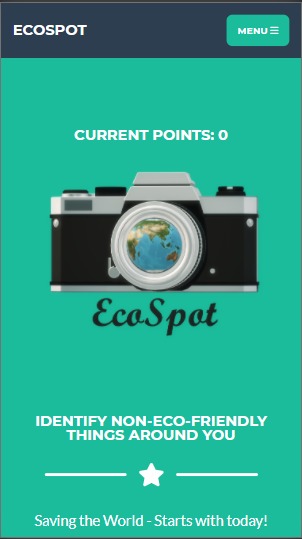
Splash Page
-
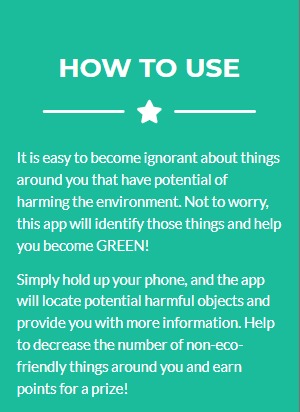
Info Page
-
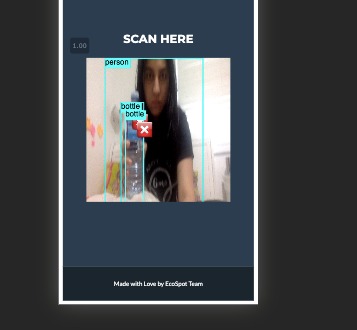
Camera


Team 6
Inspiration
On average a person will consume over 273 kWh daily or 100 000 kWh annually of energy used for electricity, transportation, and heating. Every day on average a person will produce 0.34 kg of plastic waste or 124 kg annually, with only 20 percent of that actually being recycled. Our daily consumption may not seem large but over time and over generations our waste issue gets worse. Waste means higher energy costs, higher hydro costs, water shortages, pollution. Through EcoSpot we will be able to identify aspects of our lives that we need to change. By recognizing our wastefulness from things like leaving lights on, to water waste, or the daily use of plastics. Suggestions for alternatives will mean that people not only know what they need to change but how to make that change. If EcoSpot can change how we see the world around us, we still may be able to shape the future as well.
What it does
We would like to present EcoSpot, an app that allows individuals to scan their surroundings and it identifies any problematic items. The user simply logs onto the app, can read the instructions if they wish to, accept any permissions for camera use, and then using the camera within the app to scan their surroundings. The app would show an x symbol near the items that are harmful to the environment. The user can click or hover over the x symbol to view more detail about why that item is harmful to the environment.
Workshop
Organizational Behaviour: Understanding People 101: Used this workshop to understand how to organize our business plan based on the most likely mindset of our target audience. This allowed for our to select our target audience and understand the demand in the market for our project Prototyping apps with React Native: Did not use in our product for the hackathon but we will be building the ios and android app using React Native after the hackathon.
How we built it
We built this app using angular.js and tensor.js. We used a template to figure out the image recognition as it would be really difficult to build that in 24 hours. More details in the Technical Decision Making section.
Challenges we ran into
Since the hackathon was online, it was difficult first to organize roles at first and make sure that there are no gaps in the project. We started off by assigning general roles to get the project started and tried to help each other out along the way. Since during in-person hackathons, you can discuss ideas quickly and help each other with the coding, we tried to resolve this by constantly doing group calls to check-up on others and bounce off ideas from each other. Another issue that we faced was that it was really difficult to keep the message on the camera stable given the time limit. This would require time to be able to expand the camera on the app so that the message shows nicely on the camera section. It was really challenging for us to figure this out and it was taking a really long time, hence we decided to move on and work on a different part of the project so that we don't fall behind.
Accomplishments that we're proud of
We are proud that we were able to get the main functionality of the app working. I think that our user design looks great and with some more time, we would easily be able to make it even better. We are also proud that we were able to push through the project all night in order to get as much done as possible. This was the first hackathon for most of the team members and so they were able to tackle tasks in a fast-paced environment like this really well, especially with it being remote.
What we learned
During this hackathon, we learned a lot about image recognition as well as how to clearly define a business plan to launch a product and steps to take to ensure that the app becomes successful. There was a lot of business content and so the developers learned a lot about business and the business folks learned a lot about development.
What's next for EcoSpot
We are currently focusing on introducing our product across North America. Once we are able to successfully integrate our product, we will conduct another strategic and financial analysis to determine the right time it will be feasible to expand globally. This analysis will include research on the global audience, establishing our target audience, and both long-term and short-term financial plans. Moreover, we will constantly strive to reach perfection by collect feedback from our current users through surveys. Our goal is to creatively implement a system for individuals to be more eco and this will be reflected in our entire process.
Execution
As established by our financial analysis, the process of applying and receiving funding will take approximately nine months. Once, the funding is complete, we will be able to pitch our product to various firms with pricing options. This explains how to go from the initial idea to the launch of our product.
Risks: Financial Risk: As we are a start-up, our variable costs may increase and we may need additional purchases. This will affect our budget and financial decisions.
Privacy Risk: Depending on how the app is used, we need to ensure that it does not violate any sort of privacy law with the data collected. Hence, to mitigate this risk, we will explain any potential risks in the terms and agreement. This will ensure transparency between the consumers and our app. Any further concerns can be addressed through contacting us. Barriers: A barrier to enter the market is product differentiation. As already existing products have brand identity and customer loyalty. However, our start-up provides a unique service to the market and hence, EcoSpot will overcome this barrier by clearly communicating its benefits to the target customer. Our target audience is firms mid to large
Financial
4 month prepare to offer- Device business plan, financial models and compile investor list. Developer optimal capital raising strategies (grants, loans) 4-month prospecting-Contract Investors, provide the information and arrange meeting dates 1 month Negotiating - Negotiate term sheets, Coordinate due diligence and necessary documents. Closing 1 day - Finalize deals and sign paperwork
Market Strategy
For pricing options, we are using a subscription-based plan. Thus, companies are able to purchase monthly and yearly plans to best suit their needs. The timeline for getting funding is 9 months. Our product is targeted at companies to implement for their employees. Target Audience - Firms mid to large size Competition - There is no direct competition as this idea currently does not exist, however, we would be competing against other services such as disposal. Product Our product is our app. Place Promotion: In the future, we will consider having a free trial for a month and other alternatives to create incentives for companies to purchase our product. Pricing: For pricing options, we are using a subscription-based plan. Thus, companies are able to purchase monthly and yearly plans to best suit their needs. The timeline for getting funding is 9 months. Our product is targeted at companies to implement for their employees.
Proof of Concept
Although our app seems complex, it is definitely not impossible. Some of the main components of the app such as image recognition have already been implemented. In addition, some other components such as categorizing objects between eco-friendly and non-eco-friendly can be done using databases that already exist online. We will add more recognition for the ML software so it recognizes more objects → can be done with using more advanced libraries such as Google vision We will categorize the recognized objects as eco-friendly/non-eco-friendly. Can be done simply in code, but the environmental information will be pulled from the internet databases, can also be done using ML. After an object is recognized as non-eco-friendly, the hover box would give a quick summary of why that object is problematic, and suggest better alternative products (can be easily linked in the code) Finally, the app would be hosted on common operating systems such as Android and iOS, this can be done using many services, one of which is AWS.
Technical Decision Making
Tensor Flow - this technology allowed us to incorporate Machine Learning within our application, which is important to recognize objects in real-time. This will also allow us to continuously add more objects that can be recognized as our app grows. Used HTML/CSS/AngularJS to build the front end of the app. These languages offer a wide range of libraries that allow for full control over user design. Using AngularJS also lets us easily link our front end (HTML) to the backend (JS) files, essential for an interactive app. To deploy the app, we plan to use Amazon Web Services (AWS). This will allow us to host our app on the cloud, hence services like security and server management will be taken care of. As well, it will allow for dynamic scaling of the app in real-time, and we will pay by usage (on demand), while also making sure that the app doesn’t crash due to lack of available servers. In order to save time, we used Bootstrap as it is an easy way to make a responsive site that you can see on the phone.
User Experience Design
In order to encourage people to use the app daily, we wanted to make it as simple as possible and provide all the functionality to make it as simple as possible. We have implemented some of the principles of good user design but keeping everything consistent, following a strict hierarchy, and decreasing the difference between what the user thinks the app does vs. what it actually does. The user expects the app to simply look around and identify things around them that could harm the environment, and hence we decided to keep the app as minimum pages as possible. Although we didn’t have time to implement it, the app would include a separate splash page, login page, camera page, and finally a statistics page that will allow users to see the trend of how well they have eliminated non-eco-friendly things around them. We used simple and easy to understand the language With future implementations, the UI will include a “confirm before commit” philosophy when asking for camera permissions or right before selecting a prize.
Social Impact
In 2016 Coca Cola had closed down for the second time a bottling plant due to pollution and water depletion. Due to unsustainable practices, the company had lost 2 major facilities only 15 years apart in that region alone. However, through EcoSpot we will be able to identify aspects that we need to change. By recognizing our wastefulness from things like leaving lights on, to water waste, or the daily use of plastics, we can reduce the effects of pollution and waste on our businesses and lives. To help adopt sustainable practices, suggestions for alternatives to products can be made, meaning that people not only learn what they need to change but how to make that change happen. If EcoSpot can change how we see the world around us, we still may be able to shape the future as well.
Built With
- angular.js
- bootstrap
- css3
- html5
- javascript
- tensorflow

Log in or sign up for Devpost to join the conversation.