-
-
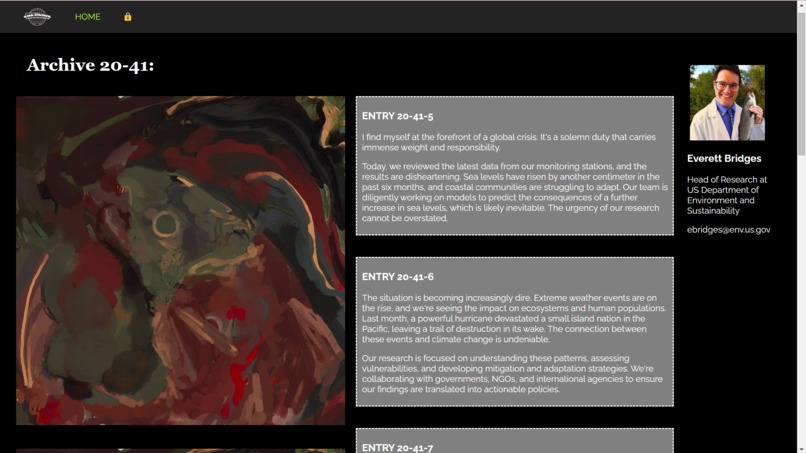
'corrupted blog' riddle page
-
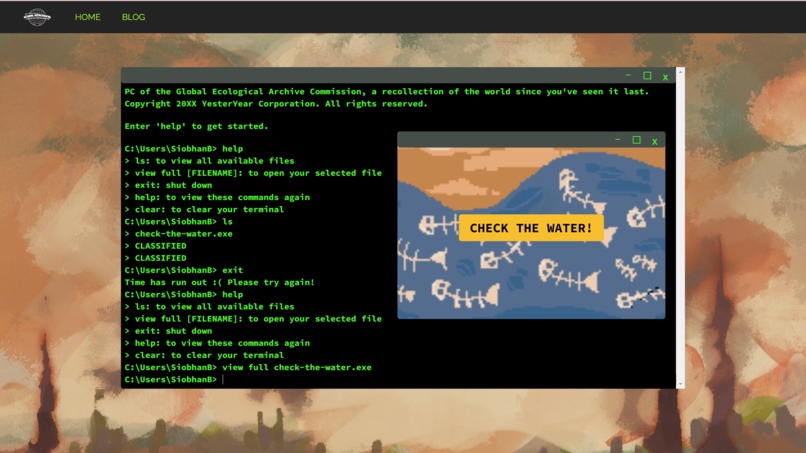
terminal with pop-up window
-
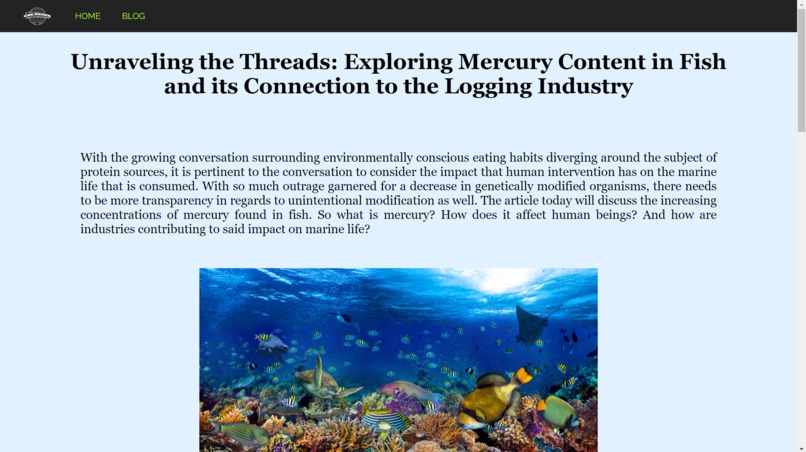
'restored blog' win page


Inspiration
Having grown up in a worsening climate crisis, environmental advocacy often felt useless in the face of uncaring governmental institutions. We imagined a future where we were unable to save the planet in time— what would that world look like? Where would we be? Who would be left to pick up the pieces?
What it does
The user approaches the website as a post-climate-apocalypse survivor. They discover an old governmental computer program, a rusty remnant of a climate and conservation archive site. What we deliver is a small fragment of the greater game, in which the user is supposed to fully restore the website to what it was pre-dystopia. Each step of the way, the user learns about predicted environmental phenomenons, and how government inaction led to worsened crises.
The puzzle we currently have implemented takes the user to a corrupted page— previously a blog run by a climate scientist, renowned for his research but ignored for his environmental advocacy. By following a series of clues, a portion of the original page is "unlocked," briefly detailing the consequences of logging on mercury levels within fish.
How we built it
We used React to program this website. Each of us took responsibility for different pages, as well as different aspects depending on our respective skills, such as HTML, CSS, React, and even art! We also used GitHub to collaborate and do version control.
Challenges we ran into
One of the bigger challenges we faced came down to narrowing down the scope of our project. Initially we had conceptualized a series of puzzles that were meant to take the user through a myriad of story points. Due to time constraints, we eventually agreed to compile our favorite ideas into a single puzzle. We also struggled with implementing a visually and functionally accurate terminal, but it ended up exceeding our expectations.
Accomplishments that we're proud of
All four of us are beginners at the Hackathon scene, and we worked hard to deliver a product! It was difficult and challenging and most certainly frustrating, but we handled it all together. We worked together in person for 16 hours, sticking together and providing each other help whenever the other needed help. Team synergy was incredibly high despite us all being strangers, and we ended up learning new skills, languages, and creating a find product.
What we learned
We learned how to utilize React, program with the terminal, and implement recursion. Most importantly, we learned that the best projects take a lot of time and planning to pull off— and if you don't have that, you quickly learn what skills to highlight and prioritize to make up for it.
What's next for Environmental Archive
We plan to take on the world, the universe, even. We have more riddles and more lines of code to build. What started off as a silly idea has the potential to really invoke introspection relating to the climate and our participation in society. The archive will grow and persevere.


Log in or sign up for Devpost to join the conversation.