-
-
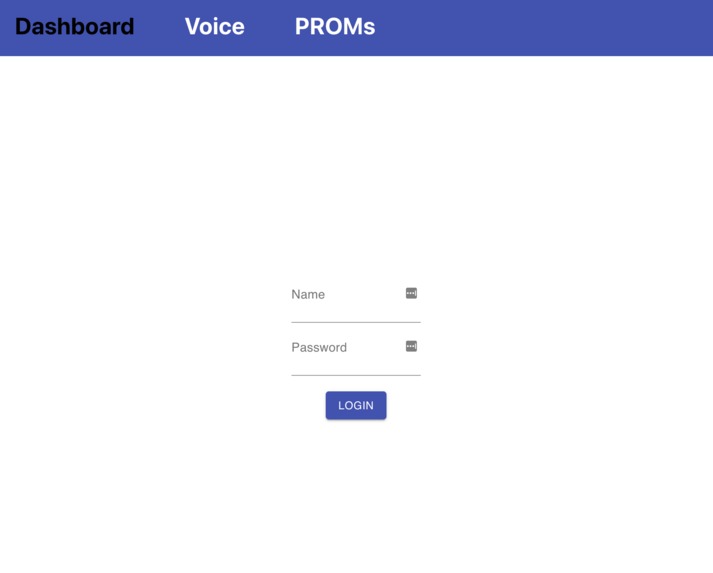
Login screen.
-
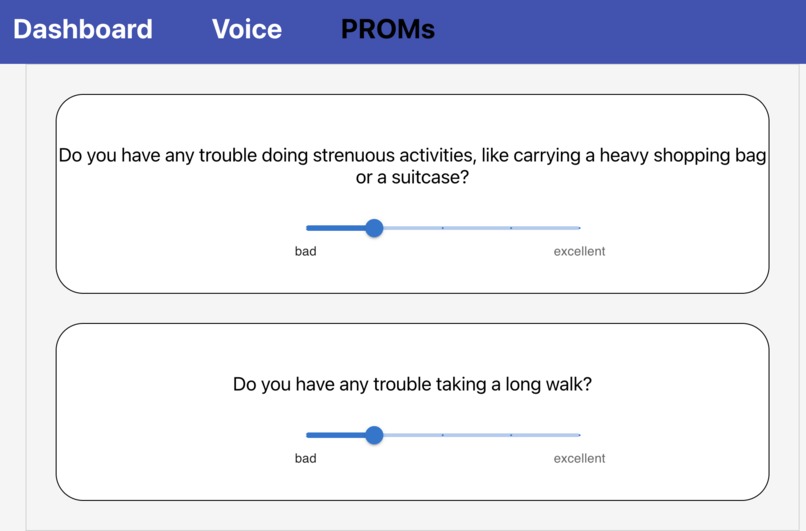
Questions are shown in a social-media style layout with sliding bars instead of fixed buttons.
-
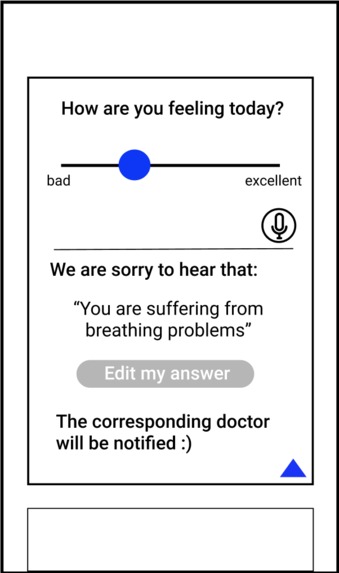
When a decline in wellbeing is detected, we actively ask the user for more information through voice recordings, which is analyszed via NLP.
-
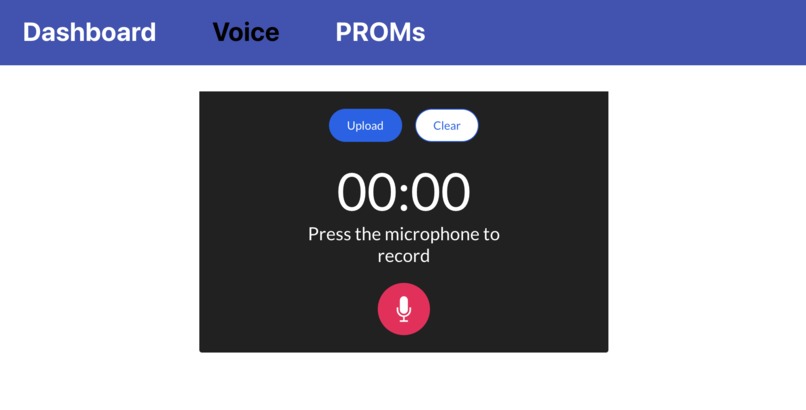
The built-in voice recorder gives the patient the possibility to give more personalized feedback to the doctor.


Inspiration
Studies show that (electronic) Patient Reported Outcome Measures (ePROMs, basically regular surveys) impact the lifespan of cancer patients very positively. However, the response rate is rather low due to multiple pain points in the customer journey:
- "It is too difficult to answer"
- "The layout and overall design is not attractive"
- "The intervals of the surveys are too frequent and cause survey fatigue"
link "Your surveys are not personalized" "Your surveys aren’t powered by conversational AI"
- "It’s badly timed — it’s either presented to the consumer immediately"
- "It’s unfocused — the survey asks too many questions about too many topics, the results are confusing and difficult to prioritize"
- "questions are too complex"
- "Personal questions at the beginning"
By tackling some of these challenges, and thus increasing the response rate of these ePROMs, we can have a direct impact on the patient’s health. We plan to achieve this by leveraging the full potential of technology.
What it does
Our app encourages the patient to regularly fill out their ePROM by (1) having a pleasant UX and making it simple to fill out the questions (2) providing immediate feedback on symptoms via a dashboard (3) Leveraging NLP (Natural Language Processing) to enable the patient to do a voice recording of their symptoms
(1) User Interface
- social media style scrolling
- modern UI elements
- intuitive gestures (in the future)
(2) Dashboard
- see your last reports
- statistics about your well-being
(3) Natural Language Processing
- speech to text to edit your response later
- summarisation for a fast overview of your experience
- highlighting of keywords to emphasize important parts of the answer
How we built it
- React frontend: Using React to build the frontend UI and deploying the to GitHub pages.
- Flask (Python) backend
- Integration with external APIs (Google Cloud Speech-to-Text, NLP Cloud, Monkey Learn)
Challenges we ran into
- different experiences & knowledge of team -> find a common ground
- communication in remote team -> Slack, Google Hangout, Figma
Accomplishments that we're proud of
- organized regular meetings across different time zones
- collaboratively implemented several conceptual improvements over the current ePROM standard
- created a working prototype under time pressure
What we learned
- assembling a team takes a lot of time -> start well before hackathon to be ready to go
- deciding for technology and setting up everything (deployment, repos, ...) takes a lot of time -> do before start of hackathon
What's next for ePROM+
- building the necessary security into it (health data)
- polishing frontend for a clean user interface
- set up proper backend with database
- evaluate if external APIs for NLP are financially feasible or if proprietary models & pipeline should be run in cloud


Log in or sign up for Devpost to join the conversation.