-
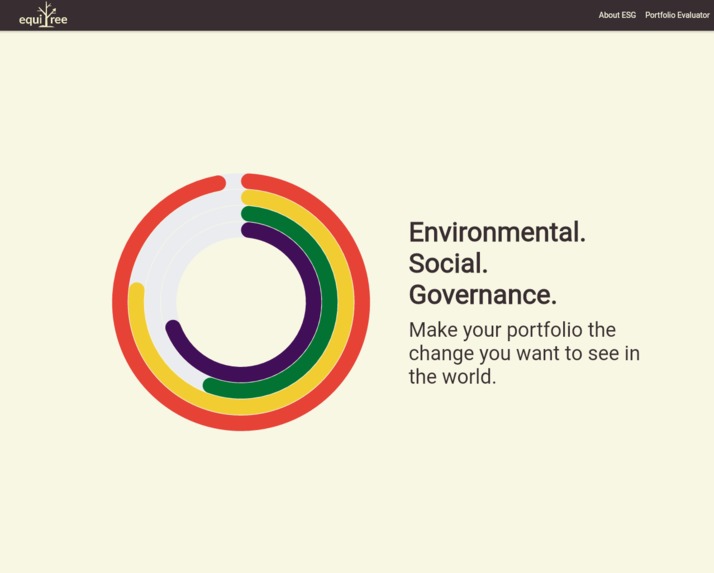
Home Page
-
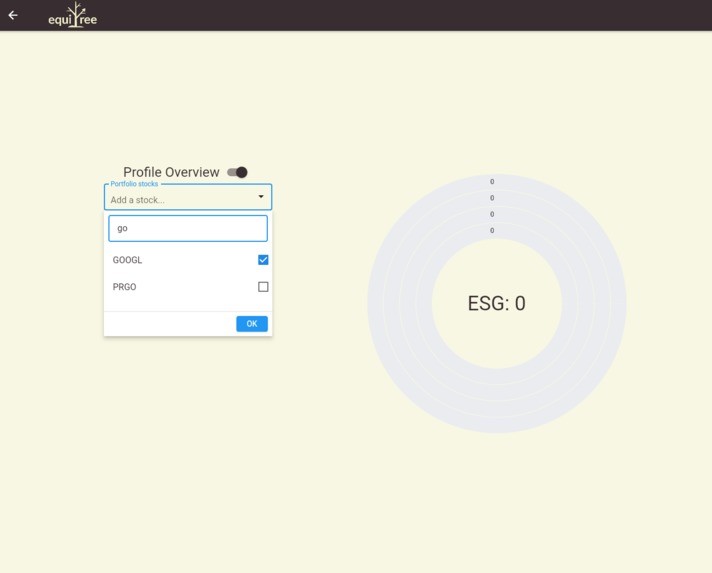
Selecting stock portfolio
-
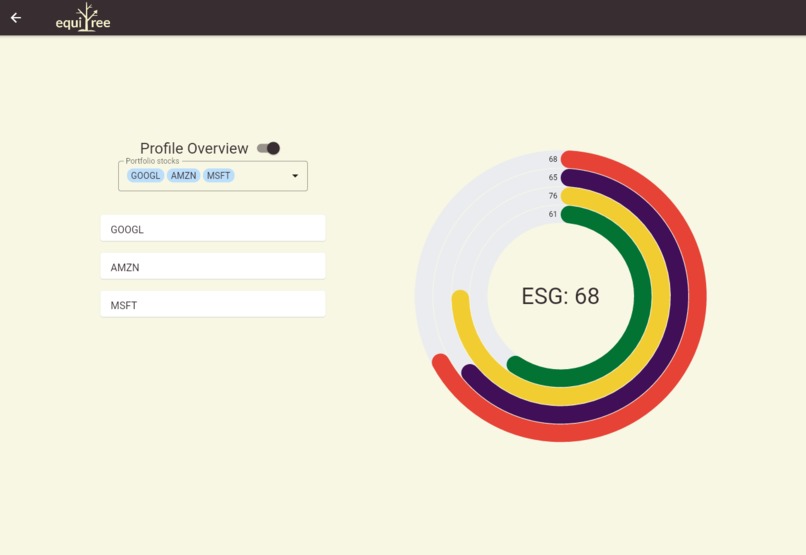
Portfolio Overview
-
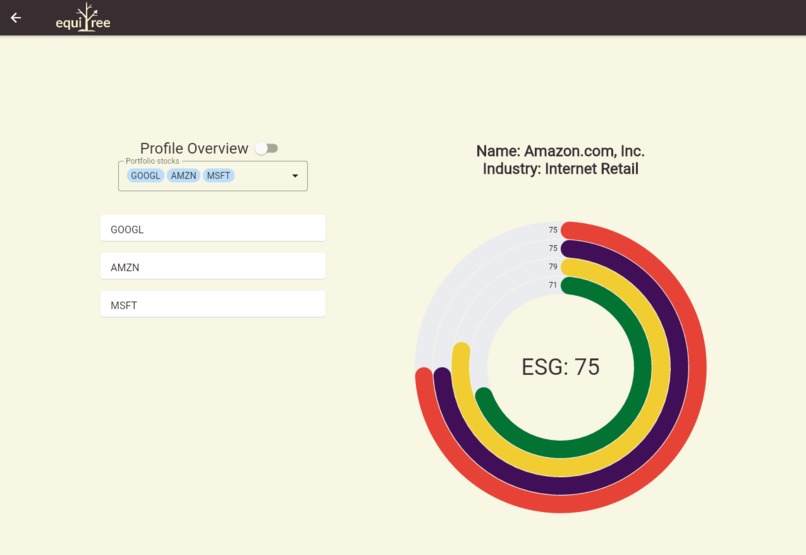
Single stock Data
-
About ESG


Inspiration
Millenial and Gen Z retail investors are taking the investing world by storm, and their increased social and environmental cognizance is coming along with them. These investors value sustainability and social justice, and they want assurance that their money will speak for them.
Most of today’s accessible information about stocks comes from measures of profitability over the short- and long-term, given a company’s financial policy and historical performance. This lens prioritizes a company’s profit margins and how those profits might continue to increase, quarter over quarter.
However, this information doesn’t help socially-conscious investors understand the underlying impact of potential investees. Corporations don’t exist in a vacuum, and investors may be leery of backing companies with a record of exploitative work practices or environmentally unsustainable operations.
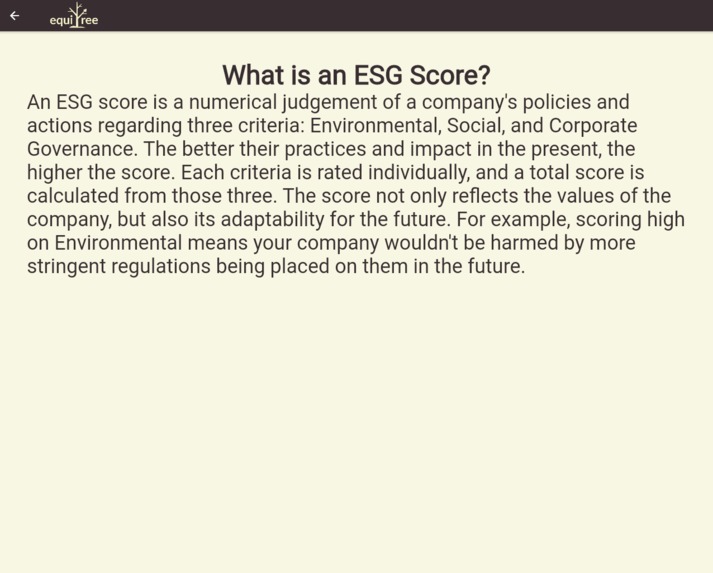
ESG scores are one way of gauging a company’s attitudes and practices within a broader sustainable and cultural context. ESG analysis focuses on three non-financial dimensions of a stock’s performance: environmental impact, social policy, and corporate governance. Analysts assign a score from 1 to 100 or CCC to AAA to a company’s performance along each dimension, and the three scores are averaged to give a total ESG score.
These scores have traditionally been the purview of professional investment managers, but retail investors can also use them to gauge risk factors and adaptability. How might an energy company fare in a world where the average temperature is 2°C higher? Does a startup going public have a pragmatic corporate governance policy in place? When available, ESG scores can give investors a navigational heading to these answers.
What it does
equiTree is a web platform that allows users to review the Environmental, Social, and Governmental dimensions of their investment portfolios so that they may have a better understanding of the future of their positions. equiTree provides a current ESG rating based on data gathered from various sources and predicts future ESG ratings based on the history of a given stock, and sentiment analysis data for that company. Users will be able to both align their investments with their values and gauge the potential long-term stability of those backings. If a business is already ahead of the curve on these metrics, they are unlikely to be caught off guard by developing forces.
How we built it
For our ESG rating and prediction models, we designed neural network architectures based off of state-of-the-art prediction networks such as SciNet to determine future ESG values, given current and previous ESG values, and sentiment analysis records for a given company. This was then linked to a Flutter website using a Flask backend, where the data could then be broken down into easily digestible graphs for the user’s convenience.
Challenges we ran into
The earliest and arguably largest challenge we faced was data availability. There exist many proprietary or by-request-only ESG datasets out there, so digging through multiple datasets for a few hours sapped up time and energy, although we eventually found a few that meshed with our goals well. The tech-stack presented a learning curve as well. Many of our members, though used to front-end or back-end development, had not used the technologies we needed to produce this website under the time constraints. As such, much of the website building was how we learned, forcing us to adapt as we went along and discovered various limits to what we could do with the information and technology at hand.
Accomplishments that we're proud of
One accomplishment we are proud of is the website’s design. It looks quite nice, especially given the short time we had, and through the leverage of a few versatile libraries, we were able to create something that both looks and feels natural.
What we learned
Most members of the team, and all of the front-end developers, had not used Flutter before. Thus, the process of designing the website also taught us how to use Flutter, which, as it turns out, is an extremely powerful tool. Our back-end developers also learned how to use Flask to create a server, answering HTTP requests from our front-end.
What's next for equiTree
The greatest improvement we could make at this point is acquiring more data. Not just in volume, but granularity as well. Many sources listed only the final numerical ESG rating, while there are a multitude of factors that play into those scores. Being able to access those as well would lend greater precision to our neural net, and allow us to provide more detailed information to the user.


Log in or sign up for Devpost to join the conversation.