-
ETMS
-
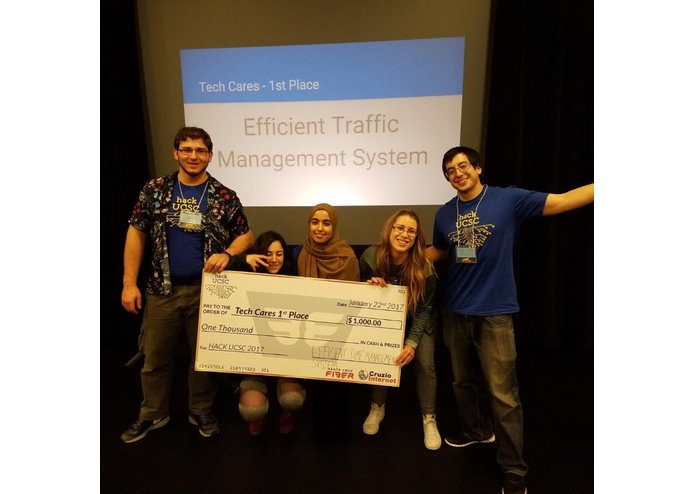
We won first place, 2 times!
-
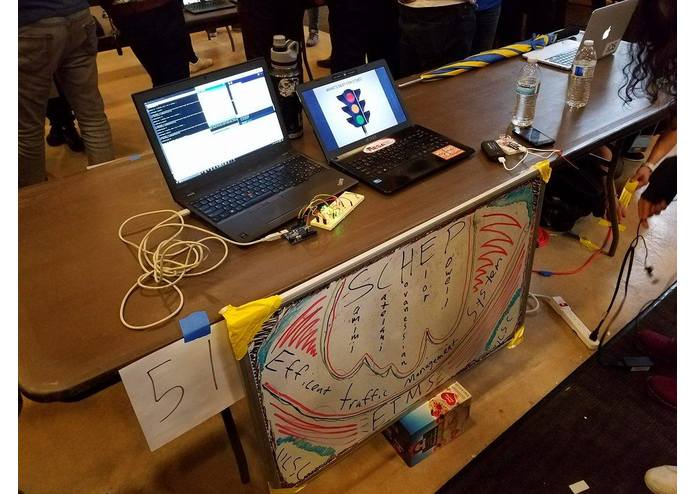
Our Awesome Demo!
-
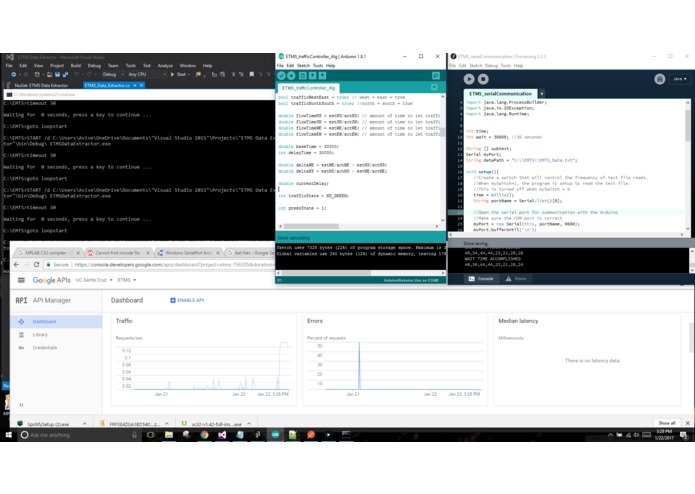
DEMO!!


Inspiration
As engineers, we are enticed by the problems that we see around us in our daily lives. The goal of this project was to make Santa Cruz a better place by reducing the problematic traffic congestion and as a result carbon emissions from stationary cars at a cost effective solution. Our project was even modeled off of the four-way intersection between highway 1 and river street in Santa Cruz, and we used a breadboard to simulate the traffic lights. We have decided to take on this problem and create an Efficient Traffic Management System.
What it does
Our project utilized the Google Maps API to access real-time ideal and actual traffic flow data. We took this data and ran it through our own custom wireless asynchronous serial communication protocol to our photon microcontroller. Finally, after decrypting the data, we then implemented our own feedback control algorithm to alleviate any traffic congestion, making the street lights smarter. We also demonstrated that this technology could be mass produced cheaply, and work independently just as any other streetlight sensor would.
How we built it
We used and Arduino, Pic32 Kit, and a breadboard for hardware development, Google API, and programmed in Javascript, and C.
Challenges we ran into
It was difficult to create a mathematical model that could quantify an appropriate lag time per light as to reduce the amount of congestion in a lane.
Accomplishments
We work and cooperate like a team should. Tasks were assigned to each individual, but we did not only focus on one task. Many tasks overlapped and we all helped one another. Most importantly, we agreed to take on a realistic project that we were able to finish successfully by the end of the hackathon.
What we learned
Hackathons help students realize their potential and show them that they can build whatever they want, and this is what my group and I have come to realize. Hackathons exist for computer science students apply the fundamentals to something applicable. Not only did we get to apply our skills to an actual application, but we had to learn quickly to take an idea that they have and build a basic level product demonstrating the feasibility of our idea.
What's next for ETMS
Google has been creating self-driving automobiles for quite some time. Using the Google Maps API, we hope our ETMS could contribute to Google's ambition in creating smart cities. Our wireless application will be able to reach to cities, decrease their carbon footprint.
Built With
- arduino
- bat
- breadboard
- c
- c#
- embedded-systems
- google-maps
- javascript
- microsoft-visual-studio
- photon
- processing
- ui-kits
- wireless-networks




Log in or sign up for Devpost to join the conversation.