-
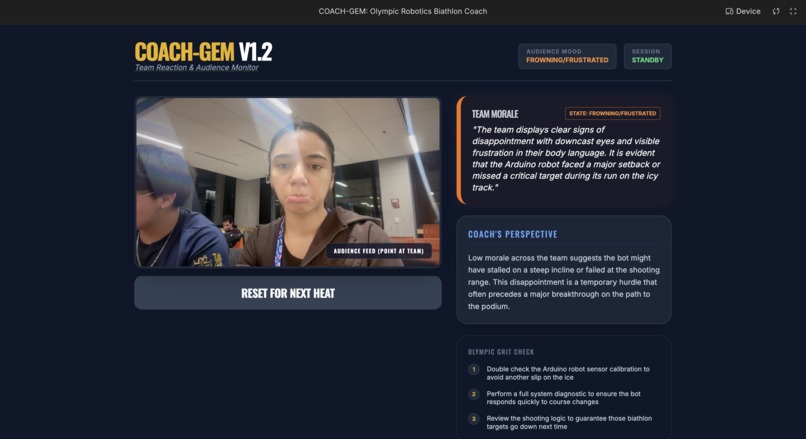
Ewana Cheerleader
-
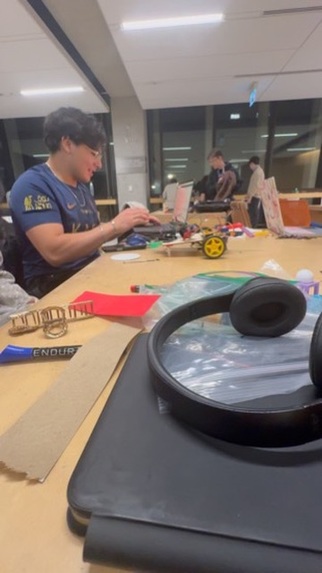
Ewana Demo


Ewana 🌸 – our slightly chaotic robot with a orchidy arm
(and her software cheerleader counterpart)
Inspiration
UTRA Hacks 2026 was a closed robotics challenge where we had to build a robot using only a provided hardware kit and make it survive a multi-stage course. Somewhere between debugging wires at 2am and arguing about servo angles, Ewana was born.
We named her Ewana because she kind of looks like she has an orchid-inspired arm and because honestly she developed a personality of her own during the hackathon.
At the same time, we decided to go for a “double threat” strategy:
we didn’t just build a robot, we also built a completely separate software project as a companion. The idea was to have two chances to win in two different categories — one for hardware, one for software — without risking disqualifying our robot.
What it does
Ewana (the robot)
Ewana is a robot designed to:
- Pick up small objects (a ball and a hollow cube)
- Navigate a path using sensors
- Avoid obstacles
- Attempt a target/shooting section
In theory.
In practice, she:
- Sometimes picks things up perfectly
- Sometimes gently bonks into them
- And occasionally just stares at them like “that’s not my problem”
The software cheerleader
Alongside Ewana, we built a separate software app on our laptops. This was not connected to the robot hardware at all, which meant it followed the hackathon’s double threat approach.
The cheerleader:
- Gave us reminders and encouragement
- Tracked progress and tasks
- Helped us stay sane when debugging got frustrating
- Was basically emotional support in code form
How we built it
Hardware (Ewana)
We built Ewana using:
- Arduino Uno
- IR sensors for line following
- Ultrasonic sensor for obstacle detection
- Color sensor for path detection
- DC motors for movement
- Servos for the arm and shooting mechanism
The main design feature is her orchid-like arm, which is a front-mounted scoop-style mechanism with a servo gate. Instead of trying to precisely grab objects, Ewana drives into them and traps them inside the scoop. This was our way of choosing reliability over complexity.
Software (the cheerleader)
The cheerleader was built as a totally separate software project using our laptops, following the double threat strategy.
This meant:
- No extra hardware was added to the robot
- No risk of disqualifying our UTRA hardware build
- We could still compete for software-based prizes
The app:
- Encouraged us with messages
- Helped track tasks
- Kept the team motivated during long debugging sessions
Challenges we ran into
So many. Honestly:
- Servo angles were never what we thought they were
- Wires came loose at the worst possible times
- The arm worked… until it didn’t
- Sensors were noisy and inconsistent
- The robot would behave perfectly in testing and then act brand new during demos
We also underestimated how long mechanical debugging takes compared to coding.
Accomplishments that we're proud of
- We built a fully autonomous robot from scratch in a short time
- Our scoop mechanism works way better than a traditional claw
- We successfully integrated multiple sensors and actuators
- We didn’t give up when things broke (even when they broke a lot)
- We implemented a double threat approach and submitted both a hardware robot and a software app in one project
And most importantly:
Ewana works sometimes, and those times felt amazing.
What we learned
- Simple designs are usually better than fancy ones
- Robotics is 70% debugging, 20% wiring, 10% actual coding
- Hardware failures are way more stressful than software bugs
- Testing in real conditions matters a lot
- Team morale is just as important as technical skill
Also: never trust a servo’s default position.
What's next for Ewana
If we had more time, we’d:
- Redesign the arm for better stability
- Add smoother control (like PID) for navigation
- Improve sensor calibration
- Make the shooting mechanism more consistent
- And give her a proper enclosure so wires stop falling out
Long-term, we’d love to turn Ewana into a more polished and reliable robot that actually behaves like we intended… instead of a chaotic but lovable prototype 🌱
Double Threat Submission Strategy
For this project, we followed the Double Threat approach:
- We built two completely different things:
- A physical robot (Ewana) for the UTRA hardware challenge
- A separate software app (the cheerleader) on our laptops
- A physical robot (Ewana) for the UTRA hardware challenge
The advantage:
- No risk of disqualifying the robot
- Two chances to win in two different categories
- Hardware + software in one project
Submission:
- One Devpost entry
- Two GitHub repositories:
- One for the robot code and build
- One for the software cheerleader app
- One for the robot code and build


Log in or sign up for Devpost to join the conversation.