-
-
FareHunter

💡 Inspiration
We realized that ride prices fluctuate dramatically depending on your pickup point — sometimes just moving one block away can save several dollars. Most riders never notice this hidden pattern, so we built FareHunter to make those savings visible, accessible, and automatic.
⚙️ What It Does
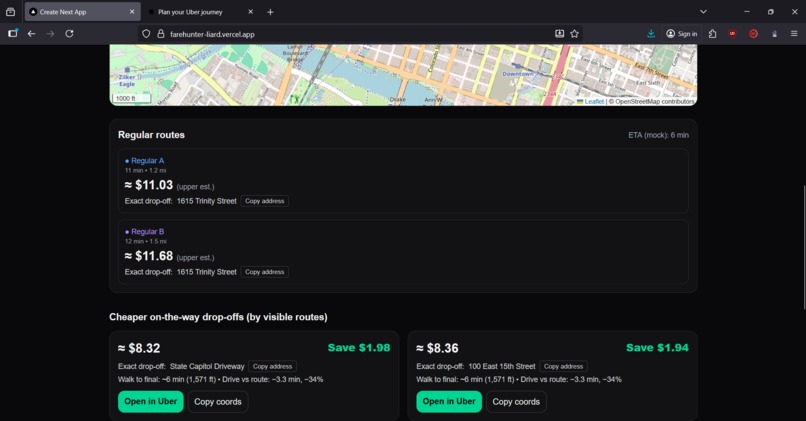
FareHunter scans multiple pickup and drop-off points around your location (based on your maximum walking radius), compares real-time fare estimates, and identifies the most cost-efficient route.
The user can visualize routes directly on the map, see exactly how much they save, and even copy coordinates directly into the Uber app.
🧩 How We Built It
- Frontend: React + TypeScript using OpenStreetMap API and MapBox for dynamic route rendering and interactive map visuals.
- Backend: Node.js + Express handles fare estimation, coordinate optimization, and distance calculations.
- APIs: Uber Sandbox API for ride data simulation, MapBox API for walking distances and traffic visualization.
- Deployment: Built and tested on local and Vercel environments with seamless frontend-backend integration.
⚠️ Challenges We Ran Into
The Uber API requires official approval for live fare data. Initially, this was a limitation, but we quickly pivoted to using MapBox’s real-time traffic data to simulate real-world conditions.
This taught us to adapt fast and engineer flexible backend logic that can immediately switch to live data once Uber grants production access — no code changes required.
🏆 Accomplishments — BIG SAVINGS
- Built a fully functional prototype in under 24 hours, integrating 3 complex APIs seamlessly.
- Created a realistic simulation environment using sandbox and traffic data for price prediction accuracy.
- Designed a clean, intuitive UI that clearly shows potential savings and travel trade-offs.
- Once Uber API access is granted, FareHunter will instantly support real-time traffic and price data, dramatically improving precision — same code, new data, massive impact.
$$ \text{Same Code} + \text{Live Data} \Rightarrow \text{BIG SAVINGS!} $$
🧠 What We Learned
We learned how minor changes in pickup location can drastically alter fares due to surge pricing and geospatial algorithms.
We also gained deep experience in API integration, geolocation data visualization, and building scalable backend logic under tight deadlines.
🚗 What’s Next for FareHunter
- Integrate Lyft, Bolt, and other ride platforms for multi-service comparisons
- Add AI-based pickup recommendations that adapt to traffic and surge conditions
- Develop a mobile version that runs silently in the background and sends notifications when a cheaper route is found nearby
👥 Created By
Suvan Kasina, Ryan Varghese, Swyam Dubey, Jay Parikh
$$ \text{Innovation} + \text{Speed} + \text{Teamwork} = \text{FareHunter 🚀} $$


Log in or sign up for Devpost to join the conversation.