-
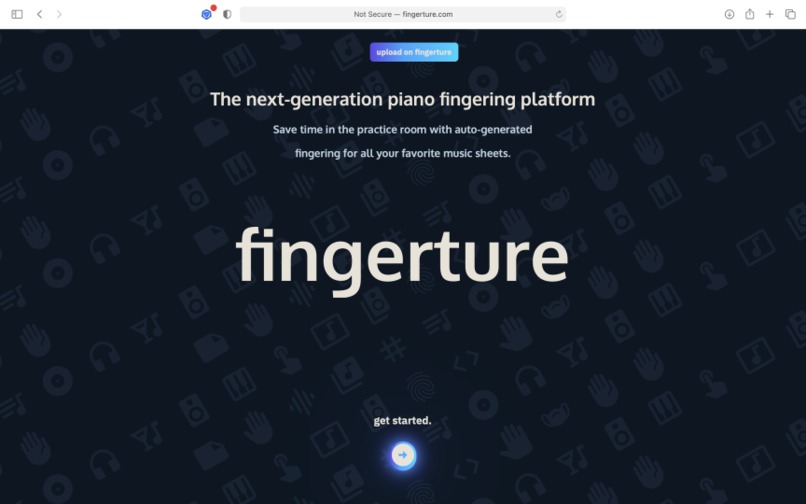
Landing Home Page
-
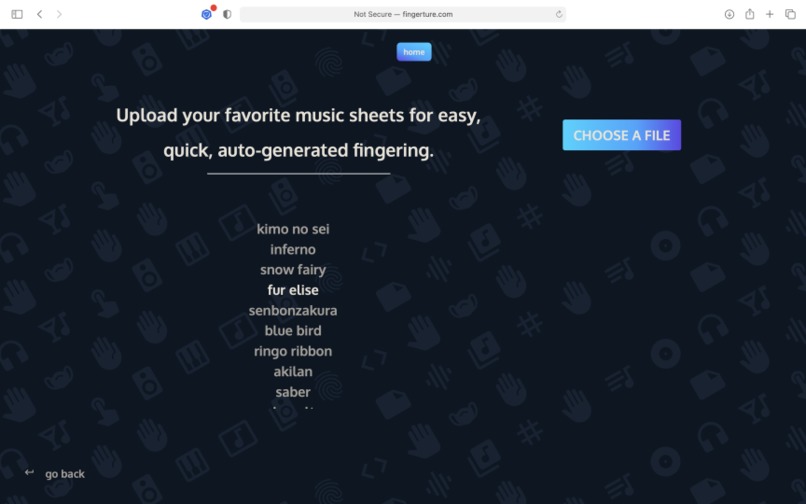
Select existing songs or upload your own for analysis
-
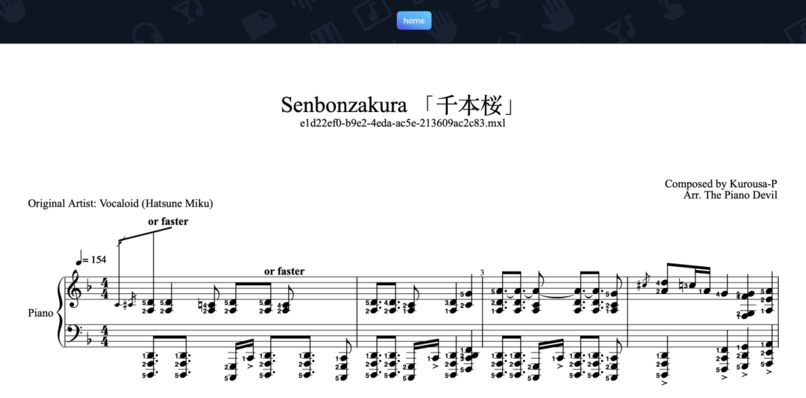
The music viewer (with AI generated finger numbers! )


Project: Fingerture
Introducing Team Members
Akil wanted to apply his passion for coding to work together with other people to create meaningful change with software.
Nicky had spent some time wanting to improve his piano skills at college and wondered if he could use technology to innovate the process of practicing the piano.
Abhi had developed an interest in coding over the pandemic and wanted to showcase it in his first hackathon. Once he met Akil and Nicky, Team 7 was set to do just that.
What It Does
Fingerture uses Hidden Markov Models (HMM) to automatically determine the best hand placements and fingering patterns for piano composition. This can save pianists countless hours during their practice and help them master songs at a much more rapid pace.
How We Built It
The first thing we learned as a group was a concept called Markov models, in which various states of probabilities are determined by the previous. We took academic literature and converted it into real code. Next, we learned how to develop our own API with python using programs like flask and postman.
We divided our project into the front end, with a web interface to present our project, and the back end, with the principles coded to fulfill our purpose. Towards the end of the hackathon, we worked on integrating both parts together.
Challenges we ran into
We faced many challenges, the first of which would be us having many parts to complete this project as a whole. We as a group solved this by dividing our workload into parts that we could work on cohesively. Another challenge we faced was the steep learning curve required to build our algorithm. With our group coming from a high school math background, we had to learn concepts such as linear algebra, Markov models, and advanced matrix math to be able to see our vision.
What's next for Fingerture?
The main goal of our project is its accessibility. We've already reduced the cost of piano tutors, now we want to bring the piano to people with disabilities. We plan on using tools like text-to-speech to help visually impaired people to experience the joy of learning an instrument.


Log in or sign up for Devpost to join the conversation.