-
-
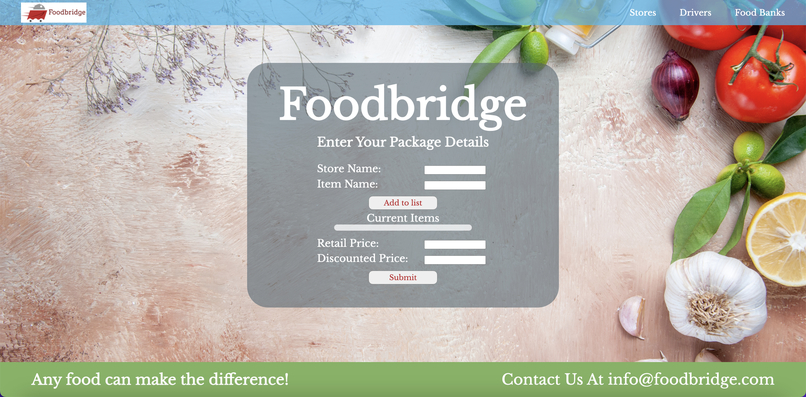
The interface for grocery stores to submit a food package offer.
-
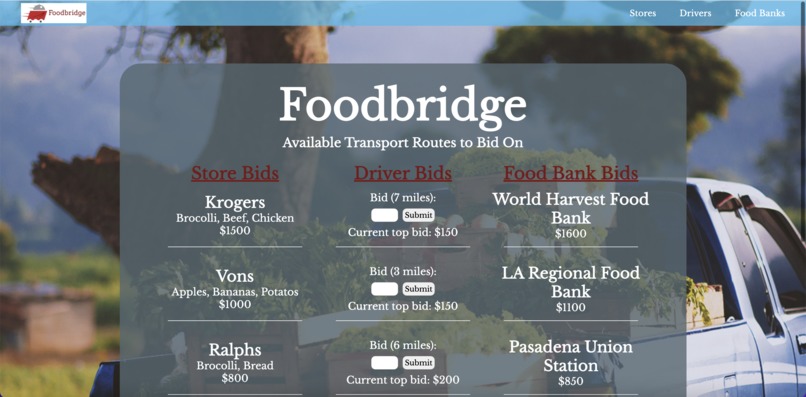
The display for drivers when auctioning for jobs.
-
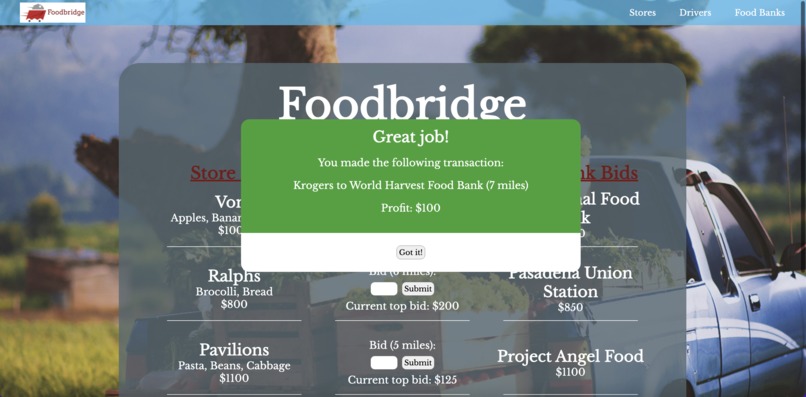
The success display after a driver successfully completes a transaction.
-
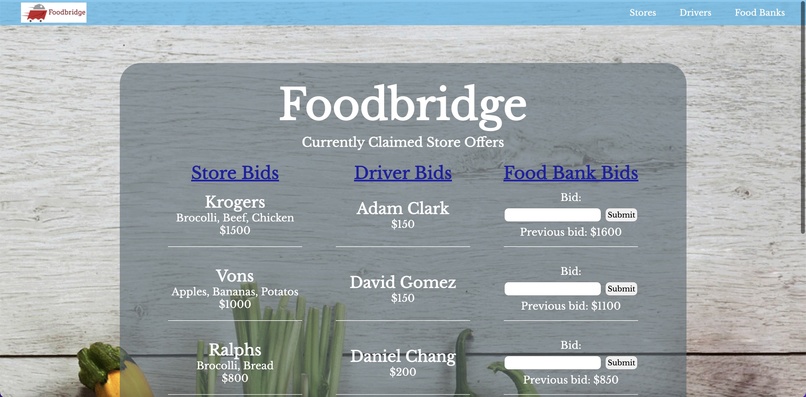
The display food banks see when bidding to complete a transaction.
-
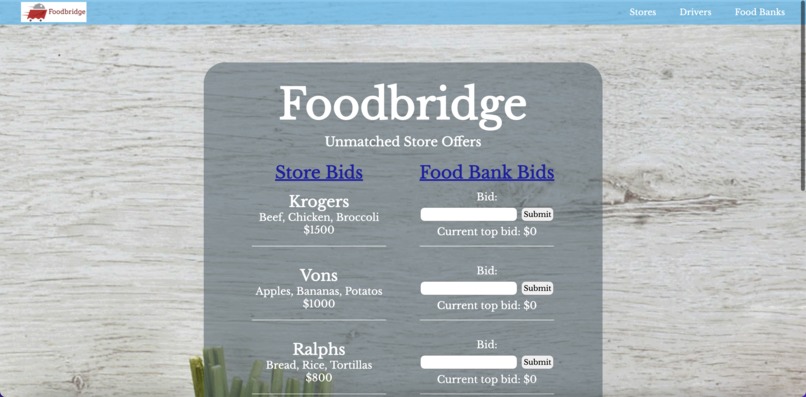
The display food banks see for unmatched store/bank pairings.
-
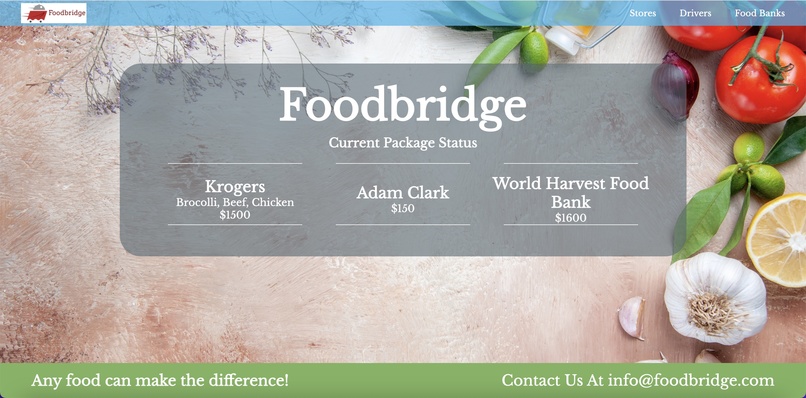
A status screen for grocery stores on their submitted packages.


Inspiration
30-40% of food produced each year is turned to waste. Together, these wastes account for 8% of all greenhouse gas emissions, making them a primary contributor to global warming. The US alone produces 170 million metric tons of greenhouse gas emissions simply from food waste. Yet despite this massive waste, roughly 38 million Americans go hungry each year, and services such as soup kitchens and food pantries demonstrate the importance of combating global hunger.
Much of the food discarded by grocery stores and other businesses has passed a sell-by date of some sort, but in reality, has a shelf life that can last much longer. As a result, there is a huge supply of perfectly consumable food and a heavy demand from a large portion of our population, but our current economy lacks a medium to activate this supply and demand.
Thus, we used this opportunity to create an online marketplace connecting grocery stores, transportation vendors, and food banks (the feeders to soup kitchens and food pantries) that incentivizes these parties to trade in an economically beneficial manner while also combatting the rampant global food waste.
How It Works?
According to an article in Forbes magazine, grocery stores discard about 5-7% of their food on average at no profit. Our service allows grocery stores to auction off products hitting their sell by date to food banks and food pantries. Additionally, the system allows for seller bids, meaning that grocery stores can submit their own payment baselines such that they are guaranteed to receive at least as much money as they bid for their package. Thus, grocery stores can submit heavily discounted packages of soon-expiring goods but still protect their product by setting minimum payment standards.
The next part of the puzzle is transporting the food from the source to its destination. Our website offers another auction for drivers to bid on how much they are willing receive to drive the food from its grocery store source to the food bank destination.
The budget for these payments comes from the food banks. Food banks purchase a large amount of their food, and while buying in bulk generally gives them discounts, purchasing further discounted goods in this manner would be very beneficial to food banks. Further, since these packages would also largely be in bulk, their cost would generally far outweigh transportation costs, making it a small issue to subsidize transportation.
Importantly, the auction system also allows for charitable actions. Any grocery store that would like to make a donation, simply needs to bid $0 for their package. Likewise, a charitable driver or volunteer can also bid $0 and automatically take the market for that transportation. As a result, the food banks don't need to pay for these transactions and they act as donations to the cause.
Thus, the website connects grocery stores, transport, and food banks in a way that has not been done before. Restaurant to customer apps have been created in the past, but these operate on a small scale and don't have the impact that a grocery store to food bank connection would have. Further, the incorporation of transport systems is a novel development that opens up the doors to connecting these different systems. Finally, the auction system introduces a capitalist element that incentivizes all parties in a way that truly benefits business desires while still serving a good cause.
Economic Analysis
We crunched some numbers to verify the economic feasibility and found the system to be quite profitable for all parties. Kroger, the biggest grocery store chain in the US, estimates that roughly 4% of their annual sales worth of food is thrown out each year. This amounts to about $5.6 billion worth of food and roughly $5500 worth per store per day. This number is likely higher at other grocery stores as the average waste is 5-7% and Kroger has invested significantly to lower their waste. With packages of $5500+ each day, even when buying at 10% or less, food banks will more than cover transportation costs and still be able to buy huge amounts of food for tiny costs.
For the grocery stores themselves, if they sell the 5-7% of the food thrown out for 10% of the initial cost, their annual sales would increase by over a half a percent which is quite significant when the largest chains make hundreds of billions of dollars. For a grocery store using FoodBridge, these numbers should be very reachable.
Likewise, transport apps such as Uber are only growing prevalence, and with new drivers looking for work each day, the prospect of having reliable jobs each day would be very appealing.
Therefore, it is economically desirable for all three parties involved to use FoodBridge.
How we built it
We used HTML and JavaScript to build the bulk of the website. In order to handle storage and submissions of bids for the auction, we created an API that handled GET and POST requests to our back-end such that various bids would be posted and reflected in the front-end. The front-end design was built using CSS.
We additionally built an XGBoost learning model described below to develop a recommendation system for drivers looking for favorable jobs.
Technological Standouts
One technological standout was a machine learning recommendation system matching drivers to favorable store/food bank pairings. Presumably, there are a wide range of drivers that have various preferences on the drives they would be willing to make. For example, some might prefer longer drives while others prefer limited loads or decreased payments. Our website implements an XGBoost learning model to predict the probability that a driver will accept a particular drive. Taking features such as load weight, time of day, payment, and distance the model will output the probability for a certain match. In this way, when the potential matchings of stores to food banks becomes combinatorially large, the recommendation system can show drivers only the matchings they would be most interested in. One note is that this model is trained and stored in a Google Colab link shared below, but is currently not implemented in the website demo due to a lack of real test data.
Future Outlook
We believe that FoodBridge has a very good chance at becoming a legitimate business in the future. As described before, it is an economically logical choice for all parties involved, and if the website were to take 1% of all transactions, when taking into account that it could be transmitting billions of dollars worth of transactions, it could become very successful. However, we think it could actually be better suited purely as a non-profit purposed towards eliminating food waste. In fact, it could take 1% of profits from transactions where consumer surplus exists (higher bids than are necessary) and redistribute these funds towards helping other transactions go through. In this way, it would do the most for combatting food waste. As stated before, it also has very strong charitable attributes allowing for users to volunteer time, money, or services, and we hope that it becomes a platform for change.
In terms of future features, we hope to develop a robust authentication system and further develop user history profiles and notification systems. We also want to incorporate a mapping system to better connect different locations and perhaps implement a filter system to work together with the recommendation system in place. Goals that are further in the future include different auction systems to incentivize trade as well as expanding to other vendors such as restaurants or even individuals.


Log in or sign up for Devpost to join the conversation.