-
-
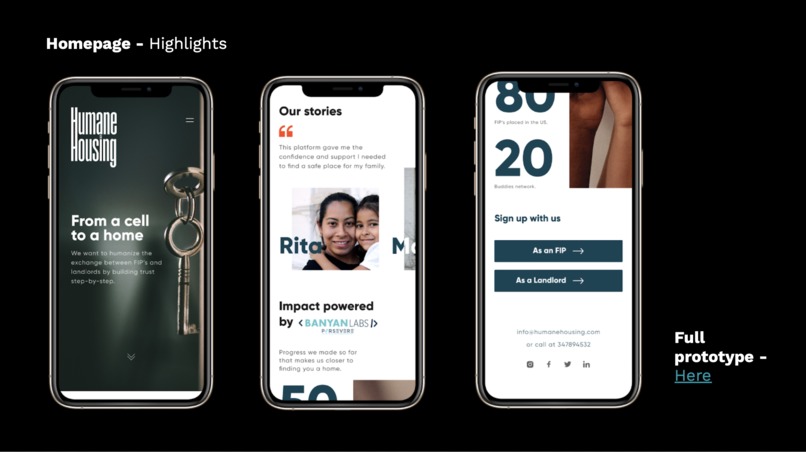
HomePage and Highlights
-
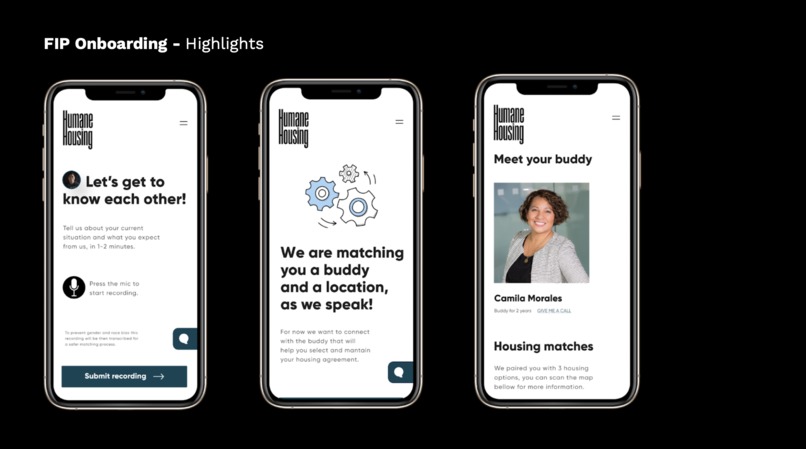
Onboarding for FIP's
-
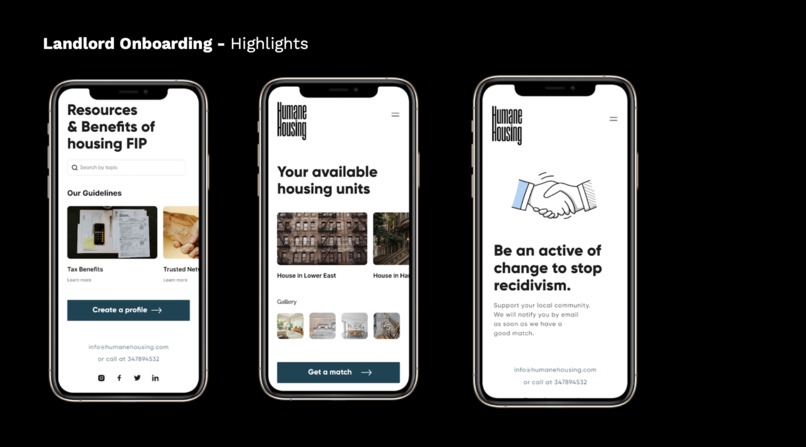
Onboarding for landlords


Inspiration
Cristal (our team member) shared a story about her uncle Carmelo, who was incarcerated for 3 years before he attempted to find housing in New York State.
Carmelo was essentially homeless and experienced dozens of rejections to his rental applications. Many people like her uncle end up homeless after being released from prison.
The problem is huge itself, cause it’s hard to imagine building a successful life without a place to call home, but this basic necessity is often out of reach for formerly incarcerated people.
Nationwide 600,000 people return from prison each year to try to rebuild their lives. Around 50,000 people go directly to a shelter after being released from prison. 71% of people returning from prison go back there during the first year.
That’s why we decided to address this problem through the creation of Humane Housing. A project that aims to help FIP’s find a place they could call home.
What it does
It’s like StreetEasy but for FIP’s!
1) Formerly incarcerated people join “HumaneHousing” to get matched with a “buddy” who can help them with the housing application process at no cost to the applicant. Buddies are trained to help with common FIP barriers to housing such as language barriers, computer literacy gaps, and financial concerns. 2) After video chatting with a new FIP housing applicant, Buddy (our employee and former FIP) fills out housing forms on behalf of the applicant and sends them to verified landlords within the “HumaneHousing” platform.
From a landlord perspective we will try to show them all benefits to place as many FIP’s as we could. Find people that were placing FIP’s before, and put them all on a map.
3) Benefits for Landlords: a) Automatic rental payment setup for landlords directly from employer b) Missing rental payments will notify the 'Buddy' and non-profits the tenant is enrolled in c) Rules and requirements are signed by tenant before move in d) Resources on Tax breaks e) Background checks, credit checks f) Automatic matching with housing
4) Benefits for formerly incarcerated persons: a) Can submit an automatic application to all housing options available to them in their city b) Rules and requirements are signed by tenant before move in c) Automatic matching d) Build trust with landlord e) Help with money management with automatic rent payment setup f) Empowers formerly incarcerated persons by providing them a choice
How we built it
We built two user-flows, one for applicant users and one for landlord users. We also built a database of applicant profiles, Buddy profiles, landlord profiles, and housing listings using MongoDB. We sourced landlord data from a number of local rental advertisements including those on OpenIgloo. Once an FIP application is complete our trusted background and credit check is done backed by the United States housing authority. Our algorithm then matches the formerly incarcerated with property owner listings automatically.
The application database is currently being built using MongoDB, Express and Node.js. It features user authentication and currently has user routes working that will sign up and create a user with the necessary inputted information. A landlord model will be created as well which will submit their data to the database. The listings that the landlord posts will be available to view on the home page of humane housing and the user will be able to sort by zip code for any available listings nearby.
Challenges we ran into
1) One of our major challenges is building trust with the landlords. However, our trusted background checks, credit reporting and our satisfaction rates have eased property owner concerns. 2) Another major challenge is to be able to provide guarantors for the formerly incarcerated seeking housing as the landlords worry about the tenants missing a payment. We assume that this could be their buddies, family or special firm that provide this service (here possibly funding might be needed). 3) Find funding to be able to pay the Buddies and set up a system that acts as a guarantor for a formerly incarcerated person. If anything happens and former FIP’s are not able to pay. We should have to provide a funds to cover it.
Accomplishments that we want to be proud of:
Our trusted matching process has helped 1000s of FIPs get matched to housing with a 99% satisfaction rate of property owners. The following have contributed to our high satisfaction ratings from our property owners:
a) Each FIP is required to sign a rules and requirements document before moving into housing b) Automatic rental payments setup is sourced directly from employer or guarantor prior to move in c) Our trusted background and credit check reporting is backed by the United States housing authority d) Property owners are provided resources with benefits for participation such as tax breaks and automatic tenant matching
What we learned
1) The specific challenges that come with being an FIP and re-integrating into the society after getting out on parole or completing the sentence. 2) FIPs face prejudice not only when trying to obtain long term employment but also while applying for housing. 3) One of the most important inquiries on the renter application form is the existence of previous criminal record, and on the basis of this FIPs are often denied the opportunities that are accessible to other applicants.
What's next for HumaneHousing
The future that we envision for HumaneHousing is to be able to have a positive impact on reducing the rates of recidivism amongst the FIP. 71% of the inmates return to prison within 5 years. We want to reduce this percentage to values as low as possible so that the formerly incarcerated get to have a real chance at rehabilitation and the first step towards it is to have a safe space that they can call home. Our immediate target is to be able to build a strong relationship with the landlords using our services. Our long term goal is to be able to expand this network of landlords and build a relationship of trust between them and the formerly incarcerated person tenants. Ultimately, we want to reduce the rates of recidivism and help the formerly incarcerated persons integrate back into the society.


Log in or sign up for Devpost to join the conversation.