-
-
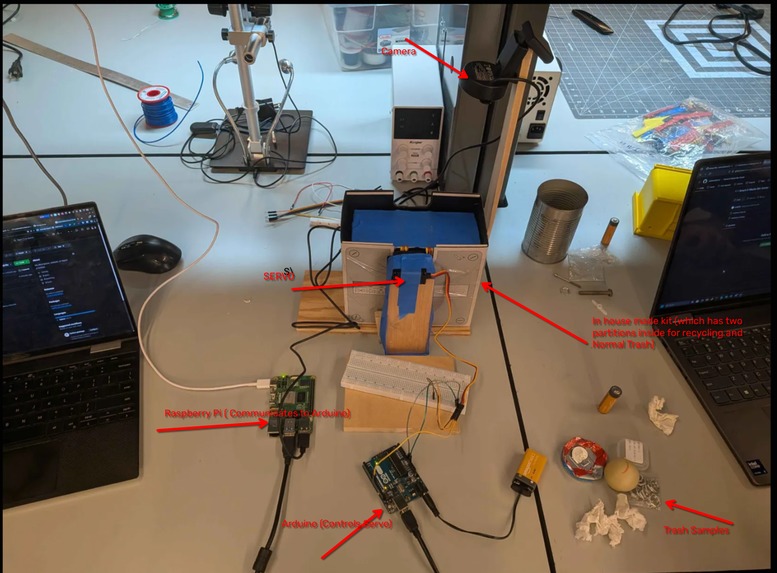
Setup

Inspiration
We were inspired by the growing problem of electronic and general waste mismanagement on campuses and in cities. Seeing overflowing bins and recyclables mixed with trash motivated us to design a solution that makes waste sorting smarter and more sustainable through automation and AI.
What it does
Green Huskies++ is an intelligent waste-sorting system that uses computer vision and machine learning to identify different types of waste—such as plastic, paper, glass, and metal—and automatically directs them to the correct bin. The system helps reduce contamination in recycling streams and promotes environmentally friendly disposal habits.
How we built it
We built the project using a Raspberry Pi connected to a camera module for real-time image capture and an Arduino to control a servo motor that sorts the waste into the correct compartment. Our model was trained on the TrashNet dataset using TensorFlow Lite for lightweight inference, and we integrated OpenCV for image preprocessing. The Pi and Arduino communicate through pySerial, allowing seamless coordination between detection and mechanical movement.
Challenges we ran into
Some major challenges included achieving high classification accuracy on real-world images, handling different lighting conditions, and ensuring the servo mechanism aligned perfectly with the bins. We also faced issues optimizing the TensorFlow model to run efficiently on the Raspberry Pi without lag.
Accomplishments that we're proud of
We’re proud of successfully integrating hardware and software into a functional prototype that can automatically detect and sort waste in real-time. Achieving consistent performance across different materials and lighting environments was a big milestone for us.
What we learned
We learned a lot about embedded AI, computer vision, and edge computing with limited hardware resources. We also gained hands-on experience in microcontroller communication, model optimization, and working collaboratively on an end-to-end sustainable tech project.
What's next for Green Huskies++
Next, we plan to improve the model’s accuracy using more diverse datasets, add IoT connectivity for bin status monitoring, and design a larger, community-ready version that can be deployed in schools, offices, or city recycling centers. We also hope to integrate solar power and data analytics to track environmental impact over time.




Log in or sign up for Devpost to join the conversation.