-
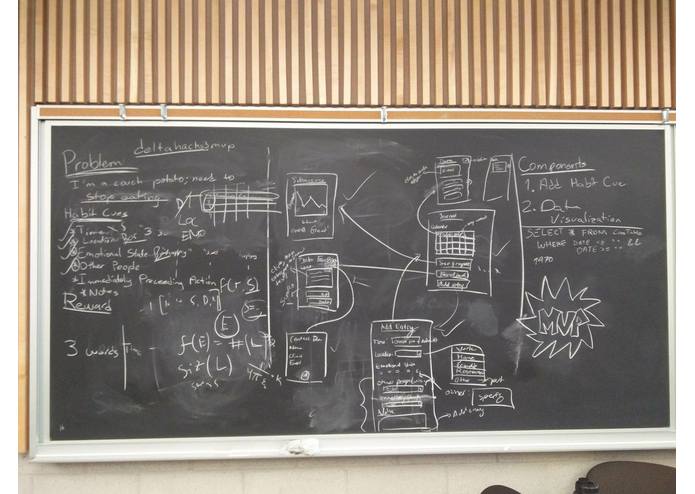
Storyboard

Inspiration
We were fascinated by rlsolutions' challenge to help patients follow their doctor's recommendations more closely, and improve communication between them. In particular, the problem is very complex, and rlsolutions not only allowed, but encouraged, any kind of solution we could come up with. Furthermore, the problem of managing habits is one that applies to everyone; we could help a lot of people outside of hospitals as well as inside.
What it does
Habittack is based on a system laid out by Charles Duhigg's best-selling book, "The Power of Habit". Duhigg lays out a system for conquering habits by understanding how they work, and taking advantage of some of the tricks our brains use in order to reshape them. Habittack is based on a collaboration between doctors and their patients. By making it as easy as possible for users to log their bad habits, we not only increase the user's awareness of their own bad habits, but also provide a mechanism for getting that information to their doctor.
How we built it
We used a combination of Android Studio and C (for Android and Pebble, respectively). For Android, the voice recognition is done using the PocketSphinx library, and for Pebble, it is done using Pebble's built-in features. For both Android and Pebble, we also store all of the collected data in an SQL database, done through SQLite.
Challenges we ran into
As a result of trying many different technologies in such a short amount of time, integrating everything together into a single product was quite difficult. Furthermore, since we were generally unfamiliar with the environments we were working in (and even flip flopped several times between them), a lot of our time early on was dedicated to just setting up.
Accomplishments that we're proud of
We undertook a very large project, with one of the mentors asking on multiple occasions if we really thought we could finish in just 24 hours. While our hack is certainly not polished, the vast majority of the core systems are in place and functional - we have a prototype.
What we learned
Before Delta Hacks, only one of the three of us had experience with Android, one with SQL, and none of us knew anything about voice recognition, nor the Pebble.
What's next for Habittack
All three sub-components (the two Android sections, and the Pebble project) all use the same SQLite database underneath. In the future, by enabling these different components to share their databases, we would be able to provide a more holistic view of a person's habits. This might be done by using a server, for example, to centralize the information and make it available to the doctor in real-time as well. Doctors would be able to notice trends among multiple patients, and develop a better understanding of how to help patients overcome bad habits like smoking and overeating.
Built With
- android-studio
- c
- java
- pebble
- pocketsphinx


Log in or sign up for Devpost to join the conversation.