-
-
Logo
-
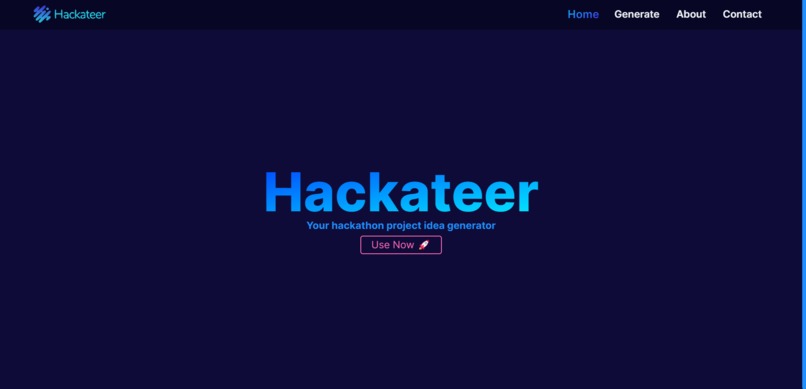
Landing Page
-
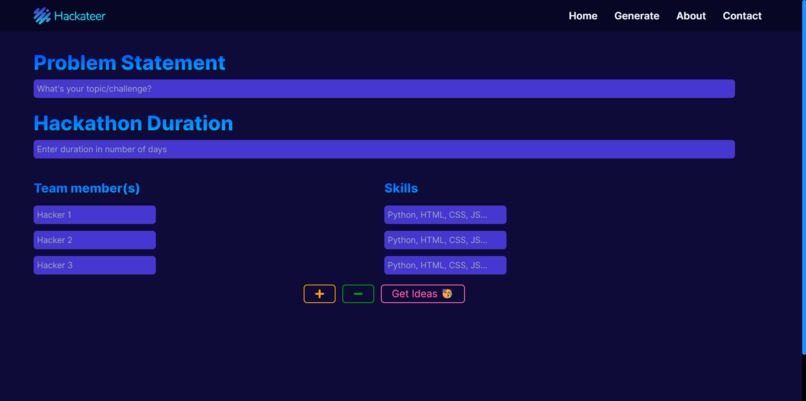
Generate Ideas Page
-
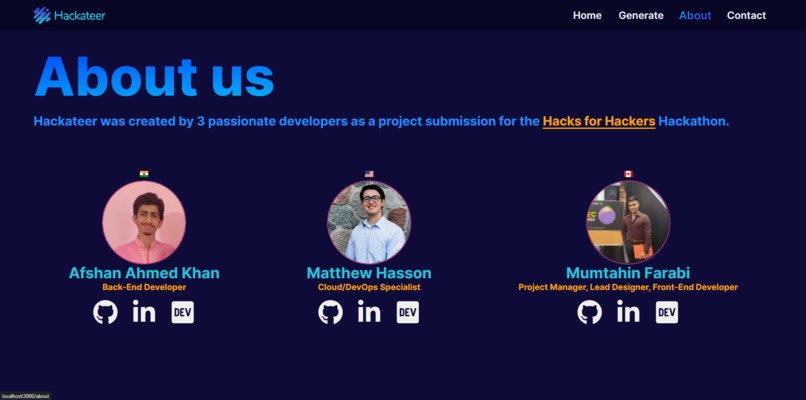
About Us Page
-
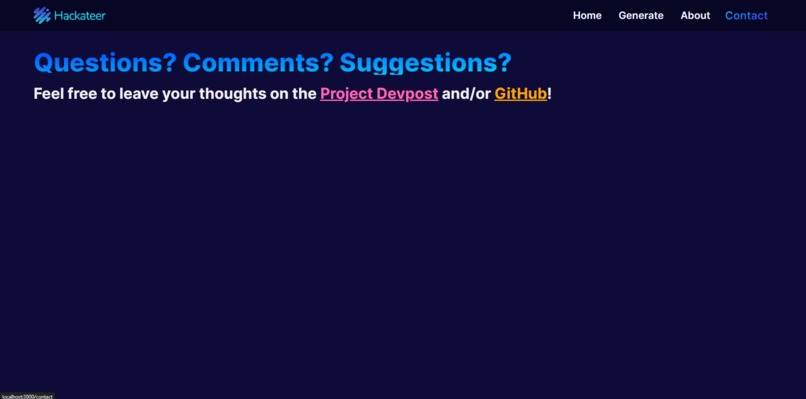
Contact Page
-
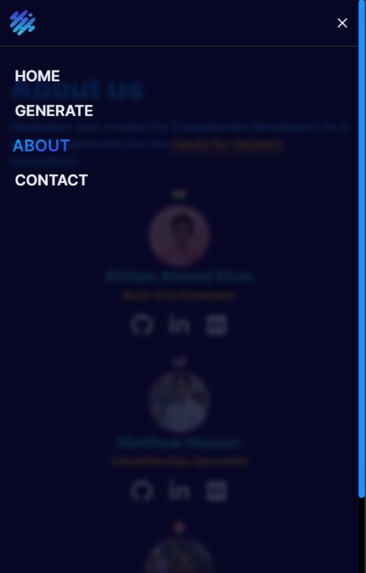
About Us Page Mobile Nav Menu Opened


Live Demo | GitHub Repository | Figma Design
Inspiration
In the fast-paced and competitive environment of hackathons, time is of the essence, and every moment counts towards creating a winning project. One of the most significant early challenges faced by hackathon teams is the process of brainstorming and agreeing on a compelling idea to pursue. Our vision is to create a solution that streamlines the process of coming up with quality ideas for a hackathon that is able to utilize the diversity of backgrounds and skillsets of a particular team.
What it does
- The user inputs their unique problem statement(s), the designated duration of the hackathon, and the specific skill sets of each team member.
- Using this information, Hackateer generates high-quality, customized suggestions tailored to meet the user's specific requirements. This includes comprehensive pros and cons of each proposed idea, providing the user with a thorough understanding of the potential outcomes.
- To enhance the success rate, Hackateer offers an evaluation for each idea based on the given timeframe and the team's cumulative skill set, ensuring the suggestions are realistic and achievable.
- Hackateer also even provides a tentative schedule for the project's development, fostering effective time management and efficient task distribution.
Additional planned features
- Factor in team dynamics
- Interests
- Timezones/Availability
- Generate a more complex project roadmap and schedule with specific todos for each team member.
- Provide tips and suggestions for initial project planning and bootstrapping. Such as:
- Create Devpost page.
- Create GitHub/GitLab/BitBucket repository for collaboration.
- Create a project board on GitHub/Jira/Trello etc for quality project management.
- Create Discord server with dedicated channels for effective communication.
- And more...
How we built it
Our initial team discussions to generate a project idea morphed into the inspiration behind our application - a tool that fosters idea generation. To facilitate efficient collaboration, we established a dedicated Discord server, which housed individual channels for various aspects of development, such as design, frontend, backend, and cloud development.
To streamline our project management, we fully utilized the capabilities of GitHub projects. We meticulously organized issues based on priority, tagged them appropriately, linked relevant pull requests, and so forth. Our repository architecture comprised numerous branches, each correlating to a different development category. We even maintained a separate branch dedicated to documenting our meeting minutes.
The design process kicked off with wireframing on Figma, prioritizing the landing page. Farabi conducted in-depth research to curate a vibrant and appealing color palette, which complemented our selected typography and type scale. The design and frontend development progressed synchronously, ensuring a seamless integration of visual aesthetics and functionality.
Simultaneously, our teammate, Afshan, delved into backend development; focusing on learning and implementing the OpenAI API from scratch. Matt, on the other hand, dedicated his efforts to facilitate cloud deployment with CI/CD on Microsoft Azure.
Throughout this journey, we emphasized maintaining open lines of communication, employing Discord chats, comment sections of issues and pull requests, and voice chats to ensure clarity and cohesion among the team. Through efficient collaboration and continuous learning, we were able to successfully construct and deploy our innovative application.
Challenges we ran into
Our team encountered several obstacles during the hackathon. Initially, our team comprised three members, including Farabi. However two of the original members, both of whom had prior hackathon experience, were unable to continue their participation in the hackathon, which led to Afshan joining a bit later and a significant re-evaluation of the project's scope. This sudden shift in team composition necessitated a re-distribution of responsibilities, adding to our challenges.
As the hackathon progressed, we were fortunate to have Matt join our team. However, with him joining towards the end of the first day, he was catching up with the progress we had already made. This transition was not without its difficulties, one of which was navigating a significant time zone difference of 10 hours with Afshan.
Furthermore, we faced technical difficulties as Discord wasn't compatible with Afshan's device. Consequently, we were obliged to conduct our voice calls via Google Meets. Unfortunately, this platform sometimes presented connectivity issues, leading to instances of miscommunication, such as difficulty hearing each other and inadvertently talking over one another.
In the initial phase of the hackathon, we diligently documented our progress and brainstorming sessions in meeting minutes. We also embarked on detailed wireframing for all frontend pages. However, the unforeseen upheaval in team membership, the subsequent search for an additional team member, and the redistribution of project tasks created a chaotic environment. Amidst this, we had to deprioritize some activities, including our meticulous documentation and wireframing efforts.
Accomplishments we're proud of
First and foremost, our ability to adapt to an unforeseen shift in team composition stands out. We managed to overcome this obstacle, preserving our spirit of collaboration and determination to deliver a quality project despite all of us participating in a hackathon for the first time.
The project journey itself is a testament to our resilience and dedication. We navigated all the stages from concept discussion, design, front-end and back-end development, cloud deployment, to effective presentation without compromising on quality or cutting corners.
Our approach to organization was one of the key factors in managing the challenges we faced. We established a structured communication system, transitioning from a Discord group chat to a server with dedicated channels. This ensured that our conversations were easy to track, and various topics were neatly separated and readily accessible.
One of our greatest strengths was effective project management, achieved by leveraging all available features of Github Projects. We linked issues to respective pull requests, divided the project into manageable milestones with their unique issues, and utilized labels, status, priority, and size metrics. These strategies greatly facilitated our work distribution and progress tracking, keeping us organized, motivated, and ready to adjust tasks whenever necessary.
Lastly, we are particularly proud of our time investment in design. This upfront effort not only expedited our front-end development but also culminated in a visually appealing, fully responsive user interface. The resulting positive user experience is something we are truly proud of.
What we learned
During the hackathon, our team acquired valuable skills and insights:
Technical Skills: We enhanced our proficiency in Figma for UI/UX design, Next.js for frontend development, OpenAI API for backend development, and Microsoft Azure for deployment.
Project Management: We honed our skills in utilizing Github Projects for effective task management and documentation.
Adaptability: We learned to swiftly adjust and reallocate roles amidst unexpected changes in team composition.
Collaboration and Communication: Despite timezone differences and technical challenges, we improved our communication strategies, thus enhancing team productivity.
Design and Development: We recognized the significance and benefits of investing time in detailed UI/UX design for accelerated development and improved user interfaces.
Endurance and Persistence: We realized the critical role of resilience and cooperation in overcoming hurdles and achieving our goals.
What's next for Hackateer
Looking forward, our current plans for Hackateer are open-ended. While we believe that the platform offers a solid foundation and valuable resources for hackathon participants, our team doesn't have immediate plans for further development. This is subject to change, however, as we assess feedback and consider the potential for enhancements that could further support the needs of the hackathon community. Ultimately, our experience with Hackateer was enriching, and we are excited about the potential it holds.


Log in or sign up for Devpost to join the conversation.