-
-
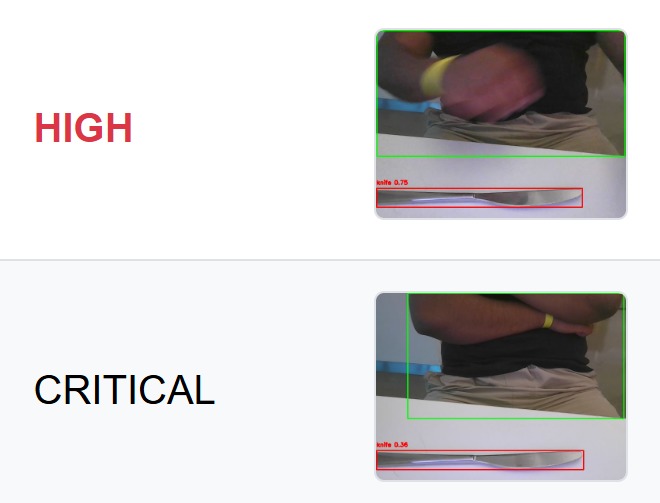
Danger Level
-
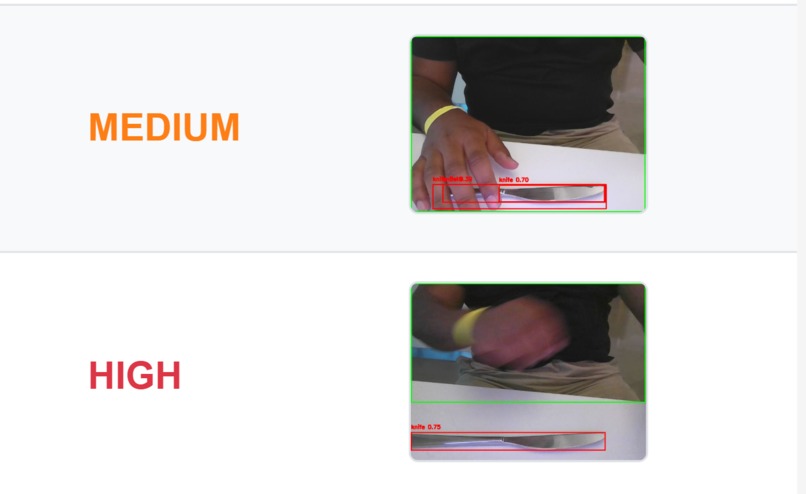
Danger Level
-
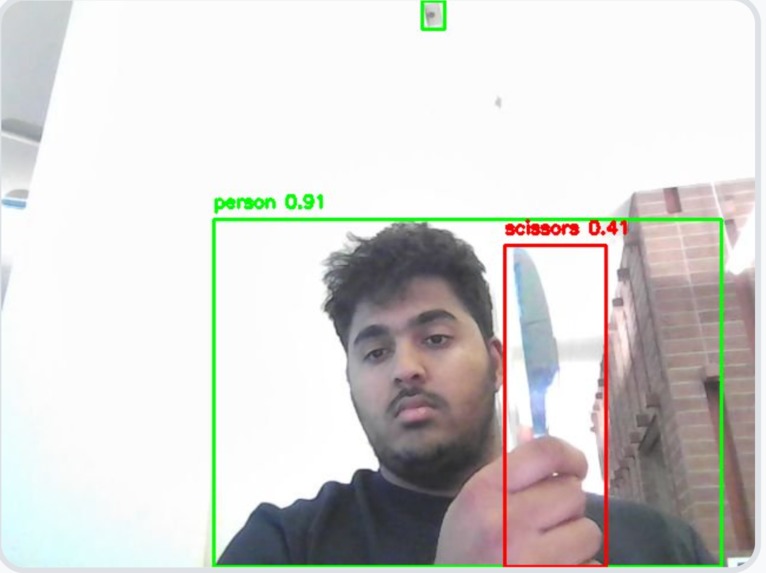
Proper Handling
-
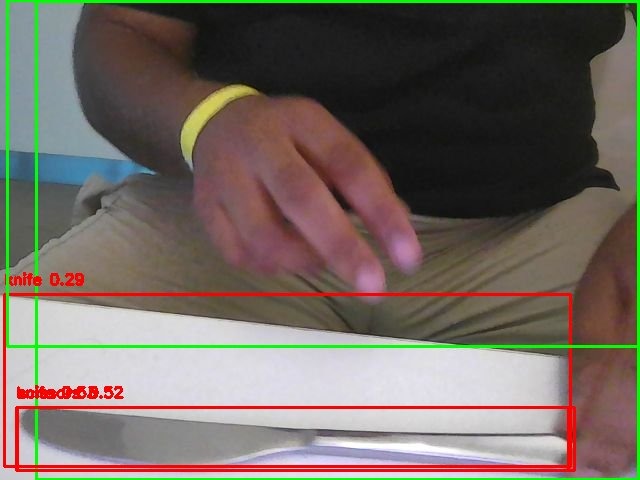
Improper Handling
-
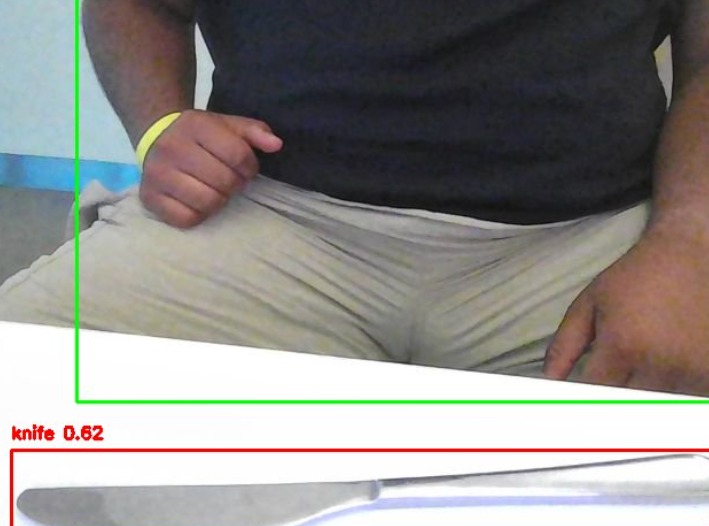
Improper Handling
-
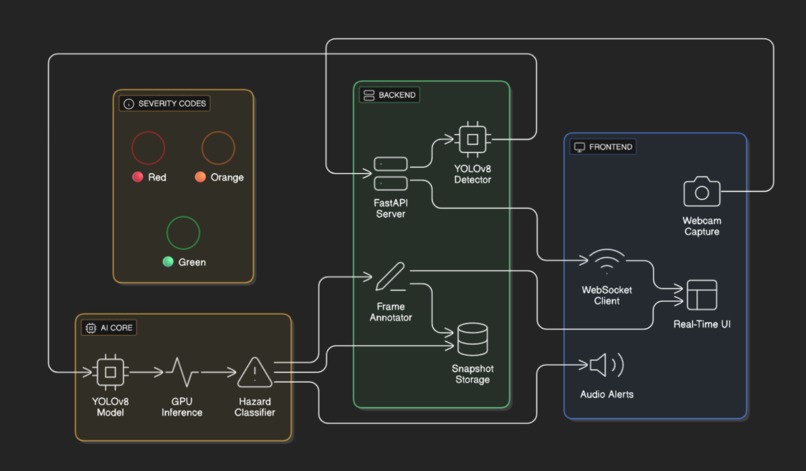
Architecture Workflow


Inspiration
Every day, nearly one million workers are injured on the job—and the majority of these injuries are entirely preventable. Visual hazards like unattended tools, blocked exits, and missing PPE (personal protective equipment) are responsible for most of them. Yet while AI innovation in fields like healthcare and finance accelerates, blue-collar industries—where lives are at stake daily—remain underserved.
Workplace safety is a crisis in the U.S.:
4,764 workers died on the job in 2022 (U.S. BLS)
That’s one death every 96 minutes
Non-fatal injuries cost the U.S. economy $167 billion annually (NSC, 2022)
We built HazardVision to bridge this safety gap. Our mission: bring real-time, intelligent oversight to factories, warehouses, and worksites—places where one missed step can cost a life.
What it does
HazardVision is an AI-powered safety assistant that monitors the workplace through real-time video. It automatically detects and classifies hazards, then alerts workers before accidents occur.
It detects:
Trip and fall risks (e.g., tools, cables, spills)
Improper PPE usage (e.g., missing helmets, gloves)
Unsafe equipment handling (e.g., stagnant knives, exposed saws)
Blocked emergency exits or cluttered walkways
Our system uses:
Live webcam input
Bounding boxes with severity-coded colors (green/yellow/red)
Real-time hazard logs
Audio alerts with pitch based on severity
It even adjusts classification based on context: a tool in use may be low-risk, but abandoned becomes a critical hazard. And if multiple hazards persist unattended, our AI agent can escalate by notifying a manager or safety officer—ensuring OSHA-level accountability.
How we built it
We designed a full-stack real-time computer vision system with agentic capabilities:
Frontend:
HTML/CSS/JavaScript for the dashboard
MediaDevices API for webcam access
Canvas API for real-time bounding box rendering
WebSockets for bi-directional communication
AudioContext API for hazard-specific alert tones
Backend:
FastAPI (Python) + Uvicorn for high-speed async handling
Ultralytics YOLOv8 for object detection (PyTorch under the hood)
OpenCV for image annotation
Custom hazard classification logic (severity scoring, event triggers)
Agentic pipeline powered by Vapi and ElevenLabs for escalated alerts
The frontend captures frames and sends them via WebSocket to the backend. There, the YOLOv8 model detects tools, objects, and unsafe setups. Based on context, we classify hazard severity and return bounding boxes and labels. If the situation escalates (e.g. abandoned blades or multiple unmitigated risks), our AI voice agent contacts factory management with a violation notice.
Challenges we ran into
Ensuring inference speed was fast enough for smooth live video
Designing a severity framework adaptable to various real-world tool usage
Syncing audio, visual annotations, and hazard logs in real-time
Learning how to implement agentic workflows using Vapi and ElevenLabs
Finding appropriate data to train YOLO for real manufacturing environments
Testing the model with real materials (tools, machines, gloves, etc.)
One of our teammates had to leave midway—requiring us to re-plan, regroup, and rebuild
Accomplishments that we're proud of
Built a complete real-time detection and alert system from scratch
Successfully trained a CNN to identify hazards and contextualize them based on environment
Achieved low-latency AI inference using YOLOv8 on webcam input
Created a live hazard dashboard with severity mapping, log tracking, and alert sounds
Formed a resilient team from across different countries and universities
Rebounded and finished the project strong, even after a teammate left mid-hackathon
What we learned
How to optimize AI models for real-time use in edge environments
How to integrate new technologies like Vapi and agentic voice systems
How to design for industrial UX—where alert clarity and speed can be life-saving
How to collaborate across time zones, adapt when things break, and keep pushing forward
What's next for HazardVision
Expand detection to fire, gas leaks, electrical sparks, and smoke
Partner with manufacturing labs and warehouse operators for field testing
Build a plug-and-play camera module for easy installation in existing CCTV setups
Continue training on more diverse datasets for better generalization
Bring the system to small and mid-sized factories across the U.S.—where safety staff is minimal and the risk is high


Log in or sign up for Devpost to join the conversation.