-
The Network Analyzer
-

The honeypot python


Inspiration
With cyber threats evolving rapidly, we wanted to create tools that actively detect and analyze malicious activity. Inspired by real-world attacks, we built HoneyPy to lure and study threats, while NetAI leverages AI to monitor and secure networks.
What it does
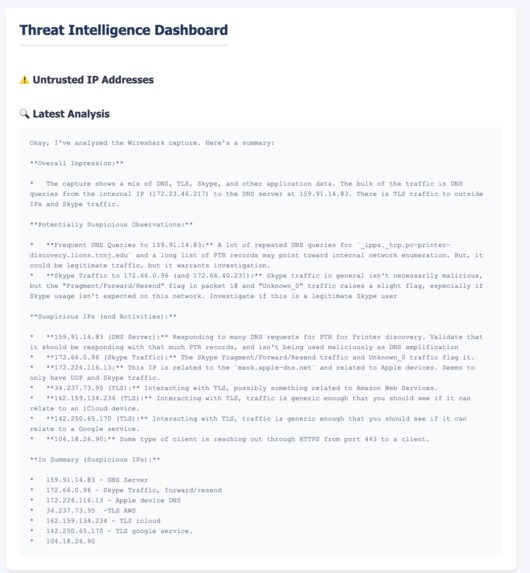
HoneyPy: A Python-based honeypot that traps, logs, and analyzes cyber threats. NetAI: An AI-driven network analyzer that processes Wireshark (.pcap) files and uses Google Gemini to detect anomalies and security risks.
How we built it
HoneyPy was developed using Python and networking libraries to simulate vulnerable systems and log attacks. NetAI collects .pcap files via Wireshark, processes them, and feeds the data into Google Gemini, which analyzes traffic patterns to identify potential threats and anomalies.
Challenges we ran into
Ensuring HoneyPy mimics real-world vulnerabilities to attract attackers. Efficiently processing large .pcap files without performance bottlenecks. Fine-tuning Google Gemini’s analysis to reduce false positives.
Accomplishments that we're proud of
uccessfully capturing and analyzing real attack attempts with HoneyPy. Automating network traffic analysis with NetAI using Google Gemini. Building an end-to-end system for both passive and active cybersecurity insights.
What we learned
How to automate AI to analyze network threats instead of manually inputting the network files into the ai for NetAI. For HoneyPy we've learned to actually understand how a honeypot works and build a simple one.
What's next for HoneyNetAI
Enhancing HoneyPy with more advanced deception techniques. Improving NetAI’s AI model for more precise real-time threat detection. Developing a dashboard to visualize network threats in real-time. Expanding integration with other cybersecurity tools and SIEM solutions.


Log in or sign up for Devpost to join the conversation.