-
-
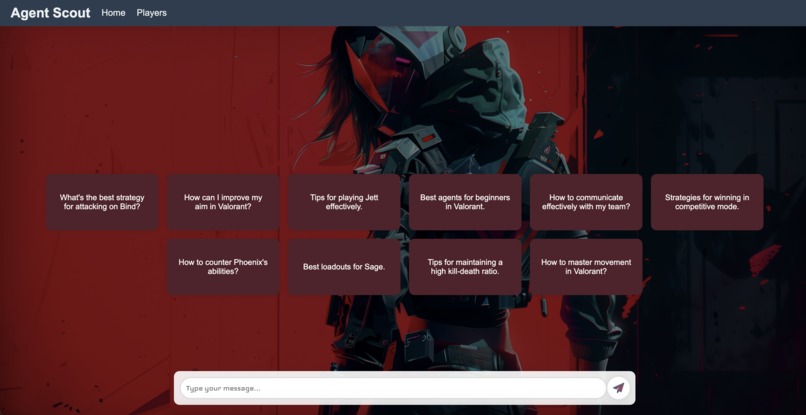
main home page

Inspiration
We’ve always been eager to explore new technologies and push our boundaries by building exciting things. When we came across the post about the VALORANT and AWS Hackathon, we were immediately excited to participate—especially since it was our first-ever hackathon. The opportunity to merge esports with AWS was something that sparked our curiosity, and we couldn’t wait to dive in.
What it does
We've built a custom database, populated with data scraped from trusted Valorant sources. When a user submits a query, the system retrieves relevant information from the database and sends it, along with the query, to AWS Bedrock, where we've integrated the Titan V1 foundational model to process the query.
How we built it
At first, we tried using the Python script provided by the VCT Hackathon, but we struggled to retrieve the right data—whether due to an error on our part or issues with the data itself. As a workaround, we decided to scrape player stats from vlr.gg directly. With the data in hand, we set up the Bedrock runtime using the following tech stack:
Backend: Node.js (NestJS), AWS Bedrock, MySQL, Prisma
Frontend: React.js, JavaScript/TypeScript
We built APIs that invoked Bedrock prompts and fetched player data from the database. This data was then used within the prompts to generate player recommendations. Additionally, we implemented an API that builds teams by selecting specific players based on their stats.
Challenges we ran into
One of the major challenges we faced was working with Amazon Bedrock using TypeScript. Most available resources were in Python, which required us to invest extra time in researching and figuring out how to implement it in Node.js. We also encountered the common error, 'Too many requests, please try again.' After some investigation, we realised this was a region-related issue. Changing the region resolved the problem, but it proved to be a time-consuming hurdle.
Accomplishments that we're proud of
We're incredibly proud of how quickly we adapted to unfamiliar technologies, such as AWS and Bedrock, and successfully delivered a functional application in such a short time. The fact that we managed to scrape live data, integrate it into a seamless system, and build a working prototype of AgentScout—all while learning from scratch—was a significant achievement for us.
What we learned
This hackathon presented a steep learning curve, as we had never worked with AWS services before. Everything was new, from setting up IAM users to configuring Amazon Bedrock. Additionally, we learned how to scrape data from websites, which opened up new possibilities for tackling the challenge. Along the way, we also became familiar with setting up Amazon Bedrock using TypeScript in Node.js—an exciting new skill to acquire.
What's next for AgentScout
Given more time, we would love to expand AgentScout by scraping more comprehensive data to build a robust knowledge base. This would enable us to enhance the application's intelligence, providing even more detailed insights and recommendations for team-building in VALORANT.




Log in or sign up for Devpost to join the conversation.