-
Procedural Generated Music

About
MLH Prime Southwest Regional 2016 entry for ayushsriv, clillie100, jer-zhang, kaellel.
Inspiration
As students, music plays a large role in our lives. In fact, clillie100 hosts a music radio show two hours per week. The ability for computers to generate music presents many possibilities especially when integrated with advanced ditigal audio workstations.
What it does
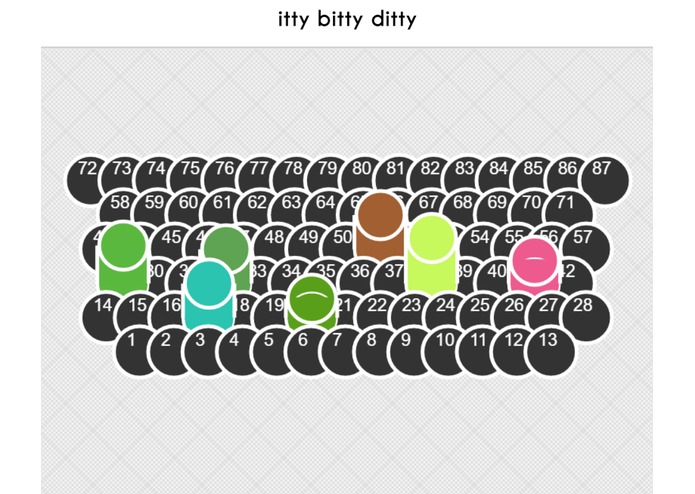
Itty bitty ditty is made up of two components: one, a Java back-end that transcribes MIDI music files into notes, and compiles a note library storing the probability of a note occuring after each MIDI note; two, a front-end user interface that allows the user to select a note upon which itty bitty ditty attempts to compose a subsequent song.
Itty bitty ditty has three libraries upon which it composes songs: one library is derived from electronic and modern pop music, one library is derived from instrumental classics, and one is derived from music composed in the fourth chord. The user may choose freely between the three libraries by clicking the itty bitty ditty logo on the navigation bar, and may also choose freely between standard MIDI instruments.
How we built it
Itty bitty ditty's back-end processor is located at /kaellel_scanner/.
Itty bitty ditty is built with Java, HTML, CSS, and JavaScript. The Java back-end analyzes a music file by reading each
note in a song. Then, all occurrences of the notes following a note are recorded. The recorded information is stored in
a probability format. In other words, the Java back-end builds a music library of Library[i][j], in which i represents
the current note, and j represents the following note; Library[i][j] represents the total number of occurrences in
which the note j (0 <= j <= 127) appears after note i. Library[i] represents an array of [0...127] storing the
occurrences of note j in [0...127] after the note i.
When notes are transcribed into the library, itty bitty ditty transcribes notes in the lower third pitch region, mid third pitch region, and higher third pitch region separately to preserve audio quality. The library "Fourth Chord" contains song transcriptions such as Adele's "Hello" and One Republic's "Apologize". The library "Instrumental Classics" contains song transcriptions such as The Beatles's "Yesterday". The library "Modern to Electric Pop" contains song transcriptions such as Ariana Grande's "Tattooed Heart".
Itty bitty ditty's front-end user interface is located in the root directory.
The user interface accepts mouse and/or touch input. Once the user clicks a note, itty bitty ditty will begin composing and playing a song based on the music library. The length of the song composed is randomized to be between 30 - 50 notes; the rhythm of the song composed is procedurally generated. The top navigation bar serves as a button to open instrument and library settings.
Challenges we ran into
Animations with JavaScript, functions and variable scope.
Accomplishments that we're proud of
Throughout the development of itty bitty ditty, we managed to shrink a rather complex seven line algorithm to just one line.
What's next for Itty bitty ditty
Itty bitty ditty will benefit from more advanced music generation algorithms, and more detailed music libraries that take into account not only succeeding occurrences in its current state, but also preceding occurrences. Future development may include automatic matching of notes to bass.
Built With
java javascript html css3


Log in or sign up for Devpost to join the conversation.