-
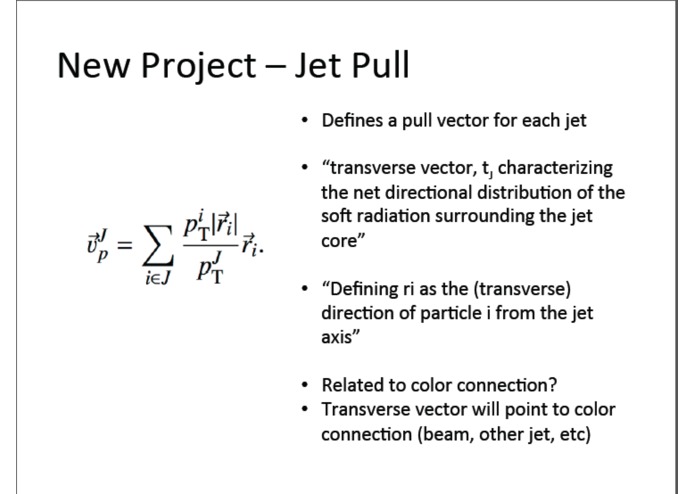
Technical Explanation
-
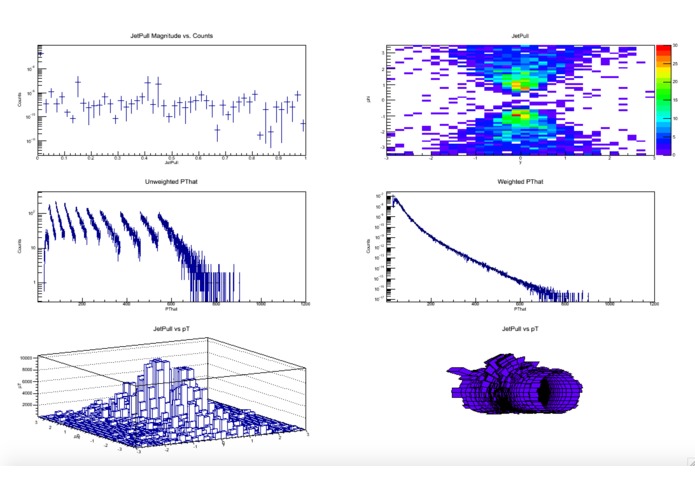
Plots created from the macro
-
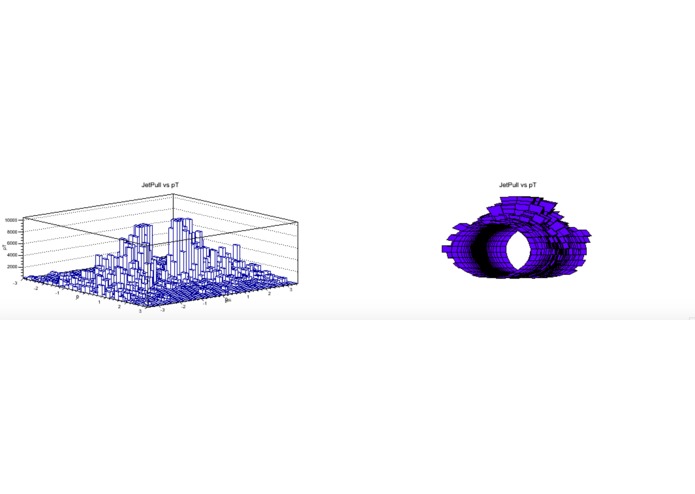
A different angle of the last two plots


The quark-gluon plasma (QGP) is a dense, hot state of matter present during the earliest moments of the universe. It is formed at the Large Hadron Collider at CERN through lead ion collisions at ultra relativistic velocities, and its properties can be studied though its interaction with jets, which are concentrated back to back sprays of particles emitted in the collision. Jets produced in the heavy ion collisions are expected to differ from those in electron-electron and proton-proton collisions, as they interact with QGP in lead-lead. There are multiple measurable jet observables that are expected to be sensitive to interactions with the QGP in order to study its properties. The jet pull vector, which describes an aspect of the strong force interaction of jets, can also be used to characterize the QGP. For this project, an analysis framework was encoded and the distribution jet pull is presented from Monte Carlo simulations. Moving forward, the developed analysis framework would be used to study the distributions in the proton-proton and PbPb collisions to study the effects of QGP on jets.
Plots shown from the code, run preliminarily on proton proton collision simulation data sets (which can't be run outside of the CERN server system, but are listed in the submitted project's text file :( ) :
1) The magnitude of the jet pull vector. 2) A distribution of jet pull for pp collisions -- it's symmetric, which is a good sign for pp, where there is no QGP expected. 3) & 4) Unweighted and weighted pThat -- just a way to show that files are being weighted correctly when combined. 5a) A distribution of jet pull from a 3d perspective. 6a) A distribution of jet pull from the eta-phi space perspective (more like cylindrical/what the detector shape at CERN looks like).
5) & 6) b) A different angle.
All very rough and preliminary.


Log in or sign up for Devpost to join the conversation.