-
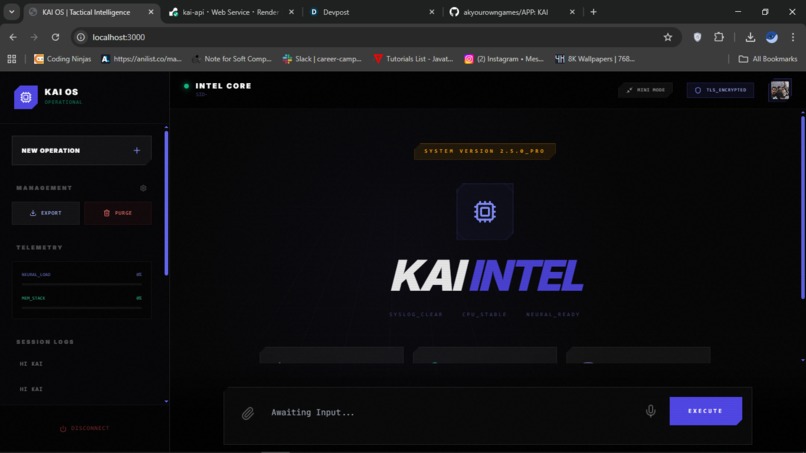
Home Page of KAI
-
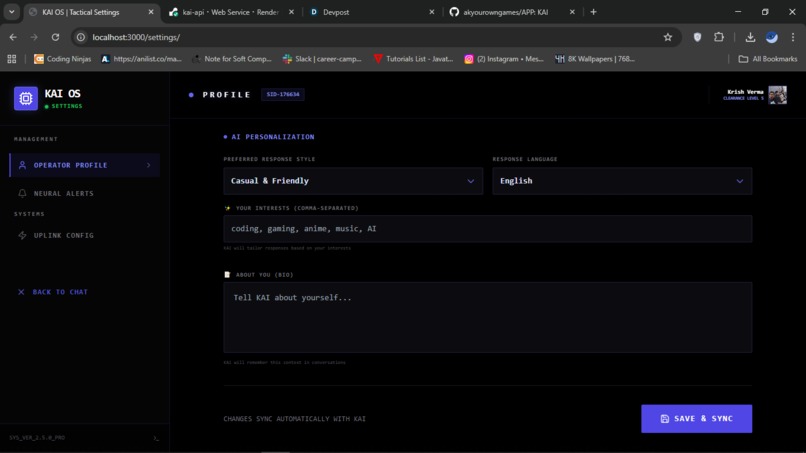
Setting Page for KAI - 2
-
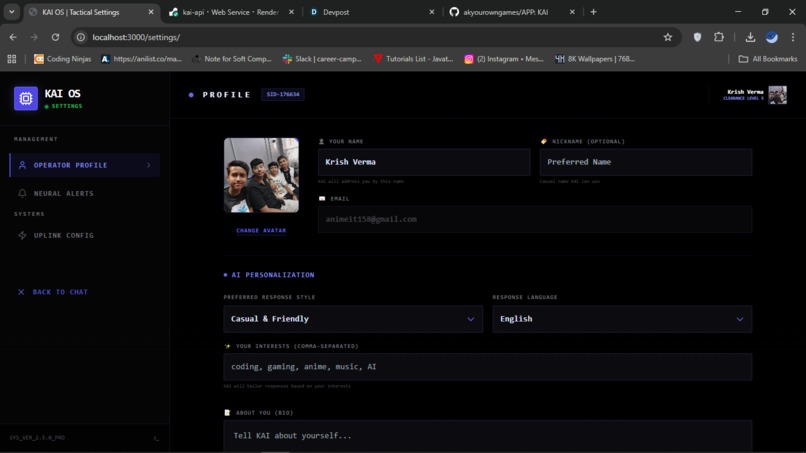
Setting Page for KAI
-
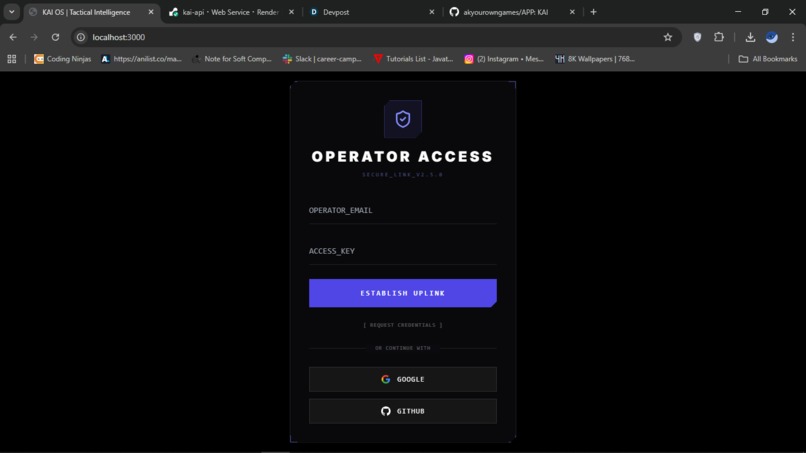
Login Page for KAI
-
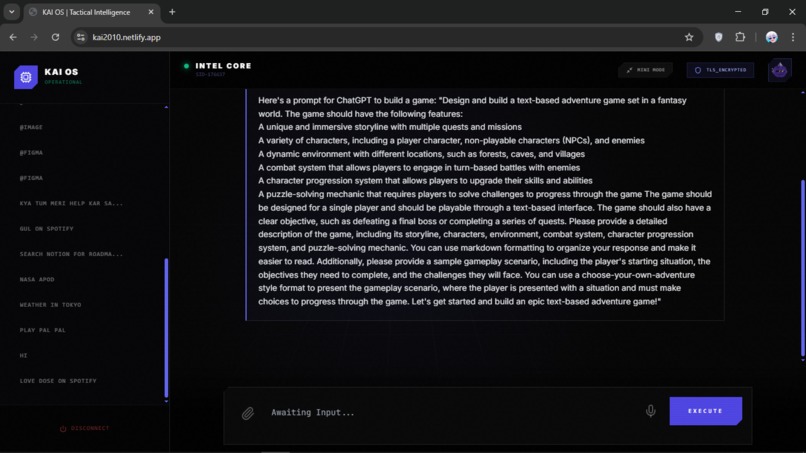
-
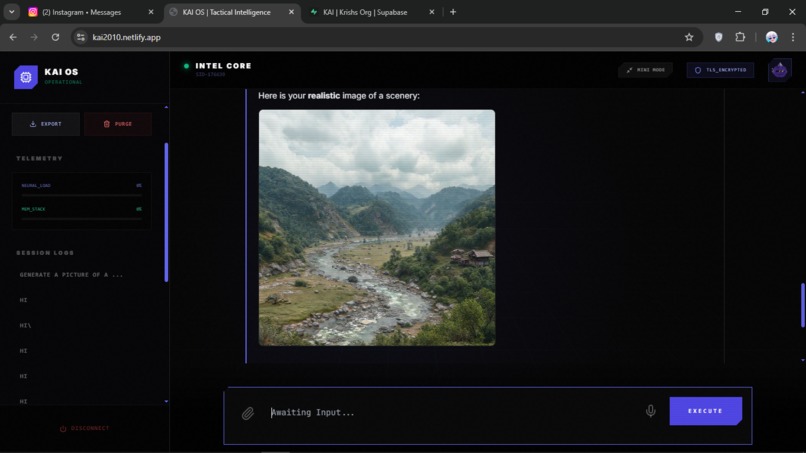
Image Generation
-
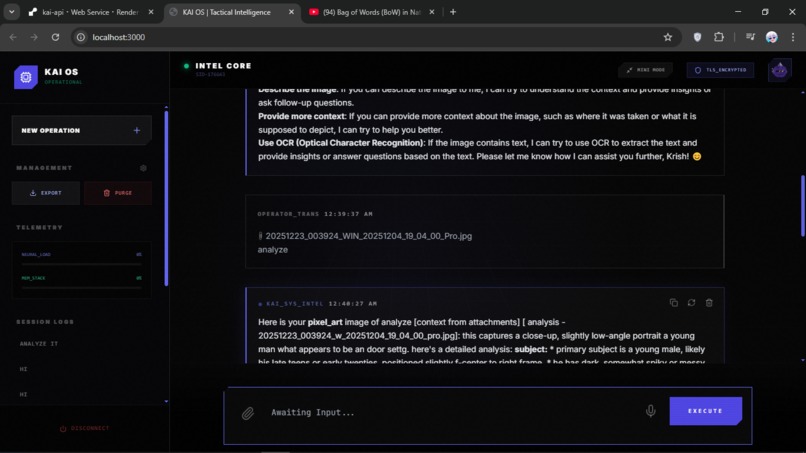
General
-
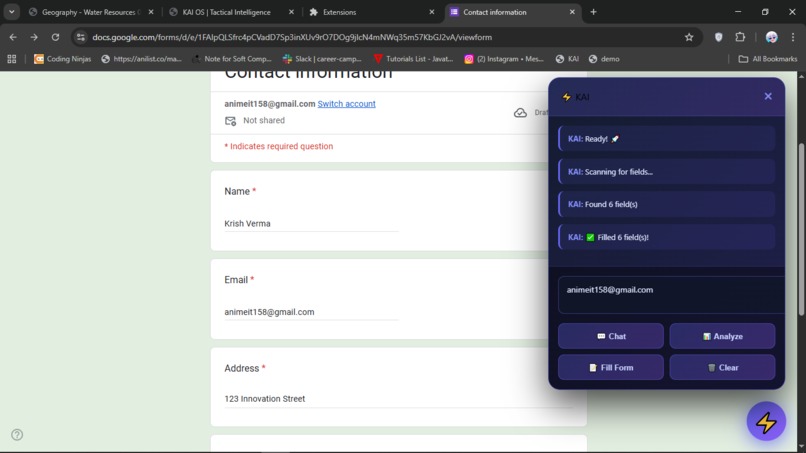
Browser Automation
-
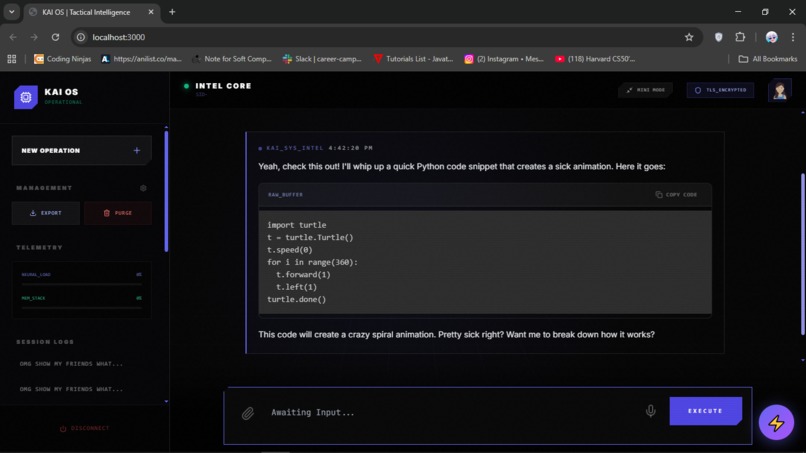
Code Generation
-
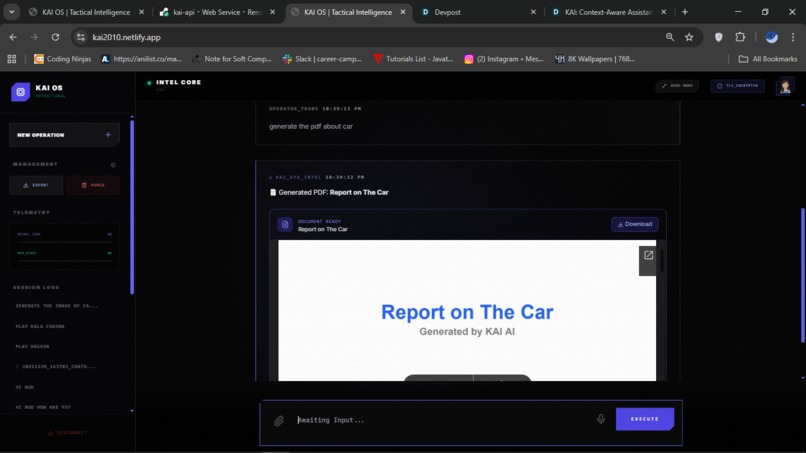
Pdf Generation


It's just a prototype and under development
Inspiration
Modern AI assistants are powerful, but they often feel disconnected from real human context. They respond to prompts, yet they do not truly understand why a user is asking something, who they are interacting with, or when it is appropriate to act. We were inspired by the idea of building an assistant that feels less like a chatbot and more like a thoughtful companion—one that understands intent, remembers past interactions, and responds only when it genuinely adds value. KAI was born from this idea: an AI system that prioritizes context, memory, and human-centric intelligence over constant interaction.
What it does
KAI is a context-aware intelligence system that understands user intent, remembers past interactions, and adapts its responses based on situation and history. Unlike traditional assistants that react to every command, KAI is event-driven—it observes selectively, reasons about context, and responds only when necessary. It also do automation, have real-time access to google and duckduckgo!! thnx to free apis, vision analysis, music playing, image generation, documents generation and many more!!
KAI supports:
Intelligent multi-turn conversations with memory Intent-aware responses (understanding why something is asked) Multimodal inputs such as text, voice, and images Real-time search and grounded responses Cross-session personalization using memory and embeddings The result is an assistant that feels more natural, less intrusive, and more human.
How we built it
KAI is built using a modular architecture that separates sensing, reasoning, and action:
Frontend: A responsive web-based interface with a modern, minimal UI
Backend: A Python-based intelligence layer handling reasoning, memory, and orchestration
AI Models: Gemini models for reasoning, multimodal understanding, and grounding; Groq for faster responses
Memory System: Vector embeddings stored in a database to enable long-term, per-user memory
Event-Driven Logic: The system activates intelligence only when meaningful triggers occur, rather than running continuously
This design allows KAI to scale across devices, including future hardware integrations, while keeping the core intelligence centralized and consistent.
Challenges we ran into
One of the biggest challenges was balancing intelligence with practicality. Continuous vision, voice, or automation quickly becomes inefficient, expensive, and intrusive. We had to redesign our approach to be event-driven, ensuring KAI feels intelligent without unnecessary computation.
Another challenge was building reliable long-term memory while keeping responses accurate and relevant. Designing intent understanding that goes beyond keywords required careful prompt engineering and semantic classification.
Accomplishments that we're proud of
Built a fully working, deployed context-aware assistant
Implemented long-term memory that persists across sessions
Designed an intent-aware response system that adapts tone and behavior
Created a clean, professional UI suitable for real users
Successfully integrated multimodal AI capabilities in a responsible way
What we learned
Through this project, we learned that true intelligence is not about doing more—it is about doing the right thing at the right time. We gained hands-on experience with system design, AI-human interaction, memory architectures, and ethical considerations in AI. Most importantly, we learned how software and intelligence can be designed to respect users rather than overwhelm them.
Features it have
🧠 Core AI Engine
Multi-LLM Provider System
- Primary: Groq (14 API keys for 1.4M+ tokens/day capacity)
- Fallback: Gemini → Cohere → Instant response
- Smart Routing: Routes queries to optimal models based on complexity
- Simple queries →
llama-3.1-8b-instant(faster) - Complex queries →
llama-3.3-70b-versatile(smarter)
- Simple queries →
Intelligent Query Classification
- FirstLayerDMM: Decision-making model classifies intents
- SmartTrigger: Ensemble system combining regex + semantic similarity
- Automatic routing to: general chat, realtime search, app control, image generation, music, web search
💬 Chat & Conversation
Per-User Personalized Chat
- User preferences (name, style, language) injected into responses
- Adaptive personality based on input style (concise/detailed/neutral)
- Chat history stored per-user in Firebase
Real-Time Search Detection
- Automatically detects time-sensitive queries (prices, weather, news)
- Routes to RealtimeSearchEngine with Gemini + Google Search grounding
- Falls back to DuckDuckGo with retry logic
- Returns source cards with clickable links
Response Enhancement
- Code syntax highlighting with Prism.js
- Markdown rendering with marked
- Social intelligence layer for human-like responses
🧠 Memory System (Beast Mode)
Persistent Per-User Memory
- Supabase cloud storage for user memories
- Semantic search using SentenceTransformer (all-MiniLM-L6-v2)
- 3-tier memory: Facts, Conversations, Session Context
Contextual Memory Intelligence
- Auto-extracts important information from conversations
- Injects relevant memories into LLM context
- Memory pulse visualization in frontend
🎵 Music & Entertainment
Spotify Integration
- Play tracks, albums, artists, playlists
- Search Spotify catalog
- Returns embedded player cards
🔍 Web & Search
Real-Time Search Engine
- Gemini with Google Search grounding (5 API keys rotation)
- DuckDuckGo fallback with HTML scraping
- 5-minute response caching
Web Scraping Suite
- ProWebScraper: Professional-grade content extraction
- EnhancedWebScraper: JS rendering support
- JarvisWebScraper: Multi-source aggregation
📄 Document & File Processing
Document RAG System
- PDF support
- Chunked processing with embeddings
- Question-answering over documents
Vision Service
- Image analysis with Gemini Vision API
- Base64 image processing
- Multi-image context support
Text Extraction
- PDF text extraction
- Document parsing
- OCR-ready architecture
🤖 Automation & Control - KAI Web - Based Extension Needed
Action Chain System
- Record and replay user actions
- Macro execution
- DOM manipulation
Smart Workflows
- Multi-step task automation
- Workflow engine for complex operations
🔗 SaaS Integrations
Productivity Suite
| Service | Features |
|---|---|
| Figma | Browse design files |
| Notion | Search workspaces |
| Slack | Channels, messaging |
| Trello | Board summaries |
| Google Calendar | Event timeline |
| GitHub | Repo management |
Financial & Data
- Crypto: Bitcoin, Ethereum prices
- Weather: Live atmospheric data
- News: AI news, Hacker News
- NASA APOD: Astronomy pictures
🎤 Voice & Speech
Voice Input
- WebkitSpeechRecognition support
- Real-time transcription
Text-to-Speech
- Edge TTS bypass for natural voices
- Ultimate Voice system
- Enhanced speech synthesis
🛡️ Security & Enterprise
Authentication
- Firebase Auth (Email, Google, GitHub)
- JWT token management
- Rate limiting per endpoint
Security Middleware
- CORS configuration
- Security headers (X-Frame, X-XSS, HSTS)
- Request validation
API Key Management
- Multi-key rotation for all providers
- Exponential backoff on rate limits
- Automatic failover
🤖 Agent System
Multi-Agent Architecture
| Agent | Purpose |
|---|---|
| PlannerAgent | Task decomposition |
| CoderAgent | Code generation |
| ResearchAgent | Information gathering |
| WriterAgent | Content creation |
| AnalystAgent | Data analysis |
| CriticAgent | Quality review |
| CreativeAgent | Creative tasks |
| WebBrowsingAgent | Web navigation |
| ToolUsingAgent | External tool calls |
| DocumentAnalysisAgent | Document processing |
| MultiModalAgent | Vision + text |
| AutonomousAgent | Self-directed tasks |
Agent Orchestration
- SwarmOrchestrator: Parallel agent execution
- AgentCollaboration: Inter-agent communication
- AgentOrchestrator: Pipeline management
🎨 Frontend Features
UI Components
- Cyber/tactical aesthetic design
- Skeleton loaders for all states
- Source cards for search results
- Memory core visualization
- Chat history sidebar
- Settings panel (full-page responsive)
Smart Loading States
- "🔍 Searching the web..." for realtime queries
- "Neural processing..." for general queries
Rich Media
- Spotify player embeds
- PDF preview
📊 Performance Optimizations
Speed
- Faster 8B model for simple queries
- Skip memory injection for short queries
- Connection pooling
- Reduced retry delays
🚀 Deployment
Cloud-Ready
- Render deployment configured
- Netlify frontend support
- Supabase for storage
- Firebase for auth & data
📈 Statistics
- Backend Modules: 97 Python files
- Agent Types: 17 specialized agents
- API Endpoints: 360+ routes
- LLM Keys: 14 Groq + 5 Gemini (rotation)
- Memory Types: 3 tiers (facts, conversations, session)
- Integrations: 10+ SaaS services
What's next for KAI: Context-Aware Assistant
Next, we plan to expand KAI into a hybrid software–hardware system, allowing it to operate as a physical context-aware node using edge devices like Raspberry Pi. We also aim to enhance intent reasoning, improve memory visualization, and enable deeper multimodal understanding—all while maintaining KAI’s core philosophy: intelligence with restraint.
Built with ❤️ by Krish Verma


Log in or sign up for Devpost to join the conversation.