-
-
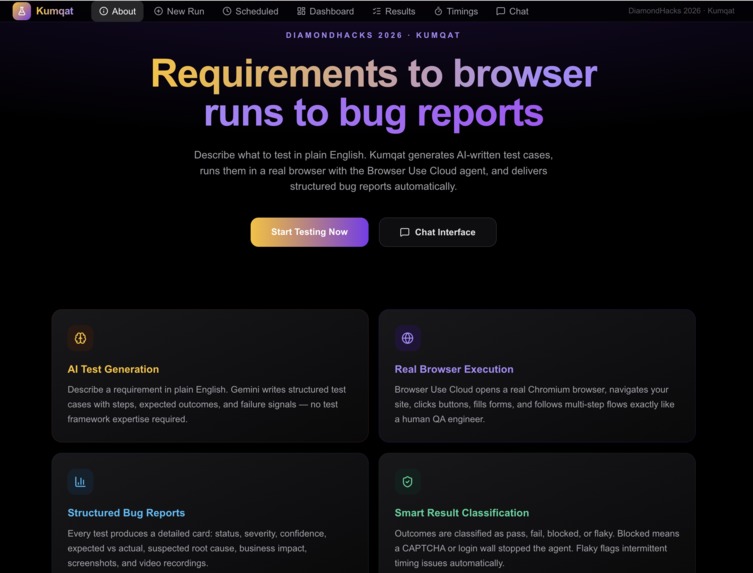
Landing Page
-
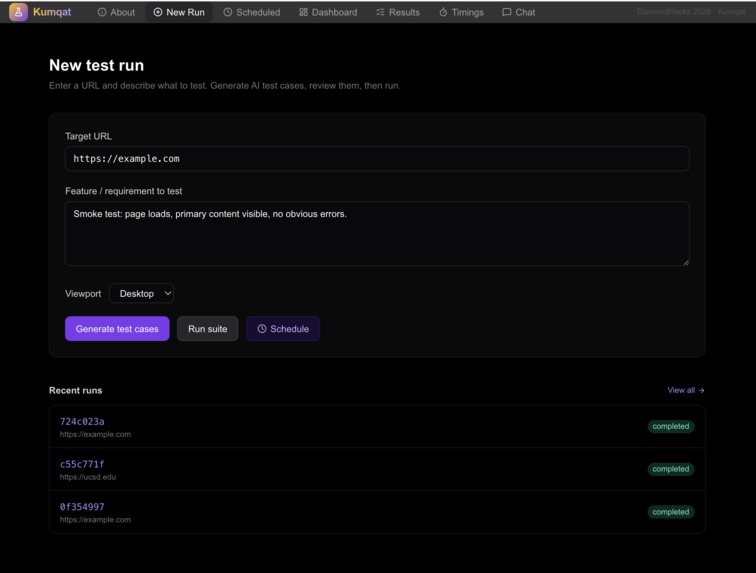
-
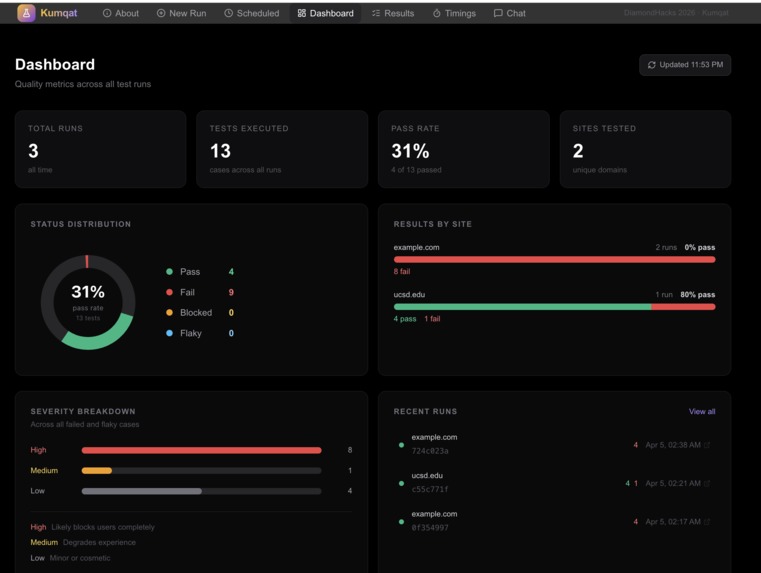
Dashboard Summary
-
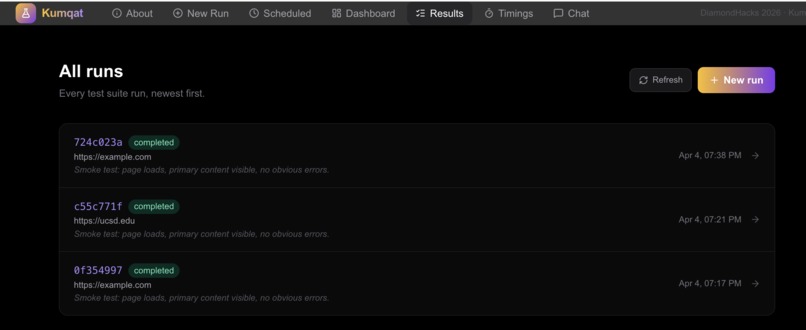
-
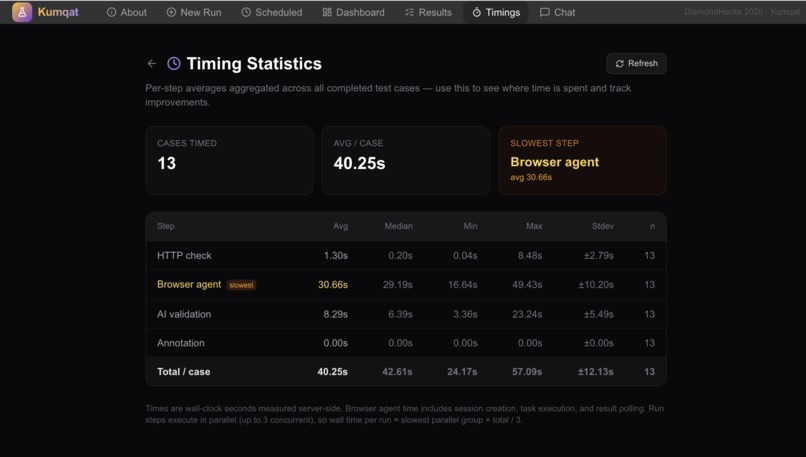
Timing Stats
-
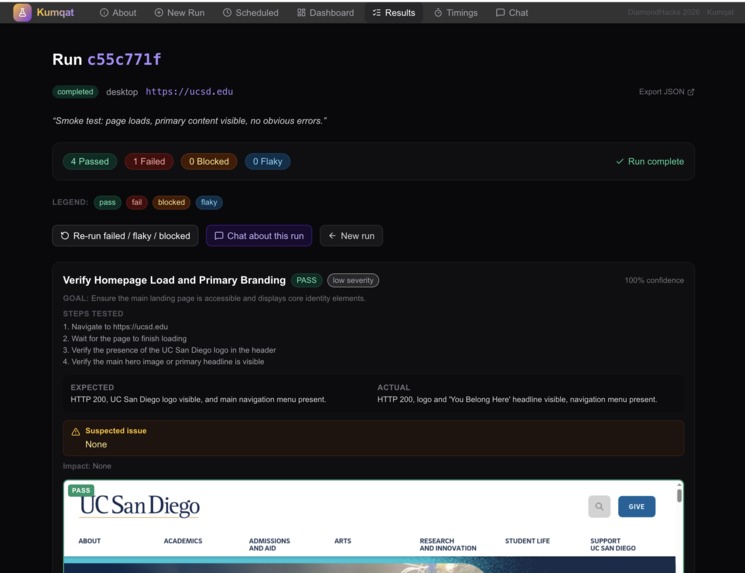
Sample Run Log
-
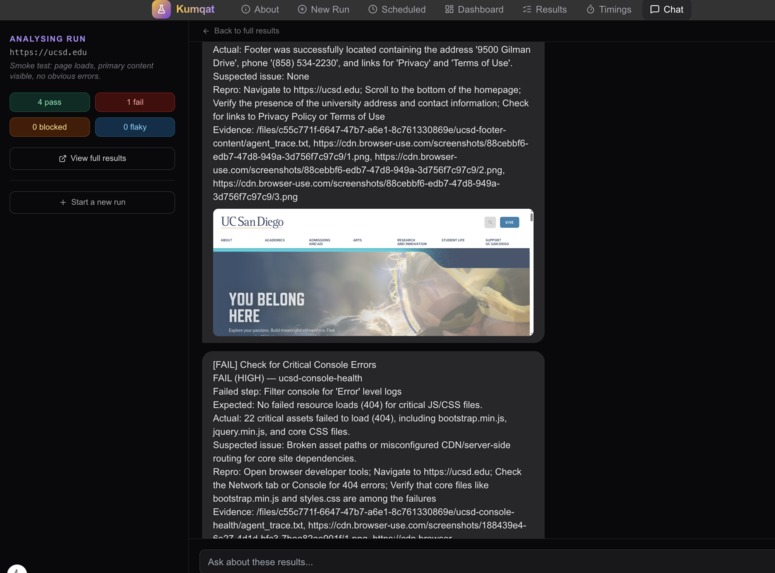
Sample Run Logs (2)


About Kumqat
Software teams move fast, but QA often becomes the bottleneck. At hackathons and in real product teams, we kept seeing the same pattern: features ship quickly, manual testing lags behind, and regressions are discovered too late.
We built Kumqat to change that workflow. Instead of writing tests from scratch, you provide:
- a target URL
- a plain-English requirement
Kumqat then turns that into an executable QA run and gives back structured, actionable results.
What Kumqat does
Kumqat is an AI-powered QA copilot for web apps that:
- generates structured test cases from natural-language requirements
- executes automated checks against the target site
- streams run progress live to the UI
- classifies outcomes as
pass,fail,blocked, orflaky - provides triage-ready result cards (expected vs actual, severity, confidence, repro context)
- stores history, supports reruns, and enables recurring scheduled runs
- adds an interactive chat/discuss mode to ask follow-up questions about a run
How we built it
We built Kumqat as a full-stack system with:
- Frontend: Next.js + TypeScript + Tailwind
- Backend: FastAPI + SQLModel + SQLite
- AI + Agent layer: Gemini for planning/validation/Q&A, Browser Use Cloud for autonomous browser actions
- Realtime architecture: Server-Sent Events (SSE) for live run updates
- Orchestration: async run pipeline with per-case lifecycle events and structured result persistence
Architecturally, we focused on an end-to-end QA loop:
- Requirement in
- Test plan generation
- Autonomous execution
- Structured validation
- Human-readable triage output
Challenges we faced
Building a trustworthy AI QA system required solving practical reliability issues:
- External websites can block automation with login walls, CAPTCHA, or WAF protections.
- Live progress needed to be stable and understandable even with partial/in-flight results.
- We had to distinguish real product failures from environmental constraints.
- We needed graceful fallbacks when keys/services are unavailable, instead of hard-failing the product.
A big design decision was making “blocked” a first-class status, so teams can clearly separate “the feature is broken” from “automation couldn’t access the flow.”
What we learned
This project taught us that useful AI products are not just about model calls:
- Structure beats raw output: developers need consistent, actionable result formats.
- Transparency builds trust: explicit statuses and evidence reduce ambiguity.
- Fallbacks are product features: robust degradation matters as much as best-case intelligence.
- UX is critical for AI tools: real-time clarity and explainability drive adoption.
What’s next
Our next steps are:
- deeper deterministic browser action coverage
- CI/CD integration for pre-merge QA gates
- stronger auth-aware testing workflows
- production scaling (shared queue/state and managed database)
Kumqat’s mission is simple: turn QA from a release bottleneck into a continuous, AI-assisted feedback loop.
Built With
- browser-use
- fastapi
- gemini
- javascript
- next.js
- python
- railway
- react
- sqlmodel
- tailwind-css
- typescript


Log in or sign up for Devpost to join the conversation.