-
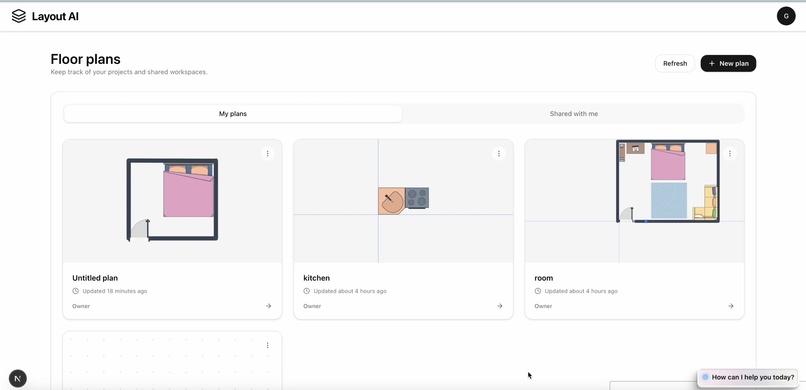
homepage

Inspiration
We saw a problem: over 80% of home design projects never reach a professional designer because tools are too complex or too expensive. Interior designers also spend up to 30% of project time redrawing client sketches into digital plans. This slows projects down and limits access for communities who need affordable housing solutions.
Our inspiration for Layout was to reduce those barriers. By combining AI with a simple canvas editor, we make floor plan creation as easy as sketching on paper while keeping designers fully in control.
What it does
Layout is a floor planning app that transforms sketches, scans, or LiDAR captures into editable, AI-assisted plans.
Automatic Floor Plan Generation
- Upload a photo, scan, or SVG. Layout detects rooms, walls, doors, and furniture and turns them into an editable plan.
Canvas Editor
- Drag walls, move furniture, resize rooms. Shared walls move together, with snapping and undo/redo built in.
Chat Agent
- Powered by CedarOS and Mastra, the agent can create, modify, or delete plan elements with simple prompts. Every suggestion is reviewed and approved by the user before it becomes part of the plan.
Sharing
- Users can generate links to share plans with others, making design collaboration simple and accessible.
How we built it
Frontend: Next.js + React (CedarOS template).
Backend: Supabase for authentication, storage, and database.
Editor: Vanilla JS infinite canvas, wrapped for integration.
AI Agent: Mastra connected through CedarOS, enabling structured edits like “add a window” or “resize bedroom.”
Data: Floor plans stored in a JSON schema describing nodes, walls, rooms, and openings.
Challenges we ran into
Input Quality: Low-quality scans made it hard to detect walls and openings reliably.
Geometry Editing: Shared walls are difficult to manage; moving one wall must also move its neighbor.
AI Reliability: LLMs sometimes mislabel rooms or misplace objects, which required a robust accept/deny system.
Performance: Parsing SVGs with many nodes slowed hit-testing, so we experimented with spatial indexing.
What we learned
We learned how to integrate CedarOS and Mastra so the AI agent stays useful but always under human control.
We learned how to design a JSON schema for floor plans that captures rooms, walls, doors, and objects in a way both the AI and editor can understand.
We learned the value of user trust: every AI-generated edit must be confirmed, otherwise errors compound quickly.
What's next for Layout AI
Real-Time Collaboration: Google Docs–style multi-user editing with sockets.
Better Input: Direct LiDAR integration and smarter scan parsing.
Professional Exports: Support for CAD/BIM formats.
Mobile-First Editor: Make floor plan editing possible directly from a phone or tablet.
Please check the Drive Link for the Demo Video
Built With
- cedaros
- mastra
- next.js
- react
- supabase
- tailwindcss
- typescript


Log in or sign up for Devpost to join the conversation.