-
-
Logo modeling a neural network, a model architecture ML-Labs excels at creating
-
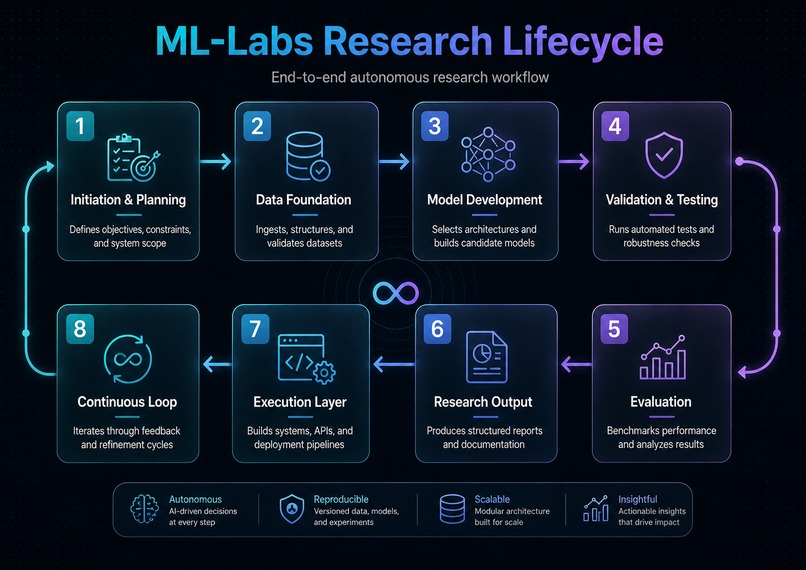
Diagram of ML-Labs research lifecycle, built to model the life cycle occurring at high-end, sophisticated research labs
-
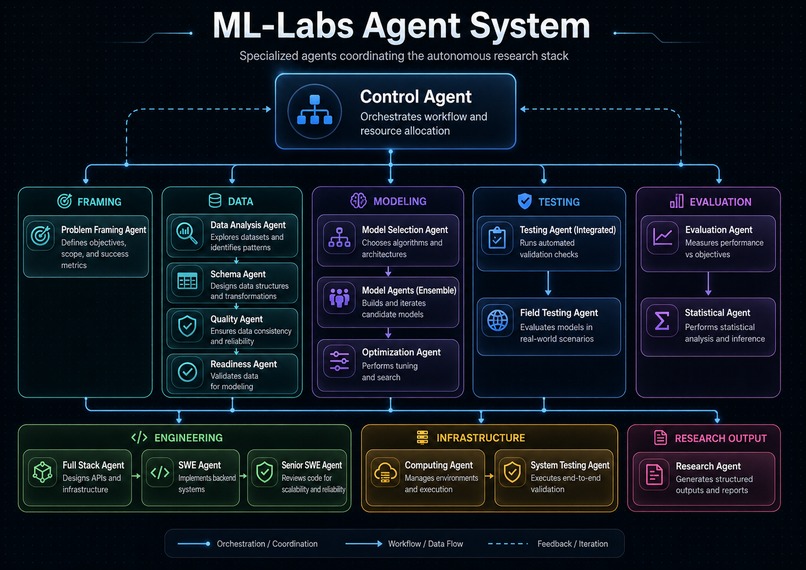
Diagram of ML-Labs multi-agent architecture, built using agents that model positions at real research labs with specialized skills/tools


Inspiration
ML-Labs came from a frustration I kept running into while building machine learning projects. The actual work of research was never just training a model. It was hours of finding usable data, cleaning broken datasets, debugging preprocessing, rerunning failed experiments, comparing results across tools, and trying to hold the whole workflow together manually. After enough late nights doing that over and over, I stopped wanting a better script or a better notebook. I wanted to build the lab itself.
A lot of this project was shaped by nights where nothing worked the first time. Models broke, pipelines failed, context got lost between stages, and small bugs would ruin full runs. But that was also what made the idea feel so necessary. The more time I spent rebuilding the same workflow by hand, the more obvious it became that machine learning research needed a more scalable architecture. That became ML-Labs.
What it does
ML-Labs is an autonomous machine learning research system that executes the full research lifecycle end to end.
It can source and ingest datasets, analyze and profile data, prepare features, design and run experiments, train and optimize models, validate results, generate visualizations, and package outputs into structured research artifacts and production-ready APIs. Instead of acting like a single assistant, it operates as a coordinated lab of specialized agents working across the pipeline.
What makes it especially powerful is that it is not built for one narrow task. It is built as a scalable research engine. The same architecture can support different datasets, workflows, and modeling problems without needing to rebuild the entire system every time. That shift from one-off pipeline to reusable autonomous lab is the core of the project.
How we built it
I built ML-Labs as a multi-agent system because real research is not one action. It is a chain of specialized decisions. A single model trying to do everything would not be reliable enough, modular enough, or scalable enough. So I split the workflow into specialized agents responsible for distinct phases like data sourcing, statistical analysis, experimentation, model training, validation, and reporting.
The hard part was not just building the agents individually. It was making them function as one coherent research system. I had to build shared context flow, execution logic, intermediate output handling, and failure recovery so that each stage could pass meaningful work to the next without the whole pipeline collapsing.
That took a lot of iteration. A lot of nights were spent debugging failing model runs, reworking how agents communicated, fixing edge cases in the workflow, and making the system more stable under real use. Over time, that process turned ML-Labs from an ambitious concept into a system with real architectural depth and real scalability.
Challenges we ran into
The biggest challenge was making autonomy actually hold up under pressure. It is easy to make a project sound advanced. It is much harder to make a system reliably carry context across multiple research stages, recover from broken runs, and still produce outputs that feel rigorous and usable.
Another major challenge was balancing scale with quality. I did not want a flashy system that could technically do many things but did none of them well. I wanted something that could scale across workflows while still feeling technically serious. That meant a lot of debugging, redesigning, and rethinking assumptions whenever the architecture looked good in theory but failed in practice.
A huge personal challenge was simply pushing through the repetition. Many of the hardest parts of this project were built during long nights of debugging models, tracing pipeline failures, and fixing one issue just to expose the next one. But that process is exactly what made the system stronger.
Accomplishments that we're proud of
What I am most proud of is that ML-Labs became more than a cool idea. It became a real autonomous system with enough scope to feel like infrastructure, not just a demo.
I am proud of how much of the ML workflow it actually covers. It does not stop at analysis suggestions or model generation. It handles the full arc from raw data to validated results and deployable outputs. That level of end-to-end automation is what makes the project feel ambitious.
I am also proud that the architecture is inherently scalable. Because the system is modular and agent-based, it can expand to new workflows, domains, and research tasks without needing to be rebuilt from scratch. That gives ML-Labs the potential to grow from a single project into a much larger research platform.
What we learned
I learned that the hardest part of serious ML work is often not the modeling itself. It is the infrastructure around it. The invisible work of sourcing data, coordinating steps, debugging runs, evaluating outputs, and keeping everything consistent is where enormous amounts of time get lost.
I also learned that if you want true autonomy, you need more than intelligence. You need structure. You need modular systems, clear interfaces, context continuity, and strong orchestration. Without that, even powerful models stay stuck as disconnected tools.
Most importantly, I learned that ambitious systems are built through iteration, not inspiration alone. A lot of the real progress on ML-Labs came from working through broken systems long enough to understand how to make them robust.
What's next for ML-Labs
The next step is pushing ML-Labs beyond workflow automation and deeper into autonomous scientific discovery.
I want to improve cross-agent coordination, strengthen experiment planning, add deeper memory across runs, and make evaluation more rigorous and adaptive. I also want to expand the system so it can support a broader range of machine learning problems while preserving the modular architecture that makes it scalable.
The long-term vision is for ML-Labs to become a true research engine: a system that does not just help with machine learning, but scales into an always-available lab capable of exploring questions, running studies, and producing serious results at a level that would normally require an entire team.
Built With
- ai
- api
- c++
- css
- kaggle
- luma
- ml
- multi-agent
- netlify
- next.js
- node.js
- numpy
- pandas
- python
- react
- render
- scikit-learn
- tailwind
- typescript
- vercel


Log in or sign up for Devpost to join the conversation.