-
-
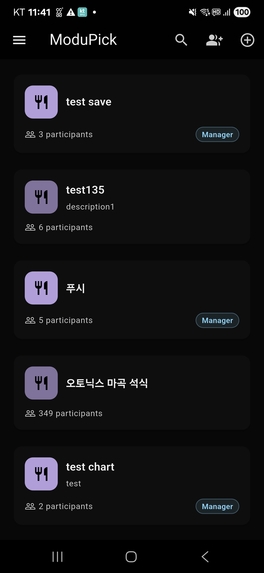
group list
-
-
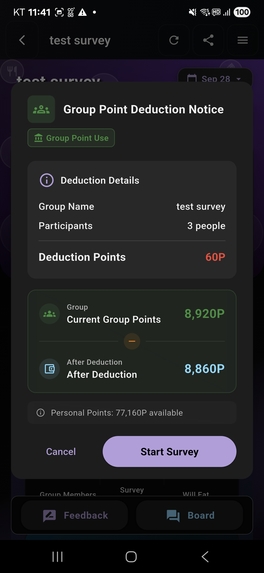
used point view before survey
-
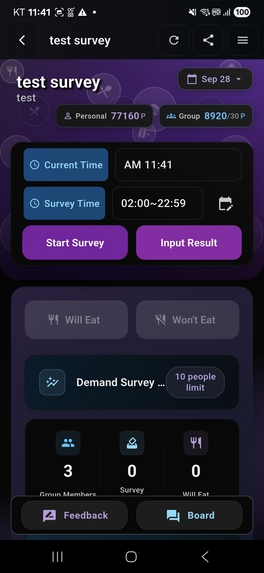
group manager
-
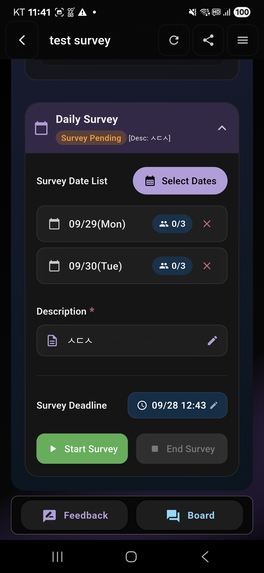
start survey
-
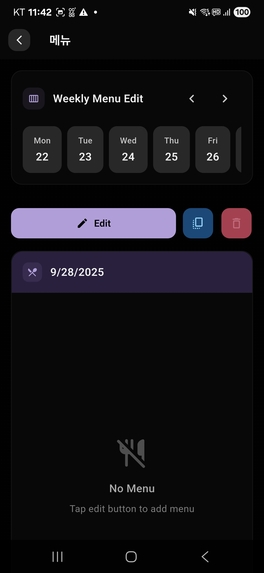
edit menu
-
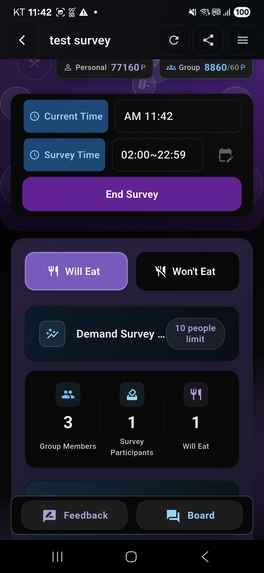
-
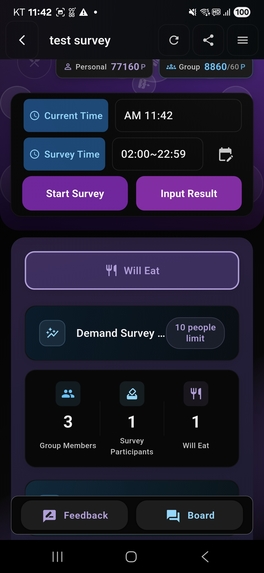
survey finish
-
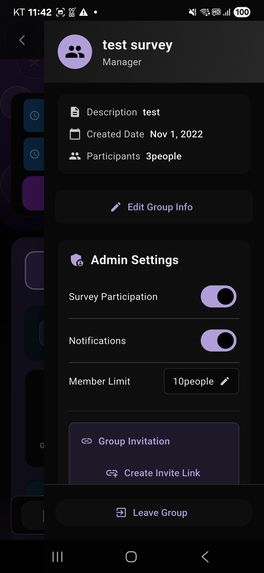
group settings drawer
-
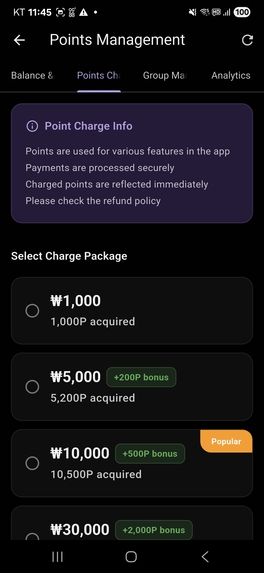
charge points


Inspiration
At our company, the number of employees joining dinner changes daily, making it difficult for the dietitian to prepare meals accurately. Previously, headcounts were collected manually via group chats, which often led to missing data or inaccurate estimates.
We wanted to reduce this inefficiency and provide a smoother way to manage demand surveys while also opening the door for future use cases.
What it does
Meal Demand Survey: The dietitian can start a survey with a time limit. Around 300 employees receive a push notification and can respond directly.
Auto-Response by Day: To minimize effort, employees can pre-set weekday responses (e.g., “Yes on Mondays”), which are automatically submitted when a survey starts.
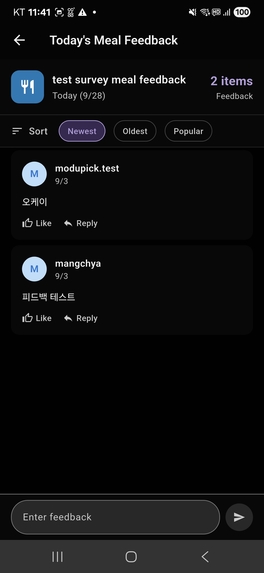
In-App Communication: A bulletin board and feedback section replace the cafeteria’s physical whiteboard, enabling transparent and real-time communication.
Point System with Payments: Each survey deducts points from group administrators, who recharge through a payment system.
Beyond meal surveys, we envisioned templates for other internal activities. One example is a Tournament Template:
Announce team-building or gaming events.
Track real-time match results.
Share outcomes, feedback, and discussions through an integrated board.
We believe this template could also be useful in workshops and general group activities, where participants can form their own groups and engage seamlessly.
How we built it
Built with Flutter, enabling cross-platform deployment.
Backend integrated with Firebase for authentication, push notifications, and real-time data handling.
Payment and point system implemented to sustain usage and ensure accountability.
Challenges we ran into
Engagement: Many users were reluctant to even click once for participation, which inspired the auto-response feature.
Accuracy: Ensuring valid data when representatives were absent or missed the deadline.
Payment Integration: Balancing usability, transparency, and security in the point system.
Scalability of Templates: Designing the system so that additional templates (like tournaments) can be added without restructuring the core app.
Accomplishments that we're proud of
Reduced manual effort and errors in meal demand prediction.
Successfully introduced an auto-response mechanism that significantly increased participation.
Built a modular design that can support multiple use cases beyond surveys.
What we learned
Even small daily inefficiencies, when scaled, create big problems.
Automating routine actions (like preset weekday responses) can greatly improve adoption.
A modular system design allows rapid extension into new domains (like tournaments or workshops).
What's next for ModuPick
Tournament Template: Enable team announcements, live score updates, result sharing, and feedback within the app.
Workshop & Group Activities: Extend templates for team-based events beyond the company, making ModuPick usable in any organization.
Analytics & Insights: Provide historical participation and engagement data to administrators for better planning.
Built With
- apis
- cloud-firestore
- cloud-messaging
- firebase-authentication-for-login
- for
- hosting)-database:-firebase-cloud-firestore-(real-time-nosql-database)-apis-&-integrations:-firebase-cloud-messaging-for-push-notifications
- in-app
- languages-&-frameworks:-flutter-(dart)-for-cross-platform-mobile-development-cloud-services:-firebase-(authentication
- payment
- point


Log in or sign up for Devpost to join the conversation.