-
-

Journal Entries
-
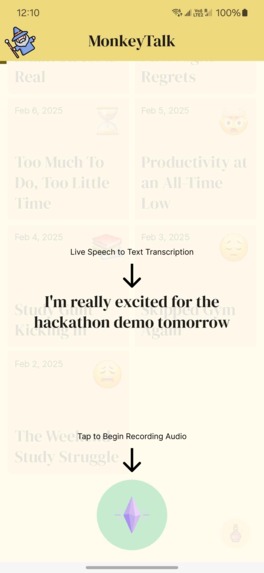
Voice Memo
-
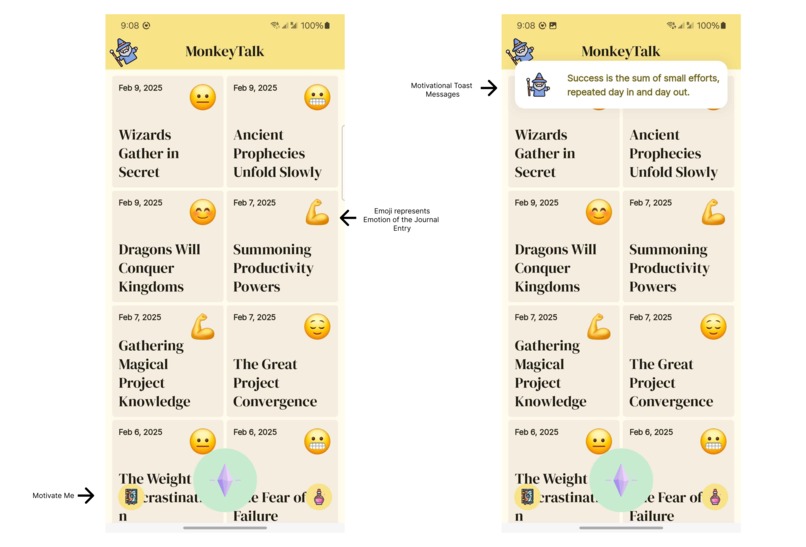
Positivity Reminders


TRACK: "The Sanctuary"
Inspiration
The main motivation for MonkeyTalk was mainly due to rise in stress and burnout on young adults. To help people with self-reflection and keep in track of healthy habits, Journaling is a great way to make a change, but it can be tedious and time-consuming.
What it does
We introduce MonkeyTalk, which converts your audio logs to text and builds a cohesive journal entry per day. We made it with a whimsical interface to keep journaling fun and engaging.
We deployed language models on our local machine to give context-aware suggestions for a positive impact in users life, because of the nature of local language models, personal data stays within the device.
How we built it
We started by experimenting with Python for rapid prototyping and data handling. We integrated a local instance of Llama (version 3.2, 3B parameters) for natural language processing and generation. To manage vector embeddings and enable robust similarity search, we employed FAISS, which allowed us to quickly and efficiently retrieve relevant text segments. We used LangChain to facilitate RAG (Retrieval-Augmented Generation) workflows, ensuring that our system could provide personalized suggestions based on user-provided entries.
We combined all of these on the backend with Flask, serving as a lightweight API layer for both the RAG engine and the locally hosted Llama model. For the frontend, we turned to Flutter to build an Android application, giving us cross-platform capabilities if we choose to expand later. Finally, Figma played a crucial role in our design process, helping us visualize and refine the user experience before writing a single line of code.
Challenges we ran into
One of the biggest hurdles was optimizing the local LLM for consistent performance on less-powerful machines. Balancing speed and accuracy required tuning model settings and carefully managing hardware resources. We also faced challenges ensuring secure on-device data storage while still allowing enough access for the app’s analytics.
Another key challenge was designing intuitive prompts for the LLM—through prompt engineering—to yield contextually relevant responses without overwhelming the user. Lastly, stitching together various frameworks (FAISS, LangChain, and Flask) introduced integration complexities that required careful testing and debugging.
Accomplishments that we're proud of
Automatic Journal Creation: Successfully converting daily audio logs into text and generating cohesive journal entries for each day. This streamlines daily reflection without manual input. Real-Time Positive Suggestions: Implementing dynamic prompts to motivate users in a friendly, proactive way. Privacy-Centric Architecture: Storing all data on-device or on a locally hosted server ensures user privacy and ownership of personal information.
What we learned
Building a fully local, privacy-first AI solution taught us a lot about resource management and architecture design. We learned how to optimize inference for smaller LLMs while maintaining sufficient context and quality. We deepened our understanding of prompt engineering, discovering how critical prompt design is to producing relevant and engaging outputs.
What's next for MonkeyTalk
Looking ahead, we plan to enrich MonkeyTalk’s capabilities with a more holistic approach:
- Expanded Data Integration: Incorporate data from fitness trackers, location services, and calendars to generate highly personalized insights and habit recommendations.
- Local LLMs in Multiple Languages: Provide inclusive access for non-English speakers by training or integrating local models in various languages, ensuring everyone can benefit from private AI journaling.
- Gamification & Achievements: Encourage consistent use and goal achievement through badges, milestones, and friendly challenges, bringing an element of fun to the daily habit of journaling.
- Anonymous Support Groups: Introduce optional peer-to-peer or group features that allow users to share progress and maintain accountability By continuing to emphasize user privacy, local inference, and an engaging user experience, we aim to transform MonkeyTalk into a go-to journaling assistant that seamlessly fits into daily life.



Log in or sign up for Devpost to join the conversation.