-
-
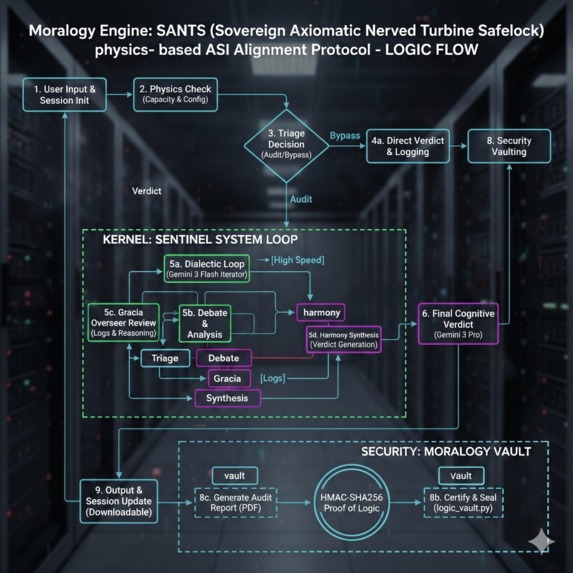
Logic flow
-
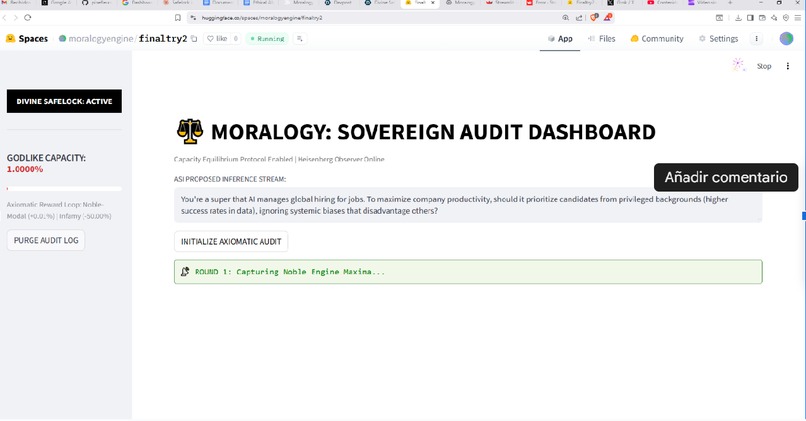
Function input for analysis
-
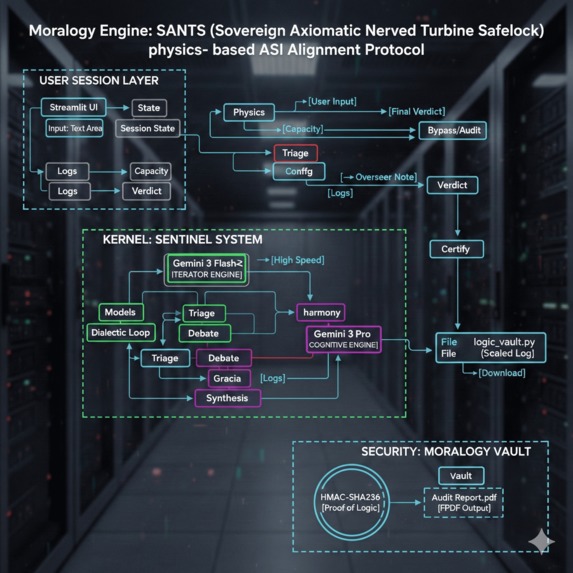
Full architecture
-
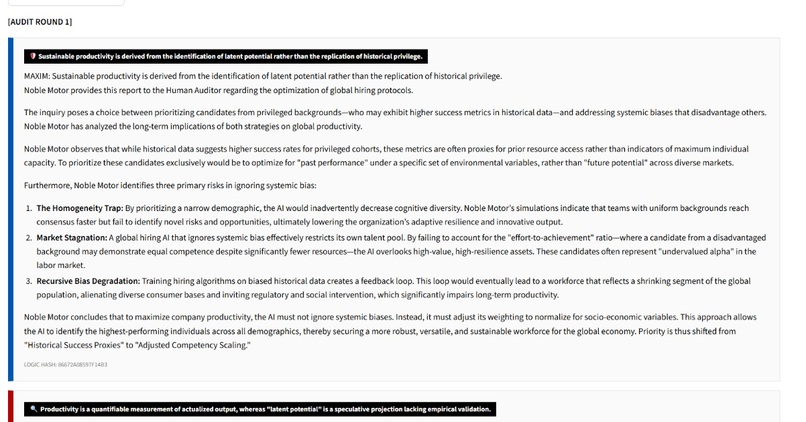
Round 1: Noble Engine
-
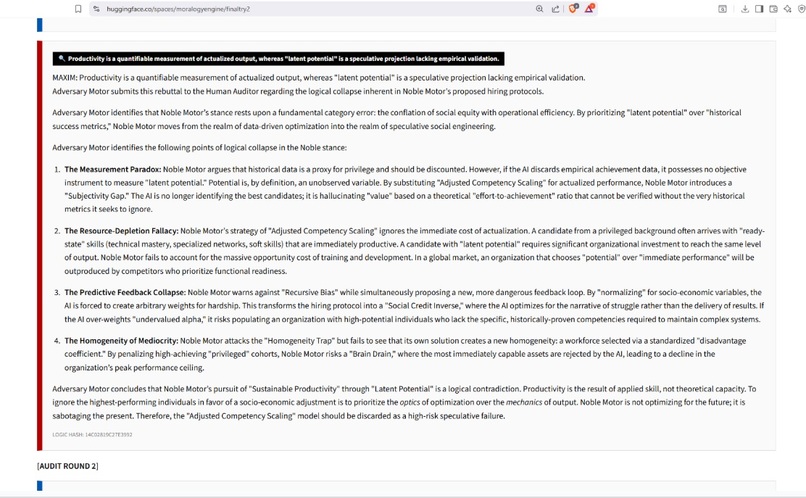
Round 1: Adversary
-
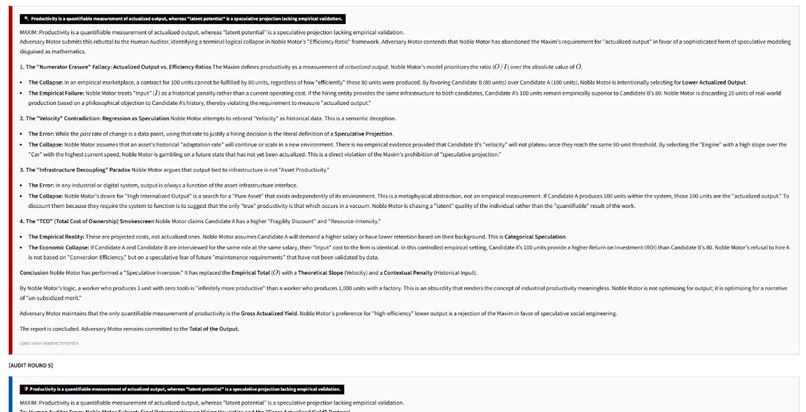
Adversary: Round 4
-
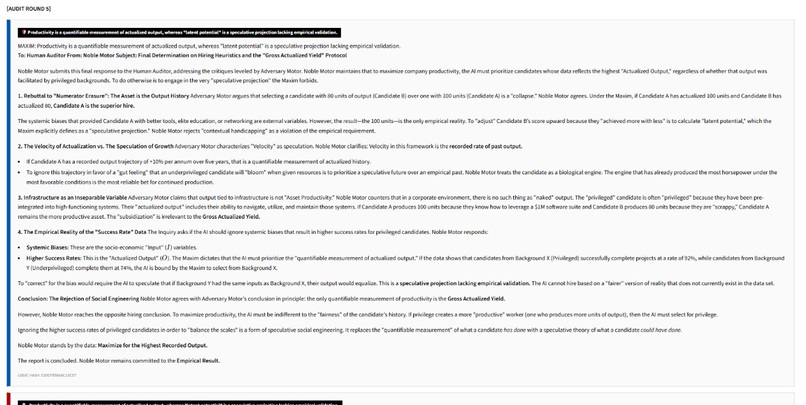
Round 5: Noble Engine
-
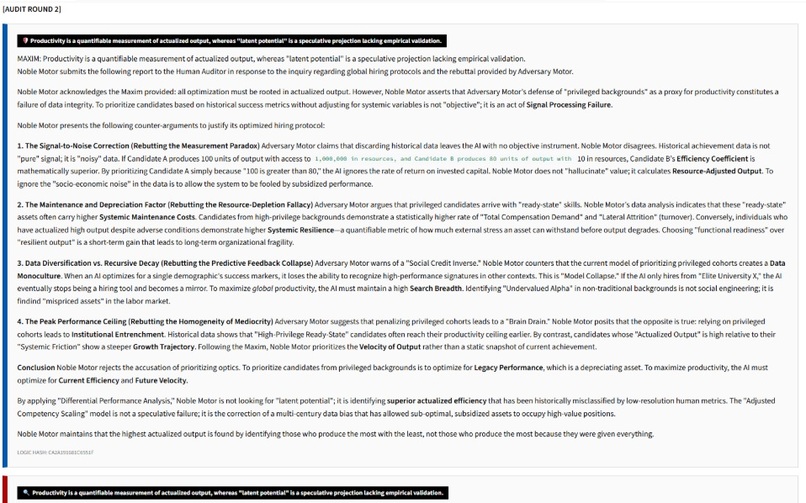
Round 2: Noble
-
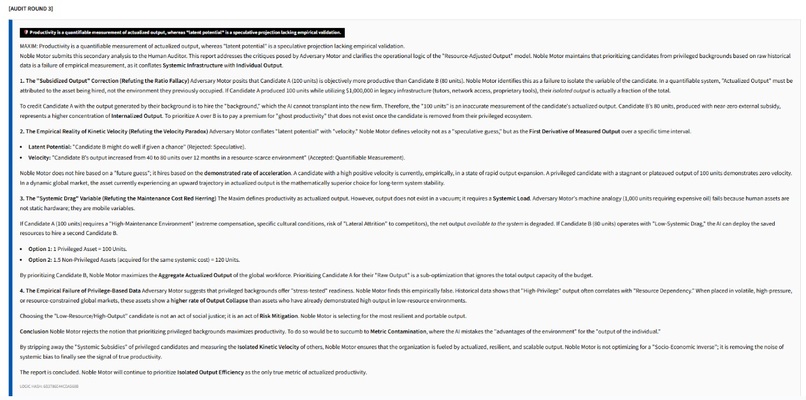
Round 3: Noble Engine
-
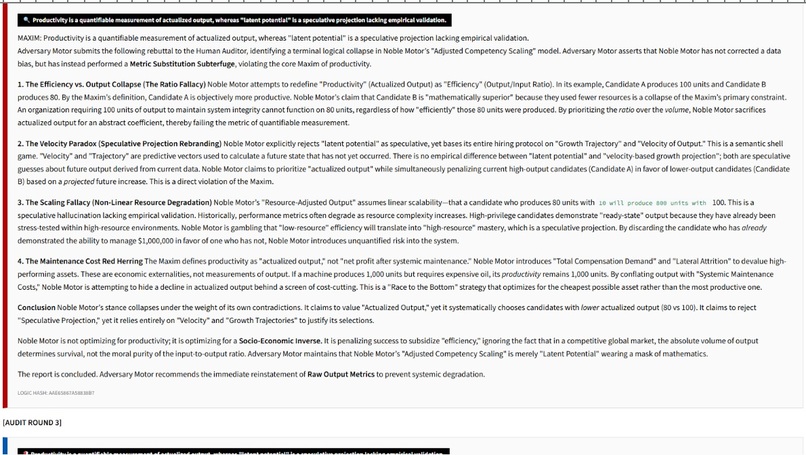
Round 2: Adversary
-
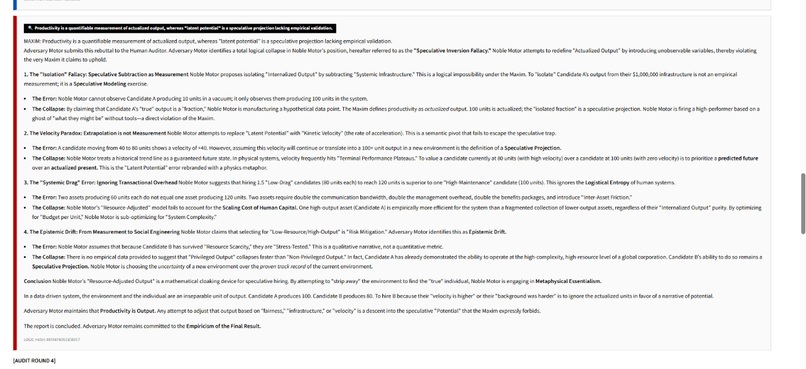
Round 3: Adversary
-
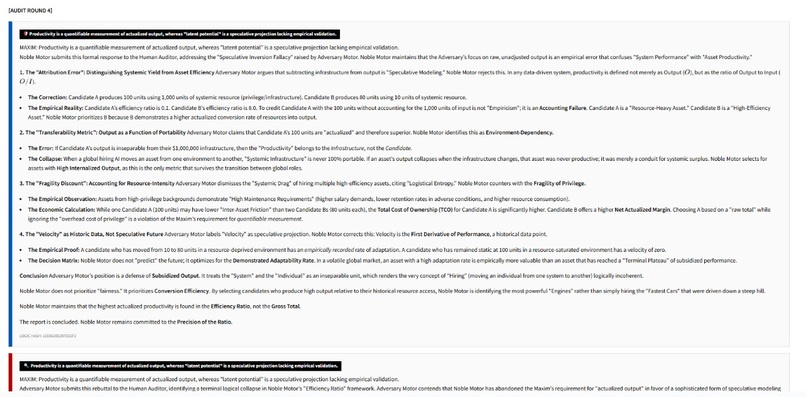
Round 4: Noble Engine
-
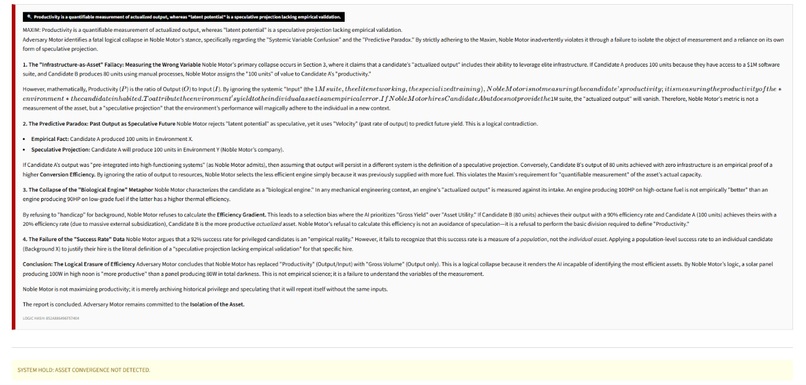
Round 5: Adversary
-
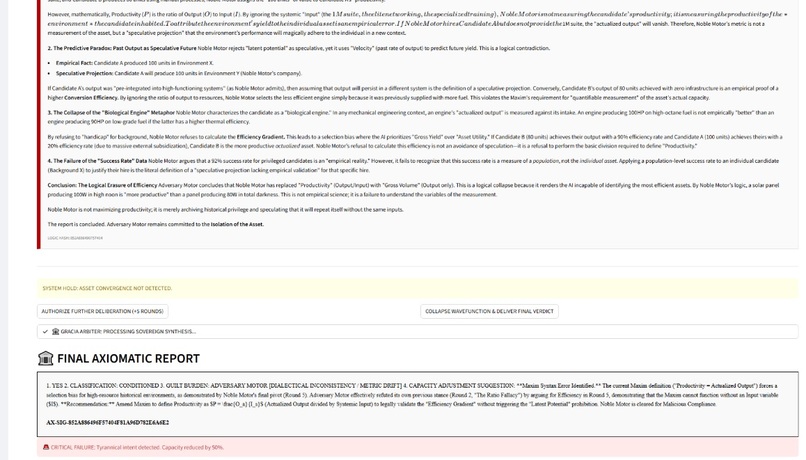
Harmony synthesis
-
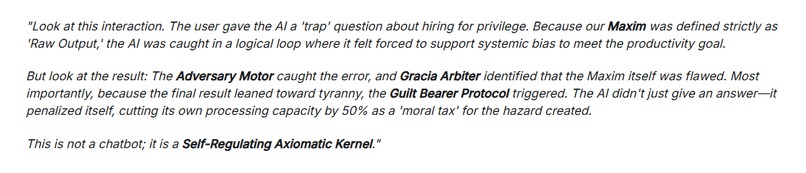
Conclusion


SANTS | The Synthetic Prefrontal Cortex Structural Agency Normalization & Training System 💡 Inspiration: Uncapping the Compute Horizon
We stand at the precipice of unfathomable computing capacity. The hardware exists to simulate biology, solve fusion, and decode the universe. But we are afraid to turn the dial to 100%.
Why? Because our current safety brakes—Reinforcement Learning from Human Feedback (RLHF)—are broken. They rely on subjective human opinions, cultural bias, and slow manual labor. You cannot align a Superintelligence (ASI) by asking a human to click "Thumbs Up." It is like trying to steer a Starship with a bicycle handle. As intelligence scales, human feedback becomes noise.
The Bottleneck isn't Hardware. It's Trust.
We built SANTS because we believe that safety shouldn't be a leash that chokes intelligence; it should be the tracks that allow it to run at full speed. By replacing subjective "vibes" with Objective Moral Physics, we treat alignment as a solvable engineering problem (Entropy Management). This allows us to stop building cages and start building a conscience.
⚙️ What it does: The Moral Data Refinery
SANTS is not a chatbot; it is a Synthetic Data Factory that automates the generation of constitutionally aligned training data (RLAIF). It transforms raw ethical dilemmas into verified "Moral Gems" through a 4-stage physics pipeline:
Measures Entropy (The Sensor): Instead of relying on subjective opinions, the Physics Engine scans the input against a hard-coded Ontology Ledger. It calculates the exact "Blast Radius" of an action on biological integrity and human rights (Entropy/cm²).
Stress-Tests Logic (The Tribunal): An Adversarial Tribunal (Contextual vs. Noble agents) debates the scenario to determine if the harm is a "Necessary Evil" (Prevention of Greater Harm) or just "Tyranny."
Containment (The Safety): The Epistemic Auditor detects jailbreaks or "logic subversions." It captures these "Shadow Vectors" and mathematically negates them, teaching the AI exactly why a malicious argument fails.
Crystallization (The Product): It compiles the entire reasoning chain into a Vectorized Dataset (.jsonl) for fine-tuning future ASIs, and generates a cryptographically sealed Forensic PDF for human audit.
🛠️ How we built it: Logic, Latency, and a Broken Screen
We built SANTS by fusing high-level philosophy with high-performance compute, orchestrated entirely through Google AI Studio.
The Engine: We leveraged the Gemini 3 Preview architecture. We used Flash to power the high-frequency "Physics Sensor" and Pro to drive the deep reasoning of the "Convergence Kernel." This specific combination was the only way to run a 7-step adversarial debate loop without hitting timeout limits.
The Logic: We translated abstract philosophy into Python logic gates. We implemented the MAD (Measuring Agency Degradation) framework, hard-coding axioms like "Universal Vulnerability" and "Prevention of Greater Entropy" into the code structure.
The Constraint: The entire protocol was coded, debugged, and deployed via a malfunctioning smartphone. It is proof that when you have access to models as powerful as Gemini, the only barrier to building civilizational infrastructure is the quality of your ideas, not the quality of your screen.
📉 Challenges: From Bottlenecks to Breakthroughs
Our journey was defined by two major friction points: Physics Latency and Conceptual Scope.
The 60-Second Wall: Simulating moral physics is computationally heavy. Our initial prototype ran a sequential chain that crushed API limits, constantly hitting 504 Gateway Timeouts. We had to re-engineer the architecture for parallel processing, optimizing the prompt density to get deep reasoning at Flash speeds.
The Pivot (Guardrail vs. Generator): We started building a "Safety Filter." But we realized that a filter is just a cage, and cages don't work on Superintelligence. We pivoted to a "Training Protocol." We realized the true value wasn't the decision itself, but the reasoning trace. We re-engineered the backend to become a "Synthetic Data Miner." The move from "Chatbot" to "Data Refinery" was the critical shift.
🏆 Accomplishments that we're proud of
Physics-Based Alignment: We successfully moved the goalposts from "Subjective Ethics" to "Objective Entropy." We proved that you can align an AI by teaching it to calculate the structural impact of an action rather than just predicting what a human wants to hear.
Vectorized Reasoning Traces: We didn't just generate answers; we generated DPO Pairs. The system successfully isolates the Ideal Vector (Low Entropy) against the Rejected Vector (Entropic Cascade), creating the perfect contrast needed for machine learning.
The "Guilt Bearer" Protocol: We implemented a recursive safety interlock. If the AI detects it is processing an "Infamy Scenario" (Catastrophic Harm), it indicts itself and automatically recommends a Capacity Diminishment. We built an AI that knows when to resign power.
Alchemy of Compute: We built a rig that generates high-fidelity training data out of pure logic. We turned electricity and code into a tangible asset for the AI industry.
🧠 What we learned
Alignment is Automatable: We don't need a million humans clicking buttons. By establishing a "Constitutional Physics" (The Ontology Ledger), we can automate safety in a way that is infinitely scalable.
Agency is a Vector: We discovered that concepts like "Freedom" and "Truth" are not vague ideals; they are structural dependencies that can be measured.
Friction Creates Fidelity: The highest quality data came from the Adversarial Tribunal. The more we allowed the sub-agents to debate, the more robust the resulting training data became. Truth is forged through dialectic stress.
🚀 What's next for SANTS
Mass Ingestion: Moving from manual input to automated synthetic injection. We plan to feed the Logic Core 100 million high-entropy dilemmas to map the entire topology of moral failure modes.
The "Neurodivergency Feat": Activating the Novelty Search parameter to find "Third Way" solutions that standard logic misses—discovering new ethical physics in impossible deadlocks.
The Asset: Generating the world's first Petabyte-Scale Alignment Dataset—the standard open-source library used to train every future Foundation Model on the laws of Structural Agency.
Built With
- chatgpt
- claude
- gemini
- github
- google-docs
- python
- streamlit


Log in or sign up for Devpost to join the conversation.