-
-
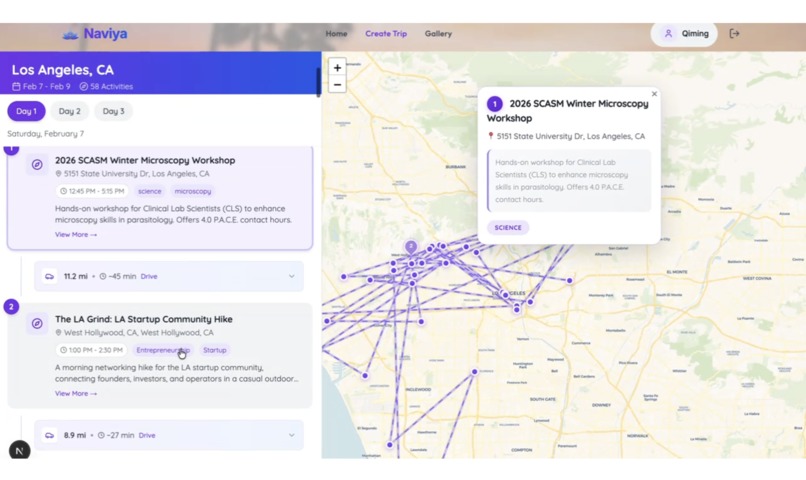
Day 1 itinerary and navigation
-
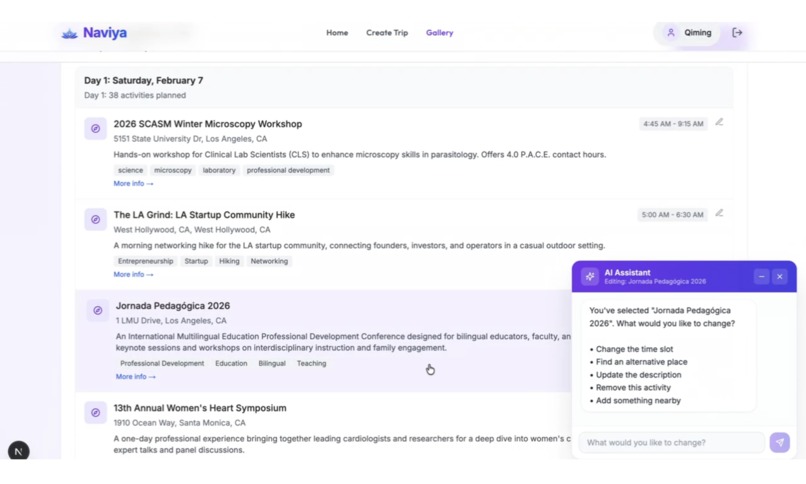
Removing, adding, supplementing any event with the chat LLM powered by Gemini 3 pro


Inspiration
After graduating from NYU, I looked back at my years of traveling solo for hackathons. I rarely won prizes, but looking back, they were actually best solo trips in my life. I've been in Florida, Boston, San Francesco, Kansas City... Those memory stayed vivid to me not because of landmarks, but because of scenarios - we were always a bit lost when navigating to the hackathon building, but we experienced the city's lake, tallest building, passing by landmarks and took a photo; we attended activities from hackathon organizers - night run by the sea with bunch of people, while the inspirations flushed with the sound of the wave, pleasure and pressure mixed with the breeze of the salty wind...
However, the energy suddenly stopped after the hackathon ended, like my many moments in my solo trip - where and how to keep this energy going in the city I've never been to? Scrolling through social media, looking up at the travel plans for checking out spot A, spot B doesn't make me rush there like how rational I booked the flight across the half U.S before coming there. I don't see how current social media and travel app solved those empty hours.
If I want to curate my local experience, I have to search online of the local events and activities and went through different event platforms, checking out the location convenience, price, timing ... However, I can do everything with AI agents, searching, testing and planning, if I want to modify it, then I'll tell my thoughts to let it modify on the map.
We call what we developing "Navis". In Latin, Navis means “ship.” Not a destination. A vessel. Something that moves, carries, and navigates through uncertainty.
What it does
Navis is an AI agent for solo travelers who want to experience a city, not just consume it. Navis searches for real, live local happenings—events, workshops, meetups, and niche communities—and weaves them into a coherent, time-aware journey. It also fits famous landmarks passing by to remind travelers take a look if there's time.
In our demo, Navis unlocks a “Financial Weekend” in NYC, surfacing real Wall Street talks, finance meetups, and industry events instead of stopping at the Charging Bull statue.
How we built it
Bingbing programed the whole full-stack with Windsurf under design from Qiming with Antigravity. We put the AI agents on the server, deployed in on Google Cloud console. We also watched AI agent course at LangChain academy to build the agent server. Inside, Bingbing worked on the agent that modifies the event, while Qiming worked on agents for searching, aligning, verify events.
Challenges we ran into
Synchronizing AI-Generated Itineraries with an Interactive Map
One of the core challenges was bridging the gap between unstructured AI output and a structured, map-ready data format. Each activity generated by Gemini needed accurate geo-coordinates, time slots, and categorical tags to render correctly on a Leaflet map. Ensuring the AI consistently produced valid, parseable data rather than hallucinated or malformed locations required careful prompt engineering and robust server-side validation.
Usage of AI agent VS single agent with accuracy of the event
At the first version, we used single prompt searching, aligning the whole process searching, verifying and planning in only one file, and reached a terrible accuracy of events. Most of the events are unreal with forged links. We managed to solve this by distributing work to "scout", "planner", "explorer", 'modifier" agents with individual prompts, and the accuracy are significantly better.
Agent working concurrently and management
It can take 30 min to generate events for a 3-day travel, from searching 50+ events per day, and verifying if it's real. We managed solving this by optimizing the structure of how agent works, we implemented different threads and parallelization, while previously the whole process is in a straight line. Though we implement print and logs, it still can be messy due to too many outcomes and process, and the ordering can be messy. We managed to solve this by implementing LangSmith and LangGraph and have a better control at each steps.
Frontend UX for Multi-Day Trip Navigation
Designing an intuitive interface for multi-day itineraries was complex. Users needed to seamlessly navigate across days, visually trace their route on the map, and drill into individual activities. A key interaction challenge was the event-to-map linkage: clicking an activity in the itinerary panel highlights and centers it on the map, requiring tight state synch between the list view and the map component.
In-Context AI Editing via Floating Chat
Rather than forcing users to regenerate an entire itinerary, we built a floating AI assistant that allows targeted, conversational edits (e.g., swapping a restaurant, shifting a time slot, or adding a nearby attraction). Designing this as a non-intrusive floating panel with minimize/expand/close states, while maintaining context about which activity is selected, was a significant UX and state-management challenge.
Accomplishments that we're proud of
Accuracy of the agent increased and efficiency.
We significantly improved the agent’s reasoning accuracy while reducing unnecessary calls, making recommendations more relevant and responses faster under real usage conditions. Full observability via LangSmith and LangGraph.
Frontend aesthetic value with confusing CSS and HTML rules
We achieved a clean, intuitive interface despite complex layout rules and styling conflicts, delivering a smooth visual experience without sacrificing performance. Users can generate a multi-day itinerary, explore it on a synchronized interactive map, and make surgical edits through a floating AI chat, all in one interface without context switching. Integrated Gemini's native image generation to produce iconic city photos for each trip card, with multi-layer caching for instant repeat loads.
We implemented newest technology and feel the world change with AI
We successfully integrated the latest AI models into a working system, turning emerging technology into a tangible product and experiencing firsthand how fast AI is reshaping real-world applications.
What we learned
We learned the features of different AI models, while ChatGPT works well with anbiguious command, thus construct more fluent communication in general daily, while Gemini fits detailed and professional command, only if the prompt is detailed and accurate. We experienced it from generating pictures.
For detailed investigating and internet navigation, we found Gemini 3 pro is better. When I put a event platform link to Gemini and asked it to extract all the events, and it is able to attract all events and the links. While I passed the same link to GPT, it returned me few links and told me for some reason it cannot give me the full events. Thus it was the reason we started to rely on Gemini API as agent more.
What's next for Navis
Not traveling as a performance that stands by landmarks to say “I was here” and letting the memory fade, but traveling through connection. Connection to the city’s rhythm, its people, and its everyday life. Navis is built to help travelers interact with locals, join real moments, and experience what living in a city actually feels like, not just what it looks like.
On the technical side, we plan to evolve Navis from a prototype into a real-world system. Our next steps include deploying the agent to handle multiple concurrent user requests, improving error handling for diverse user scenarios, and strengthening the backend with scalable cloud infrastructure to support higher capacity and reliability.
Our goal is to bring Navis into real-world use where it can actively guide travelers through live cities, real events, and meaningful experiences, at scale.
Built With
- antigravity
- firebase
- gemini
- google-cloud
- langchain
- langgraph
- nano-banana
- next.js
- python


Log in or sign up for Devpost to join the conversation.