-
-
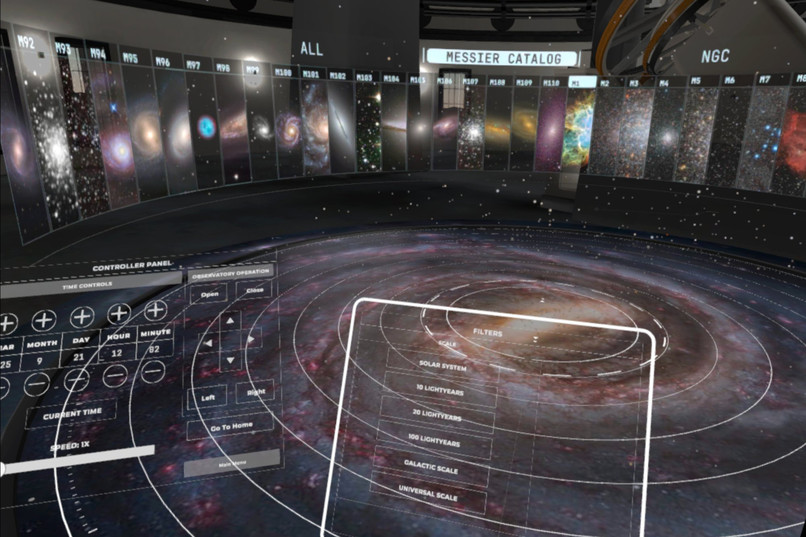
Close up of the cosmic navigator
-
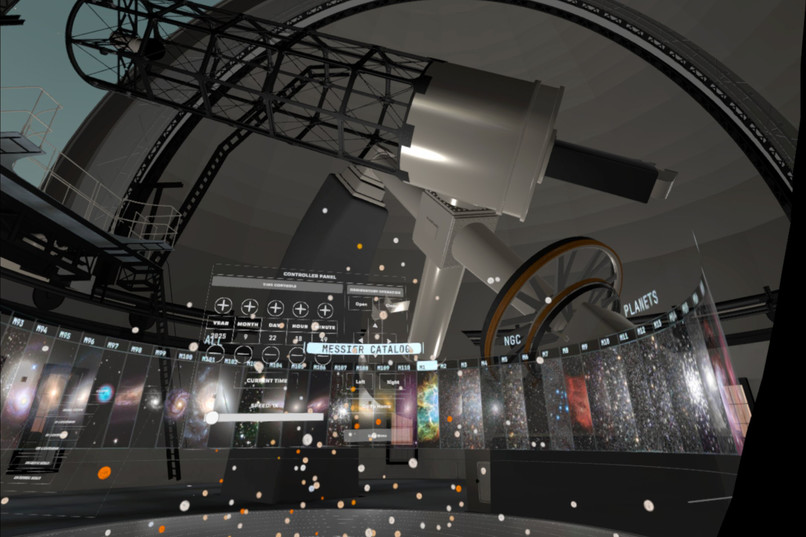
Cosmic navigator with the Plaskett telescope
-
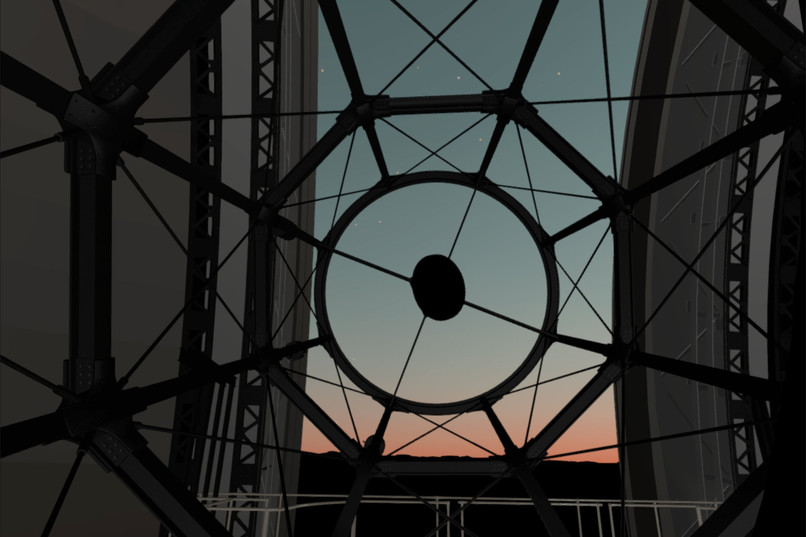
In the scope looking out
-
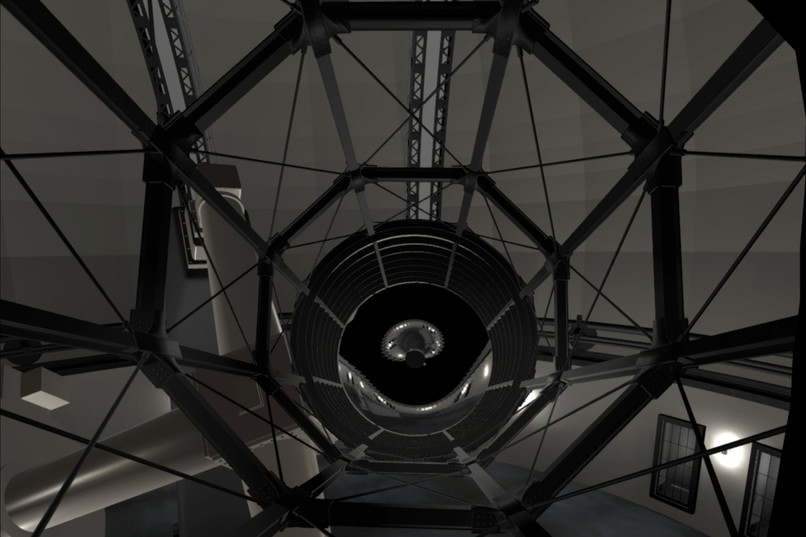
In the scope looking at the mirror
-
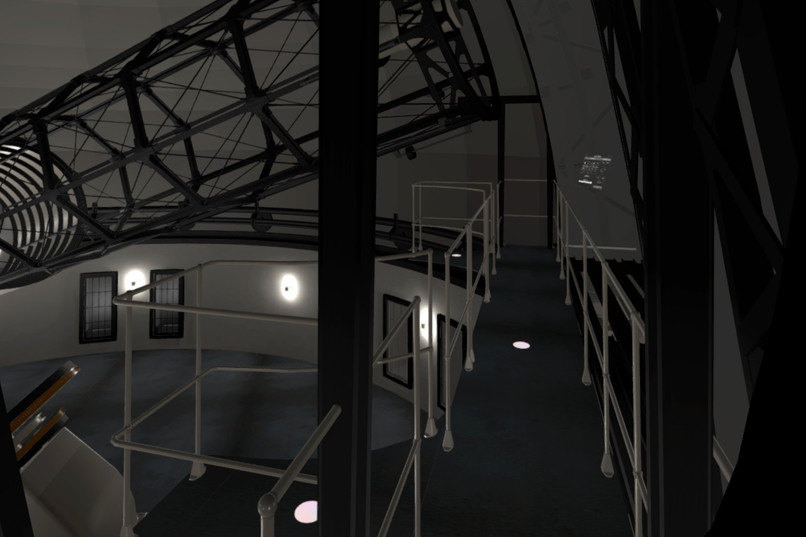
Platform shot
-
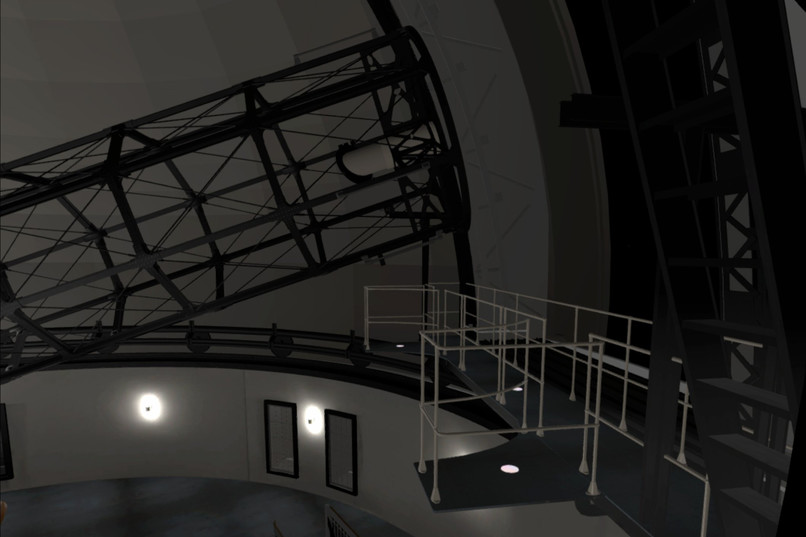
Another platform shot
-
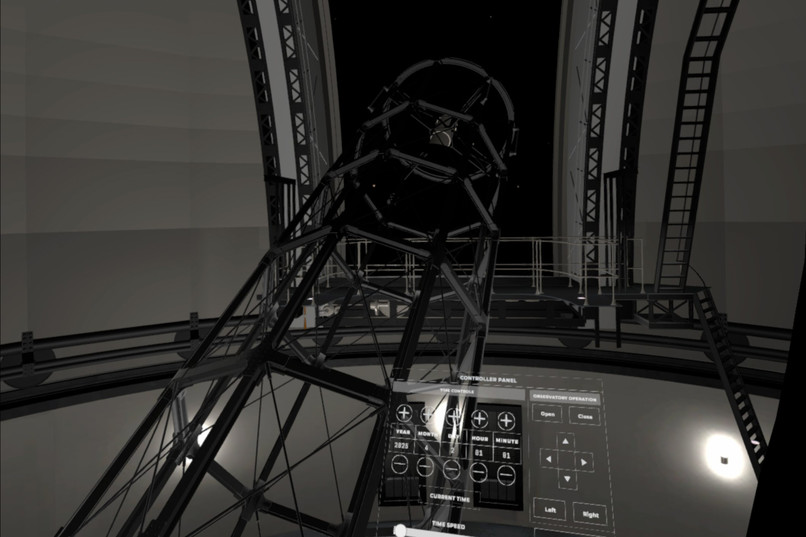
Looking down the scope to outside


Inspiration
Night Simulator grew out of my passion for nature, the night sky, and our search for meaning in the cosmos. As a Saturday night telescope operator at the Dominion Astrophysical Observatory (DAO) in Victoria, BC, I’ve had the privilege of working with a historic instrument that embodies human determination to explore. That experience—seeing how we point precise machines at faint, distant objects—shaped the app I’ve been building for the past 2.5 years. I wanted to create a virtual environment where people can truly understand what they’re looking at and where it sits in the universe, combining practical telescope skills with a “god’s-eye” view of deep sky objects and our place among them.
The Experience
This work is meant to fill a gap in how we learn about the universe. Many of us get a brief introduction to the Solar System as kids, but never really see where we are in the Milky Way, or that our galaxy is just one among billions. This experience brings that perspective forward. Users can see the night sky both from the ground and from a “pulled back” view, explore how telescopes and mounts work, understand what they’re actually pointing at, and locate those objects within a larger 3D map of the cosmos—all in a clear, visual, and approachable way.
How I built it
 The project started with on‑site research at the Dominion Astrophysical Observatory (DAO). A conversation about updating their visitor media led to a collaboration with the former NRC Victoria director and access to the observatory’s VR efforts. Over multiple visits, I used a Mavic Air drone, a digital laser measure, iPhone scans, archived images, and original blueprints to build a precise digital twin in Blender. Later, after receiving clearance and training to operate the DAO telescope for Saturday night star parties, I was able to capture detailed workflows, reference photos, measurements, ambient audio, and the control software UI. All of this informed the Unity implementation: a DAO‑inspired environment, telescope, and dome built on the XR Interaction Toolkit, with AI language models assisting in implementing and checking complex astronomical calculations based on work like Jean Meeus’s algorithms. Visual direction and UX/UI flow were developed in collaboration with an art director.
Read a longer version of the build process here.
Challenges
One major challenge has been bringing the project to a clear, presentable state while bootstrapping everything myself. I’ve had no external funding, so every step—from research and modelling to programming interactions—has been done in spare time around other commitments. Hitting the level of quality and authenticity I’m aiming for takes a lot of iteration, and it’s been difficult to balance that with also trying to define a strong visual identity. For a long time I tried to handle the art direction myself on top of the technical work, which slowed things down. Hiring a creative director to help with the cover art and UI/UX was a huge level‑up and showed how much faster the project can move when I delegate and outsource specific parts of the work.
The other ongoing challenge is finding a partner with the right mix of skills and passion. Good game and VR/AR developers are already rare; finding one who also cares deeply about astronomy and education is even harder. This project is driven by a desire to create an experience I haven’t yet found in existing apps—something that captures what I’ve seen in reality, but with a shorter, more visual learning curve. Building that largely solo means progress is steady but slower than the vision.
What’s next for Night Simulator
The current demo is a foundation: a single observatory site, a DAO‑inspired telescope, and core interactions that connect the ground‑level view to a pulled‑back cosmic perspective. The next step is to turn that foundation into a fuller learning platform. With additional funding, I would:
- Deepen the core experience with guided observing tracks (seasonal highlights, lunar/planetary nights, beginner “first light” paths) that tie telescope use directly to understanding where objects live in the larger cosmos.
- Expand and polish the content by outsourcing more 3D art, animation, and UI/UX work, freeing my time to focus on systems, interactions, and accuracy.
- Introduce multi‑user “star party” modes, where a facilitator can guide small groups through shared observing experiences, mirroring real DAO outreach nights but accessible from anywhere.
- Build tools for educators and outreach teams to create simple controls and dashboards for configuring sessions, tracking progress, and aligning VR experiences with their programs.
- Invest in accessibility and comfort by adding features like one‑handed modes, adjustable contrast/color presets, and additional comfort options.
The goal is to move from a detailed prototype to a sustainable platform for practical astronomy education and cosmic perspective—something that individuals and institutions can rely on to prepare people for their first real night under the stars.



Log in or sign up for Devpost to join the conversation.