-
-

Nudge Pet
-
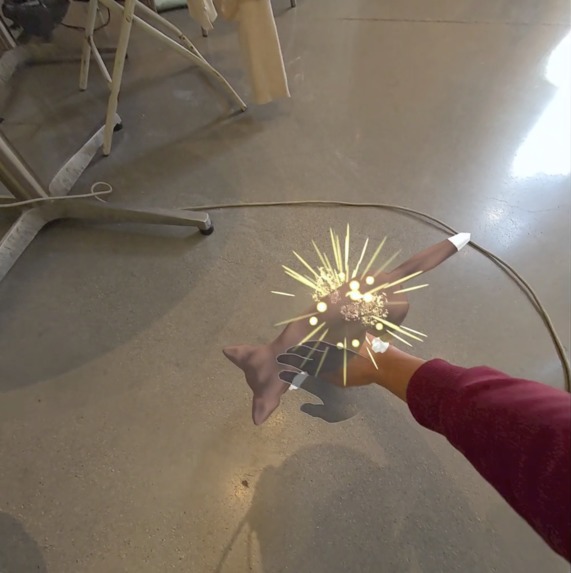
petting dog


Inspiration
Our team was inspired by the growing need for accessible mental health support in our increasingly digital world. We recognized that while emotional support animals can be incredibly beneficial for managing stress, anxiety, and other mental health challenges, not everyone can own or care for a real pet. This realization led us to conceive NudgePet, a mixed reality solution that brings the benefits of emotional support animals to anyone with a mixed reality device.
What it does
NudgePet is a mixed reality widget that runs in the background of spatial activities, providing users with a virtual emotional support animal. Using Electrodermal Activity (EDA) sensors, NudgePet monitors the user's stress levels and emotional state. When it detects heightened stress or negative emotions, the virtual pet - in our prototype, a dog named Snuffles - appears to provide comfort and guide the user through emotional regulation exercises.
How we built it
- Mixed Reality Development: We used Unity and the Mixed Reality Toolkit to create the virtual pet and its interactions within the user's environment.
- Biometric Sensing: We integrated the EmotiBit sensor to measure Electrodermal Activity (EDA) and heart rate variability (HRV).
- Emotion Recognition: We developed algorithms to interpret the biometric data and determine the user's emotional state.
- Pet Behavior: We programmed different behaviors for the virtual pet to respond appropriately to the user's emotional state.
Challenges we ran into
- Accurate Emotion Detection: Interpreting biometric data to accurately determine emotional states was challenging, especially for more nuanced emotions.
- Real-time Response: Ensuring the virtual pet responded promptly to changes in the user's emotional state without lag was technically demanding.
- Natural Pet Behavior: Creating pet behaviors that felt natural and genuinely comforting required multiple iterations and user testing.
- Integration of Hardware and Software: Seamlessly integrating the biometric sensors with the mixed reality environment presented several technical hurdles.
Accomplishments that we're proud of
- Creating a responsive virtual pet that reacts in real-time to the user's emotional state.
- Successfully integrating biometric sensing technology with mixed reality.
- Developing a system that can potentially make emotional support more accessible to a wider audience.
- Designing an intervention that is both subtle and effective in helping users regulate their emotions.
What we learned
- The intricacies of emotion recognition through biometric data.
- The potential of mixed reality in mental health support.
- The importance of user-centered design in creating effective digital interventions.
- The challenges and opportunities in combining hardware sensors with software applications.
What's next for NudgePet
- Refine emotion detection algorithms for greater accuracy.
- Expand the range of pet behaviors and interventions.
- Implement AI to allow the pet to learn and adapt to individual users over time.
- Conduct user studies to measure the effectiveness of NudgePet in real-world scenarios.
- Explore partnerships with mental health professionals to integrate NudgePet into therapeutic practices.


Log in or sign up for Devpost to join the conversation.