-
-
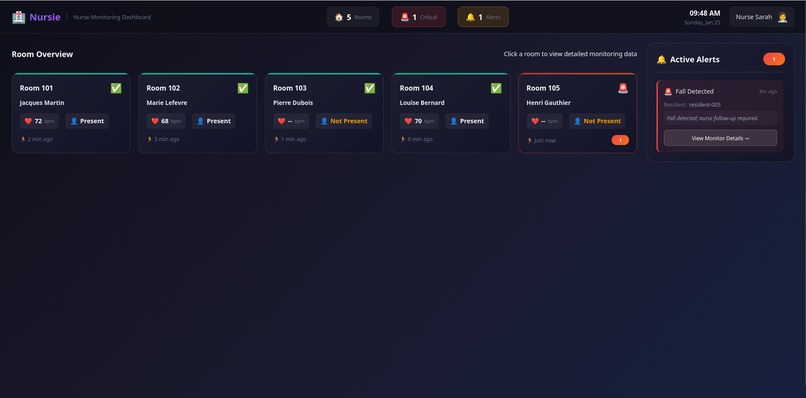
Dashboard

Building an “AI Nurse” for Long-Term Care: mmWave Fall Detection + Sensor Fusion + Voice Support
Falls among older adults are a major public-health issue in Canada. They’re a leading cause of injury-related hospitalizations and deaths for people 65+, and the trend is moving in the wrong direction. National surveillance data shows fall-related hospitalizations for older adults rising 47% between 2008 and 2019 (from 49,152 to 72,392). :contentReference[oaicite:0]{index=0}
On the mortality side, the burden is also climbing (e.g., 5,581 older adults died due to a fall in 2019, and deaths due to falls increased strongly in recent years). :contentReference[oaicite:1]{index=1}
In Québec long-term care settings (CHSLD), the problem is often amplified by two realities:
- Falls can happen unwitnessed (especially at night).
- Staffing shortages can delay assistance.
Those delays matter. When someone remains on the floor for a prolonged period (“long lie”), the complications can be severe—hypothermia, dehydration, tissue damage, rhabdomyolysis, pressure injuries, kidney failure, and more. :contentReference[oaicite:2]{index=2}
This post explains our prototype system: an AI nurse assistant that combines privacy-preserving room sensing, wearable vital signs, and a voice interface, all connected through a local on-site network.
TL;DR
We’re building an on-premises assistant for long-term care that:
- Detects falls using mmWave radar + a floor vibration mat
- Tracks context with door open + presence/occupancy
- Monitors vital signs via a smartwatch
- Sends immediate alerts (phone call + dashboard) to staff on emergencies
- Builds a resident profile over time in MongoDB to flag unusual behavior (e.g., leaving the apartment at night)
- Provides a voice interface for residents (questions, appointment reminders, medication prompts)
Design Principles
1) Fast, reliable detection > fancy features
If a fall is detected late, the system fails its core mission. Our priority is high confidence + fast alerting.
2) Sensor redundancy to reduce false positives
No single sensor is perfect:
- Radar can confuse some edge cases (e.g., abrupt sitting, blankets, furniture occlusion).
- Vibration sensors can trigger on dropped objects.
- Wearables can be off-wrist or missing.
So we fuse signals to improve confidence.
3) Privacy by architecture
We keep everything inside the facility’s LAN:
- No “always-streaming camera”
- No raw data leaving the network by default
- Local processing wherever possible
System Overview
At a high level:
*Room module Ipad *: the “AI nurse” endpoint in the resident room for voice interaction.
mmWave radar: continuous position/activity sensing + fall detection
Floor vibration mat (prototype currently cardboard): detects “impact/vibration signature” when something hits the floor
ESP32 sensor nodes running FreeRTOS:
- ESP32 #1: vibration mat sensor → ROS 2 messages
- ESP32 #2: door magnetic sensor + PIR presence sensor → ROS 2 messages
Wearable (smartwatch): heart rate monitoring (vital signs)
Local network: our own router flashed with OpenWRT, hosting a private LAN for all devices
Backend + Dashboard
- Emergency alert workflow: call nurse + dashboard alert
- Resident behavior profile + anomaly detection stored in MongoDB
- AI workflow (Gemini + ElevenLabs + webhooks)
- ElevenLabs posts
send_eventwebhooks to the backend over HTTPS - Gemini triages transcripts into structured priority / intent / summary
- The backend persists triage + events in MongoDB
- Triggers escalations when critical
- ElevenLabs posts
Challenges we ran into
- Integrating mmWave radar was difficult due to environmental noise; distinguishing a human heartbeat from a moving curtain required careful signal-processing tuning.
- We had to solve “Connection Errors” in our live telemetry stream so the dashboard stays updated even when local Wi-Fi fluctuates.
Accomplishments that we're proud of
- A system that is compliant by design with Québec’s privacy framework (Law 25 / Act respecting the protection of personal information in the private sector).[^5]
- A local AI agent that can differentiate between a “soft landing” on a bed and a critical fall on the floor.
- Bridging the gap between hardware (LiDAR, Radar) and a professional-grade nurse dashboard that prioritizes alerts.
What we learned
- The importance of Edge Computing—processing data where it’s collected to maximize privacy and speed.
- As mechanical and software engineering students, we learned that the best medical tech is “invisible”: it provides the most protection when it requires the least intervention from the user.
- We gained deeper insight into the ethical implications of AI in geriatric care.
What's next for Nursie
- Refine our Apple Watch integration as a secondary “gold-standard” validator for high-risk patients.
- Explore predictive models that analyze gait patterns to estimate fall risk before the first fall occurs.
- Scale the hardware into a sleek, medical-grade casing that can be deployed across CHSLDs throughout Québec.



Log in or sign up for Devpost to join the conversation.