-
-
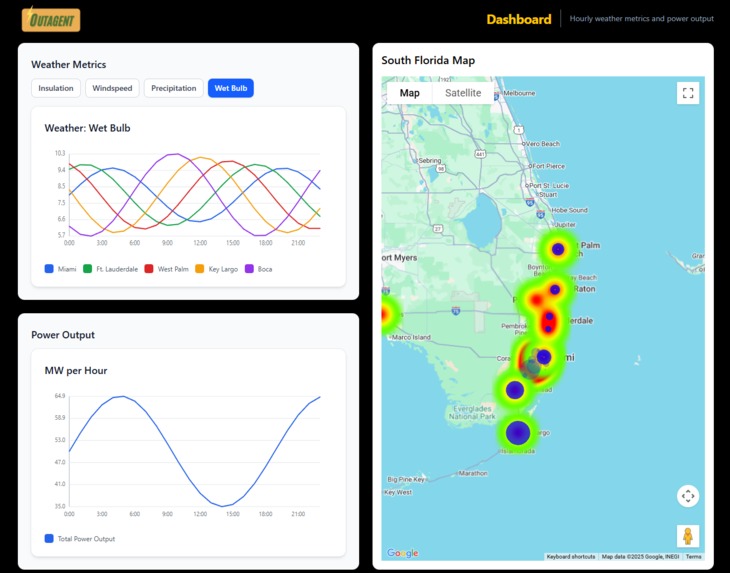
In the progress of trying visualizing it
-
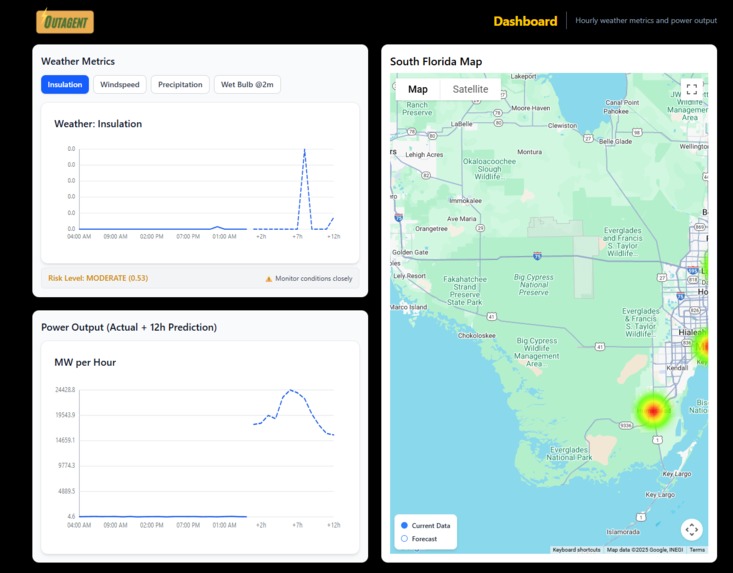
The showcase of our project


INSPIRATION
The idea came from our own frustrations living in South Florida, where power outages happen often—especially during hurricane season. When the lights go out, it usually feels like forever before we get clear updates or see progress. We noticed that the way companies like FPL handle outages can be slow, centralized, and not always responsive to what’s happening on the ground in real time.
That got us thinking: What if there was a way for us to know when an outage was going to happen by knowing how likely it is to occur? Instead of a reporting system, how about a predictive model that assesses the risk of outages in South Florida, allowing families and first responders to brace for powerless days and nights. It's adaptive, efficient, and keeps families safe.
WHAT IT DOES?
Outagent is a decentralized outage-forecasting system powered by machine learning models such as LightGBM trained on weather and electric demand data sourced from prominent providers (FPL, NASA, etc.) to allow the user to know what the probability risk of an outage is based on demand and inclement weather conditions.
There are two models, each trained on respective data sources.
The first is the weather model, which trains on parameters such as wet bulb temperature, wind speed, precipitation, insulation, and humidity. The model provides us with up to 12 hour predictions, which is then wired to a line chart in the frontend.
The second is the demand model, which trains on electric demand data within FPL's range of service (in megawatts). The model provides us with up to 12 hour predictions, wired to a line chart in the front end.
HOW WE BUILD IT
Backend FastAPI + Uvicorn → lightweight Python backend serving APIs for data and risk analysis. Requests → pulls live data from weather, flood, and infrastructure APIs. Pandas + NumPy → for data cleaning, transformations, and numerical processing.
Machine Learning scikit-learn → trains quick ML models for outage risk predictions. Joblib → saves and loads trained models for reuse.
External Data Sources
- NOAA API → real-time weather and storm alerts.
- FEMA API → flood zone and hazard maps.
- OpenStreetMap Overpass API → infrastructure data such as substations and power lines.
- EIA API → national energy infrastructure and consumption data.
Frontend
- React → interactive dashboard showing outages, risks, and grid health.
- Visualizes maps, alerts, and real-time risk levels from the agents.
Core: Python → used for backend services, agents, and machine learning pipelines.
- We plan to integrate some form of agentic automation and A2A architecture, further streamlining the process and reducing the need for human interpretation of data
Challenges we ran into
Challenges we ran into were mostly with backend logic regarding the models and data engineering.
Accomplishments that we're proud of
We built two working ML models with real data Connected live APIs Made a working React dashboard Finished in less than 36 hours
What we learned
What we learned was that models, especially LightGBM, are incredibly sensitive to outliers, and prompted us to cleaning and engineering the data further
What's next for Outagent
- Integrate satellite imagery (NASA EarthData) for better environmental context
- Develop a mobile app with push notifications for outage alerts
- Implement continuous retraining with live data feedback
- Collaborate with local utilities (FPL) and emergency services
- Expand to other high-risk regions across the U.S.
- Add autonomous A2A agents for 24/7 monitoring and self-updating predictions
Built With
- a2a
- duckdb
- fastapi
- geopandas
- google-adk
- google-auth
- google-cloud
- httpx
- lightgbm
- numpy
- pandas
- pyarrow
- pydantic
- pyproj
- pytest
- pytest-asyncio
- python
- rasterio
- requests-mock
- scikit-learn
- shapely
- tenacity
- uvicorn
- xgboost


Log in or sign up for Devpost to join the conversation.