-
-
Panda Wheels promo image
-
Interaction menus


Inspiration
We are a team of tool-builders, and we were inspired by the idea of creating an experience that would give the hackathon judges an opportunity to become hackers themselves for a few minutes.
What it does
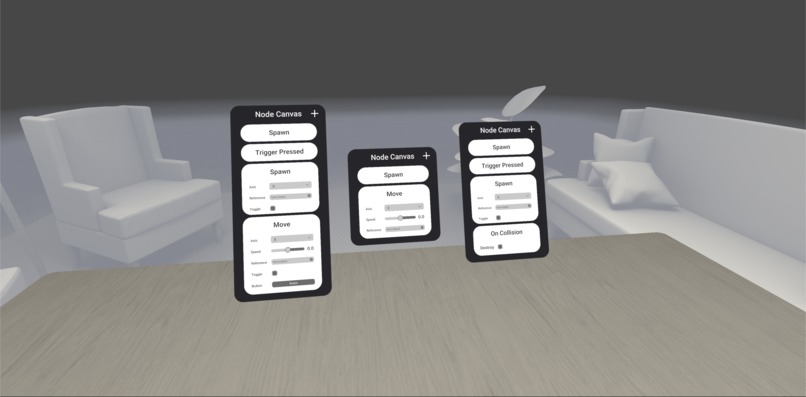
Panda Wheels is a new take on a VR prototyping application. It lets users rapidly build interactive VR experiences while inside a VR environment, enabling them to become fully immersed in the design process by eliminating the need to constantly don and remove a headset. Unlike other VR sandbox tools, Panda Wheels has a robust WYSIWYG editor for behavioral logic and interaction design. Codeless option panels make creating new objects, defining their behavior, and simulating that behavior as easy as clicking a few buttons. Not only do users get an immediate understanding of live object mechanics, but they are also actually able to adjust these mechanics in situ.
How we built it
We built Panda Wheels in Unity from scratch, basically only using existing functions and mostly writing our own custom functions in C#. We split up the work across team members and held regular brainstorming sessions to clearly define the end user experience we wanted to create. There were many lively debates about the best ways to implement certain functionality, how to make the object logic settings as intuitive for the user as possible, and whether or not the best illustrative use case for this tool would be watching someone build their own version of Beat Saber.
Challenges we ran into
As in any hackathon, we ran into a wide variety of challenges at MIT Reality Hack 2023 - the first of which was coming up with an idea! We changed our concept entirely between day 1 and day 2, and one big difficulty was distilling and crystallizing our vision for the final product as well as restricting the scope to something we thought was possible to build within our remaining time. Another challenge that we overcame on the first day was just getting all of our borrowed hardware up, running, and connected so that we could develop for it.
It was also a significant challenge to architect the app in a way that is modular and extensible. Our vision is to give the user a large number of options for codeless interaction design, and while we couldn’t build more than a few of them during this hackathon, we took extra care to figure out and write code that future Panda Wheels developers can easily reuse to add new behaviors. We also had to really think through and playtest what a standardized interface between an object and all of its possible behaviors should look like.
Accomplishments that we're proud of
We are incredibly proud of what we were able to pull together in only one day of dedicated work! We each improved our technical skills over the course of designing and implementing all the nitty gritty details that went into this project, and we're excited to take those learnings with us when we leave the MIT Media Lab today.
What we learned
We were a bit overambitious on parts of this project and learned that simple user experiences often take a great deal of complex planning on the back end. We learned to help each other troubleshoot problems and really put ourselves in the end users' shoes when making design decisions. We also learned the importance of good organization in all things, from coding to teamwork.
What's next for Panda Wheels
Using Panda Wheels, anyone can quickly create dynamic, interactive prototypes in VR for a wide variety of use cases. The functionality in this deceptively simple toolkit could be used by professional XR game designers who need a quick mock-up tool... kids and adults who want to build interactive XR games without having to sit down and learn Unity or C#... physical therapists who want to increase patient compliance to prescribed motion regimens by gamifying the repetition of targeted movements... and more! With additional possibilities in sports training, education, etc., the sky is the limit. We would love to get this application in the hands of non-XR professionals and see what they create.


Log in or sign up for Devpost to join the conversation.