-
-
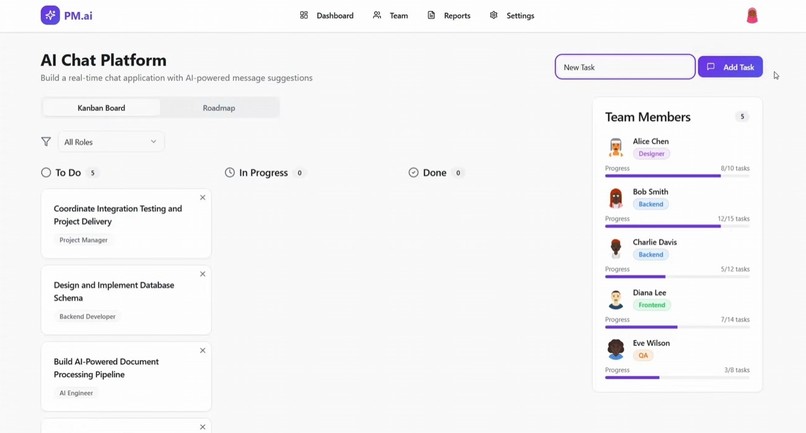
AI Project Taskboard
-
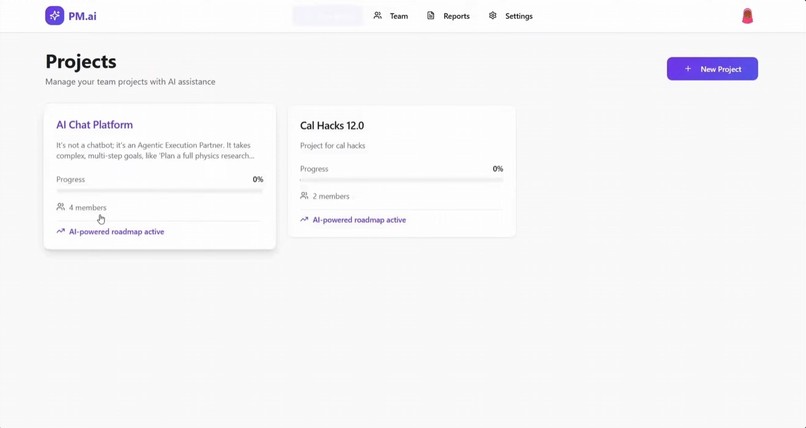
Project Dashboard
-
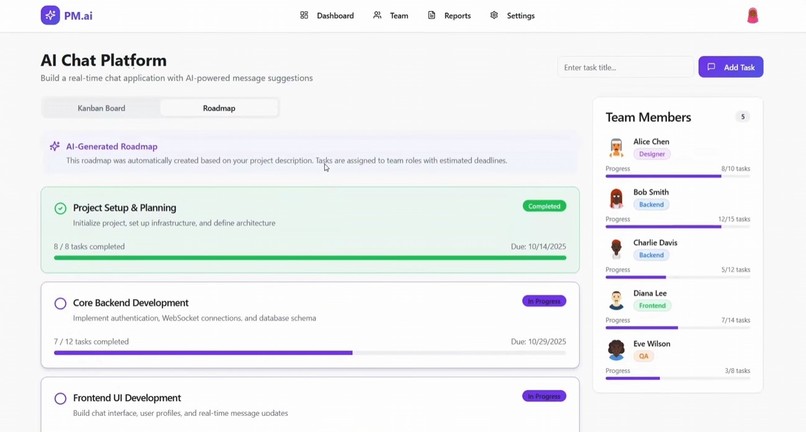
AI Roadmap
-
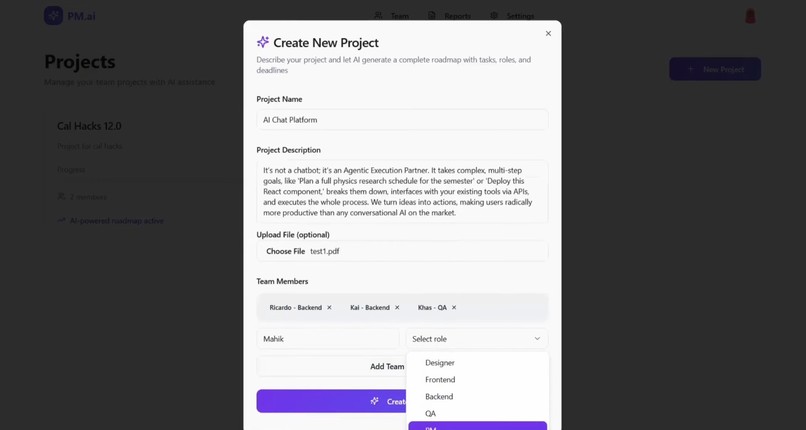
Project / Team Manager


Inspiration
As engineers, we’ve all experienced the chaos of collaborating on complex projects—messages scattered across Discord, Slack, and Notion; roles unclear; and deadlines slipping through the cracks. During the hackathon, our team realized that what slows teams down isn’t just lack of talent—it’s lack of clarity.
We wanted to build an AI-powered orchestrator that could read a project brief, understand what needs to be done, and automatically divide it into actionable tasks and clear roles — giving every team member instant alignment.
What it does
PM.ai is an intelligent project management assistant that:
- Reads your project or assignment brief (PDF/text)
- Automatically identifies roles (like Backend Developer, PM, UI/UX Designer)
- Breaks down large goals into actionable tasks and subtasks
- Assigns responsibilities based on role specialization
- Stores everything in a collaborative Supabase dashboard so teams can interact, claim tasks, and stay updated
It acts like your AI project manager — one that never forgets, never misses a deadline, and keeps everyone on the same page.
How we built it
Our stack was designed around reliability, reasoning, and speed:
- Claude 4.5 (Anthropic) for advanced reasoning, structured JSON task generation, and long-context understanding of project briefs
- LangChain for chaining AI prompts and embedding logic
- Chroma for vector-based “memory” retrieval of project content
- Supabase for relational storage of roles, tasks, and subtasks (pgvector used for memory embeddings)
- FastAPI as the backend for uploading files, calling agents, and connecting to Supabase
- Supabase Edge Functions to bulk-insert and manage data asynchronously
The workflow:
- User uploads a project brief → extracted with pdf-parse
- Text is chunked, embedded, and stored in Chroma
- Claude’s PM Agent generates high-level tasks and roles
- Claude’s Specialist Agents expand each task into technical subtasks 5.All data syncs into Supabase and is displayed in the interactive dashboard
Challenges we ran into
Model formatting: Early versions of Claude’s JSON responses were inconsistent. We had to sanitize and validate outputs before inserting them into Supabase.
Supabase schema setup: Managing relationships between projects, tasks, and subtasks without breaking function permissions required careful design.
Accomplishments that we're proud of
Built a fully functional multi-agent orchestration system that dynamically parses, structures, and assigns project tasks.
Integrated Claude 4.5, Supabase, and Chroma successfully — all talking to each other through FastAPI.
Achieved structured, reusable JSON pipelines for consistent AI task generation.
Created a system that we actually used to manage our own hackathon workflow — proving its effectiveness.
Built a team that combined AI, backend, and UX thinking seamlessly.
What we learned
The power of AI orchestration — how chaining reasoning agents can create structured workflows from unstructured input.
How to design robust API systems that handle dynamic AI responses (even malformed JSON).
The value of clear schema design in Supabase for linking project hierarchies (projects → tasks → subtasks).
That collaboration and communication—ironically, the problem we were solving—are what make hackathon success possible.
What's next for PM.ai
Autonomous Planning: Let PM.ai dynamically replan deadlines or reassign roles when someone misses a milestone.
SaaS Launch: Turn this into a lightweight productivity platform for startups, research labs, and university teams.
Built With
- chroma
- claude
- fastapi
- langchain
- supabase


Log in or sign up for Devpost to join the conversation.