-
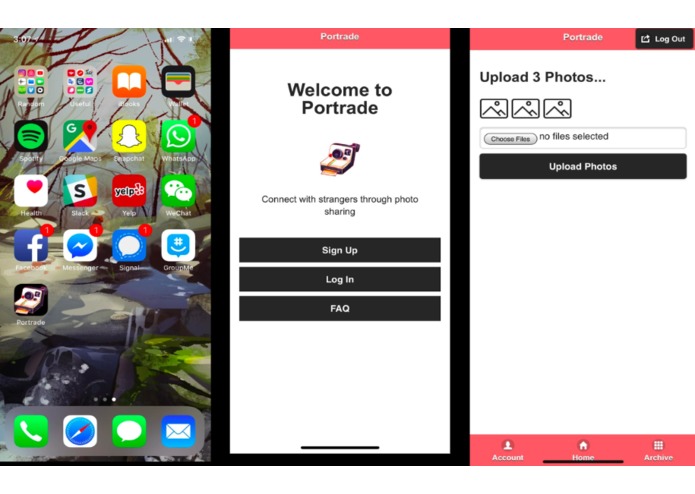
Left: Portrade App Icon on Bottom Right, Middle: App Log In Page, Right: App Home Screen
-
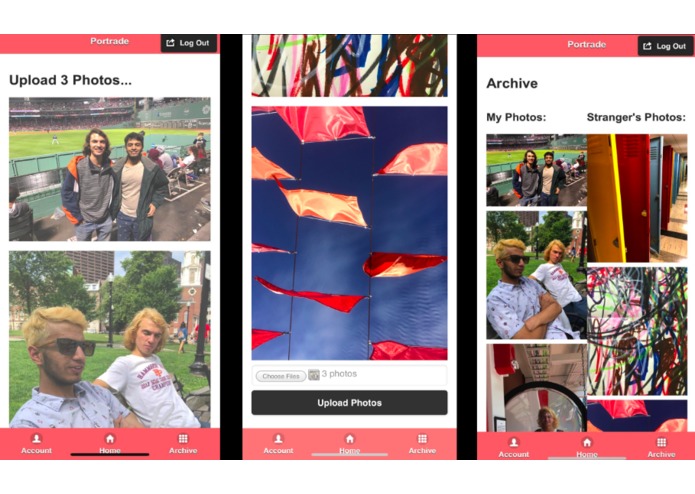
Left: After User Uploads Three Photos, Middle: Stranger's Photos from Exchange, Right: Archive Page with Side by Side of Exchanged Photos
-
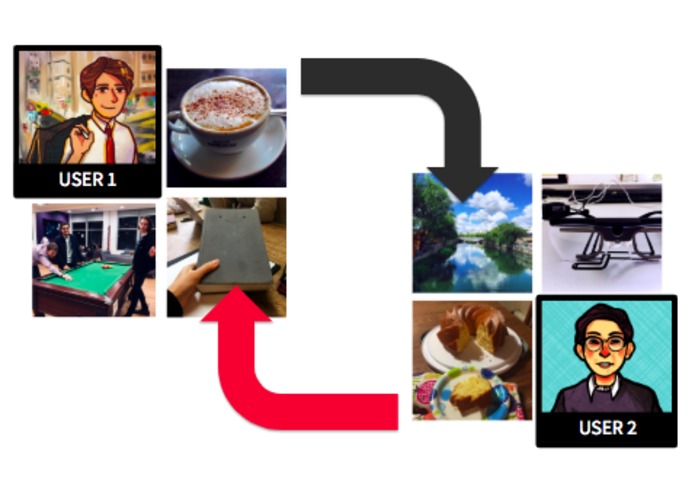
Persona User Interaction Diagram: User 1, in England, exchanges three photos of his day with User 2, in Shanghai
-
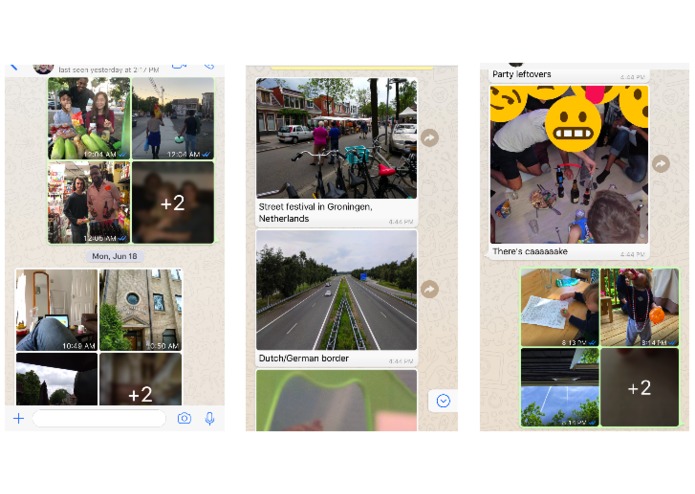
Phase 1 of Prototyping and Experiments: anonymous WhatsApp photo exchanges with participants from USA, Germany, UK
-
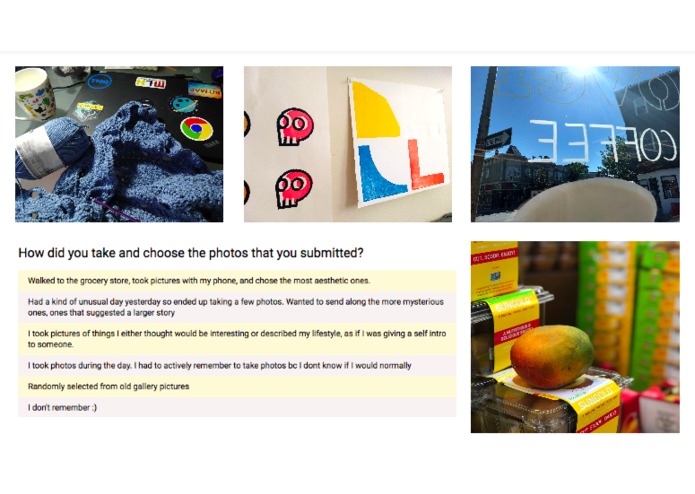
Phase 2 of Prototyping and Experiments: anonymous Google Form photo exchange and feedback form


Inspiration
In an age where photography is commonplace thanks to the prevalence of camera phones and photo- based social media, photo sharing becomes an important social issue. Who sees the photos that we share? How do we curate our social media presence through photography? How do we perceive others through shared photos? While much research has been done on the pervasive nature of digital photographs and behavioral patterns of photo sharing as a whole, very little has been done on purposeful manipulation of anonymous, paired photo exchange. We especially focused on the potential of such an exchange to increase empathy through its intimate, purely visual nature. In this study, pairs of strangers were told to send photos of their day to each other. The participants were not allowed to use text-based chat functionalities or share identifying information. Here we report findings from analyzing the content and experiences of these exchanges.
What it does
Mobile application Portrade developed for the third phase of study done at Harvard Library Innovation Lab and Berkman Klein Center for Internet & Society. Users upload three photos and immediately receive three photos from another user in return. Their photos are then stored in the server to be sent to a future user. Portrade was live demoed for one day with 10 participants sharing a total of 30 photos in addition to the pre-stocked initial images. Our study consists of three separate stages, designed to investigate anonymous paired photo exchange across three platforms – WhatsApp (Phase 1), Google Form (Phase 2), and our mobile app prototype Portrade (Phase 3). We studied mobile vs. desktop and mutual vs. non-mutual exchanges while maintaining the same user prompt for photo taking and sharing in each phase
Background
Photo sharing has the powerful potential to increase empathy and create meaningful personal connections. With the rise of smartphones and photo-based social media giants such as Instagram and Snapchat in the past decade, communication methods have become increasingly visual. As the global social and cultural norms around privacy and emotional engagement have shifted, the mainstream uses of photography have expanded to include the propagation of a curated self-identity as well as of the vicarious experience of multiple everyday realities, i.e. minute-by-minute “digital storytelling”. Interaction design has often focused on barrier removal rather than emotional engagement. In a world where users are flooded with both wanted and unwanted visual digital stimuli from friends and strangers alike, it is crucial for the HCI community to understand the emotional implications of photo sharing to circumvent societal apathy and desensitization. Photos are more effective for universal connectedness than text or audio because they transcend language and skill barriers. They produce a literal different perspective for viewers, allowing users to see and contextualize others’ lives. Instead of exploring privacy or behavior in photo exchange from a purely non-emotional standpoint, emotion is key to this study, which aims to provoke empathy, self-reflection, and broader perspectives through a mobile experiment, an online-based experiment, and a mobile app prototype specifically centered around anonymous paired photo exchange.
Conclusion
Feedback from Phase 1 and Phase 2 included requests for a mobile app catered towards paired anonymous photo sharing, as Phase 2 participants noted “the web form is harder to use” and “mobile friendly website could be good too.” Phase 1 users did not mention inconvenience as a factor of the WhatsApp, mobile-based study. When asked if they would do anonymous paired photo sharing again if made into a mobile app, 100% of participants responded “yes” to the poll, regardless of whether they reported a positive or negative experience from the studies. The Phase 3 photo category distribution was similar to the Phase 1 pattern of distribution, but unlike Phase 1, had a nearly even amount of social and landscape photos. 36.67% of the 30 photos were landscapes, followed by 33.33% social, 13.33% food, 10% object, and 6.67% animal. Participants reacted positively to the immediate feedback of receiving three photos as soon as they sent three photos, but wished that the aspect of mutuality had been retained. Users did not find themselves emotionally engaged by the app due to its lack of mutual pairing, as it felt “unfulfilling”.


Log in or sign up for Devpost to join the conversation.