-
-
Just the surface layer of fun.

Inspiration
Over 15 million individuals in North America experience significant hearing loss at some point in their lifetime. Many of these same people are unable to bike due to the increased dangers. We came up with a wearable solution to fight against this problem.
What it does
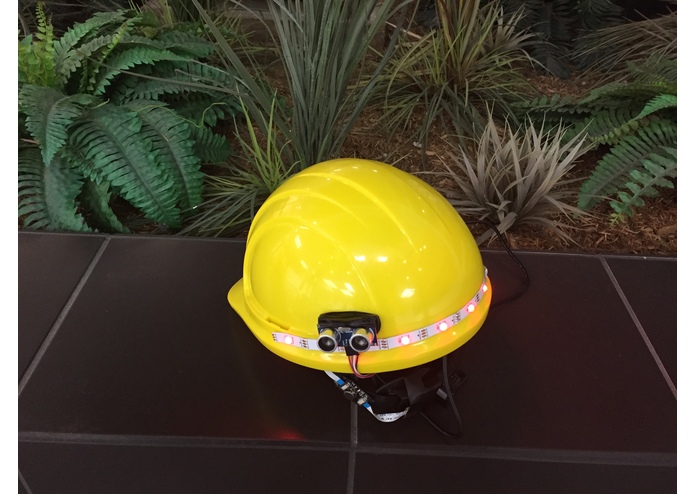
Helm is a sensor-based helmet that leverages one's surroundings and location to provide feedback for the user and surrounding drivers. This being said, its design allows for future translations to almost all headwear, particularily sports. The helmet can alert the user rear-driving vehicles through a head-mapped vibrational motor. The rear drivers can also know of the bikers decisions by signaling methods in an LED strip.
How we built it
Hardware: The helmet is built using the modular Xadow kit supported via the Intel Edison module. Vibrational motors were placed on the sides of the helmet to show incoming direction, a 3 m ultrasound to notify the biker of incoming vehicles, a very bright LED strip on the back, and a touch sensor for system control.
Software: The software portion was split into two components. The embedded programming was implemented using C++ and the Arduino IDE to interface with the Intel Edison and various sensors. The mobile application was created using Android Studio, included with the Google Maps API to provide directional data to the Edison's attached LED strips.
Challenges we ran into
Trying to break into a very non-robust Intel Edison, which seemed to be government-level encrypted, to enable Bluetooth communication with a mobile phone. Learning mobile application development was also a challenge.
Accomplishments that we're proud of
Coming together as a team and creating a worthwhile and fulfilling project. Also proud of using a hot-glue gun to its maximum effectiveness.
What we learned
How difficult it is to do firmware, as well as how much complex it can be to work with low-end Bluetooth devices
What's next for Project Helm
Creating custom, more accurate/powerful, smaller and cost effective sensors and can be mounted onto any headwear, with sustainable battery life. Also, sending sensorial data back to the mobile data would allow for strong analytics to be created




Log in or sign up for Devpost to join the conversation.