-
-
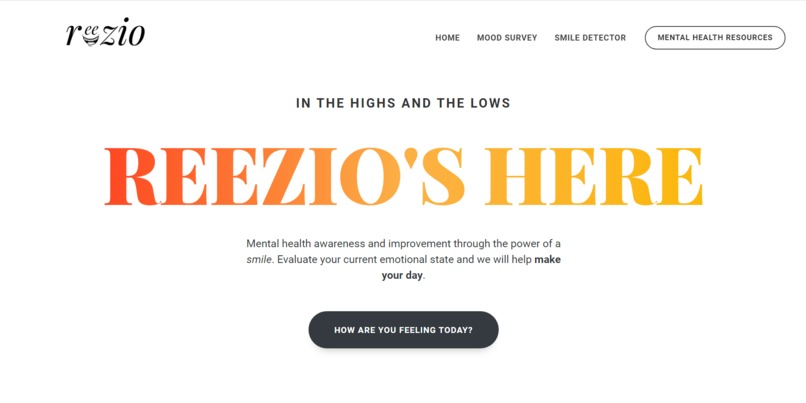
The Homepage
-
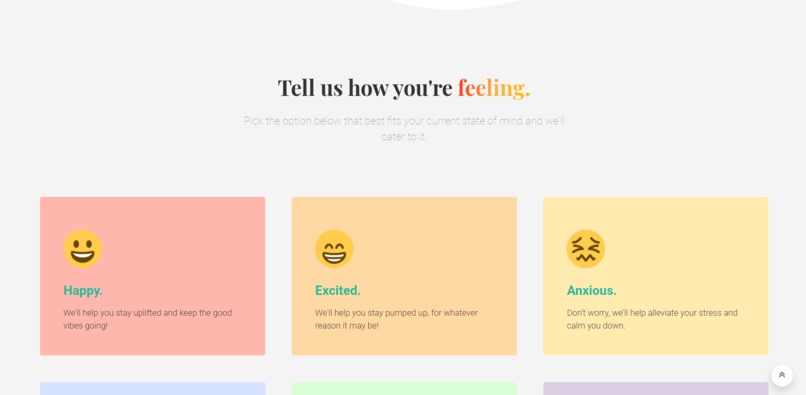
The Mood Selector
-
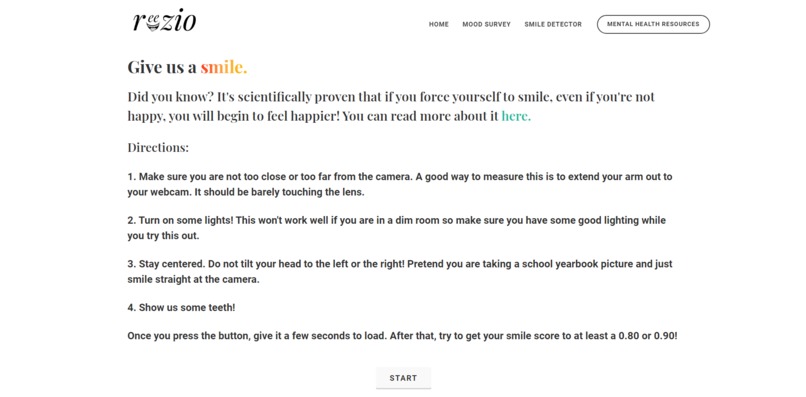
The Smile Detector


Inspiration
We were inspired partly by the 2012 study conducted by professors of psychology at the University of Kansas. From this study, we found out that smiling, even if you don’t want to, tricks your brain into having positive impacts as if you were really smiling. Additionally, seeing the potential long-term ramifications of isolation mobilized us as a collective to work on Reezio; the mental impacts that we have seen COVID have on ourselves and our peers greatly contributed to our decision to start this project.
What it does
The two main features of the website are the mood survey and the smile detector. The mood survey asks you how you are feeling today and gives you a choice out of 6 moods. Once you click on a certain mood, you will be directed to a page with videos and resources to either help you feel better or help you stay happy. The smile detector gives you directions for use and prompts you to smile into your webcam and then gives you a happiness score. You can test this feature out by smiling widely and then looking grumpy to see how the numbers change. This was again implemented based on the finding that forcing a smile can have positive impacts.
How we built it
We used the modern languages HTML5, CSS3, Bootstrap, and Javascript to create Reezio. We used the Canvas framework to get us started with the foundation of our website, and from there, we replaced it with our own features.
Challenges we ran into
Some of the biggest challenges we ran into included working with the smile detector and recording the videos. Initially, the smile detector was very unreliable. The method used to alleviate this issue was Lauren inputting even more photos for the algorithm to refine its process. Another issue we had was that we had some trouble trying to devise the best way to make this part of our program user-friendly. Our solution was to create a detailed set of instructions in the detector page. The next major challenge we had was recording the videos. Due to being in a remote setting, we had a lot of connectivity issues when attempting to use Google Meet. While we wanted to go on a video call, it tended to overheat Ameya’s computer, so we had to improvise by congregating back on Discord to record our presentation, which went splendidly.
Accomplishments that we're proud of
Though we initially ran into a few hurdles while brainstorming, once we had this idea of a smile detector, we were easily able to come up with other features we would like for our website. We were pleasantly surprised with how well the website came together after less than two days of work, both aesthetically and functionally. The accuracy of the smile detector was also something we were proud of.
What we learned
We learned how to brainstorm a creative idea within a few hours, divide up the work for the following day, and pitch the idea cleverly to the judges through our video. This took a lot of time management skills and teamwork, so we were able to improve our skills due to that. We also learned different HTML/CSS and JS skills from each other as we worked on the website.
What's next for Reezio
If we were to further develop this website, we would want to reach a wider range of audiences. Instead of having our target audience be only teenagers, we can expand it out to all demographics with the corresponding resources for the newly added groups. We hope to add more features such as having the user being able to type in a response as to how they are feeling, and then using ML to analyze that and give an appropriate response. We’d also finetune the smile detector further to make it more accurate, and we would also add mood options. Finally, we’d add an ‘about’ page so users can know the purpose and inspiration of the site along with the true meaning of the name ‘Reezio’.


Log in or sign up for Devpost to join the conversation.