-
-
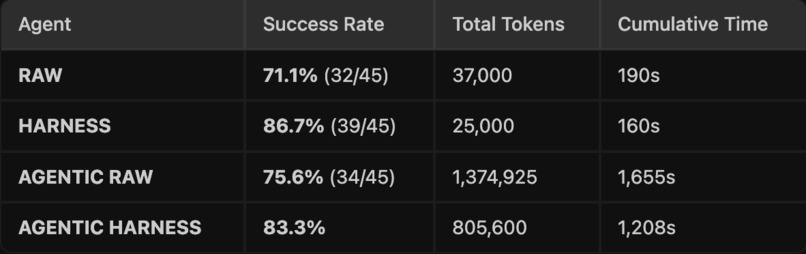
Benchmark Statistics
-
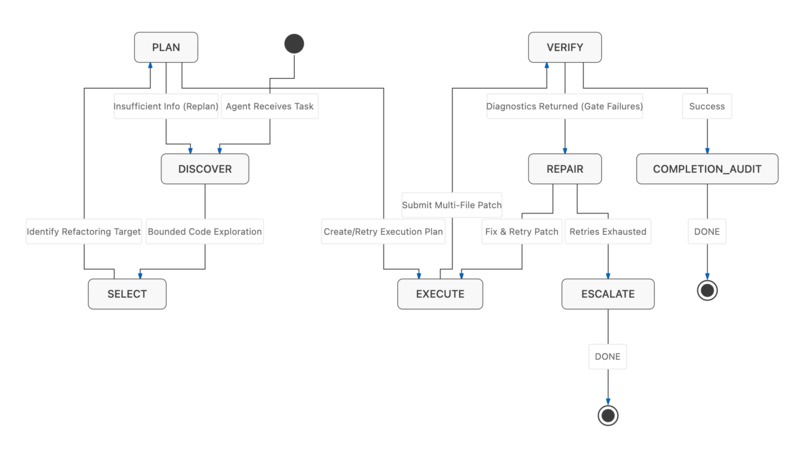
Agent Harness
-
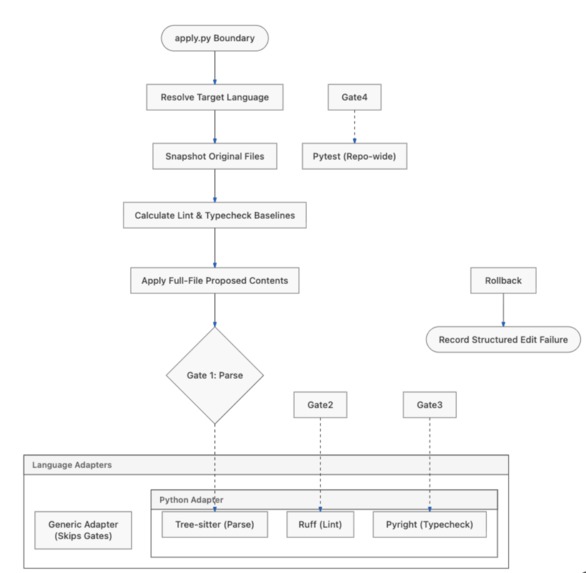
Workflow


Refactorika — Devpost
Inspiration
According to Stripe's Developer Coefficient — a study conducted with Harris Poll across thousands of engineers and C-suite executives in 30+ industries — 42% of every developer's working week is spent dealing with technical debt and bad code. That's nearly $85 billion in lost productivity every year, not from building the wrong things, but from fighting the accumulated mess in codebases that already exist.
Every codebase we've worked on has the same graveyard: god-files no one touches, duplicate logic scattered across five modules, functions that were "temporary." Linters tell you what's wrong but not how to fix it. AI suggests restructuring, but is disconnected from the filesystem, hallucinates edits that don't apply, misses call sites, and forgets everything the moment the session ends.
We wanted a tool that could act — read the code, propose a structural change, apply it, prove it's safe, and remember what it did. Something that makes mechanical cleanup as frictionless as running a linter. The hard lesson behind Refactorika: an LLM is brilliant at deciding what to refactor and dangerous at doing it. So we split the job — and that split is the whole product.
The LLM reasons about what and how. Deterministic refactoring tools do the actual transformation, reference-correctly. A verification gate proves nothing broke — or reverts it.
What it is
Refactorika is an agent harness delivered as an MCP server, riding on a deterministic, graph-driven refactoring engine. It plugs Claude directly into your codebase, gives it a reference-correct model of the whole program to reason over, and routes every change it proposes through real refactoring tools and a verification gate stack — so cleanups land proven safe or not at all.
claude mcp add refactorika -- uvx refactorika serve
It gives every repo the four capabilities they desperately need:
- Organization — splits god-files into coherent modules, reorders and deduplicates imports (stdlib → third-party → local), extracts helpers from bloated call sites.
- Complexity reduction — breaks long functions into named units, flattens deep nesting with guard clauses, replaces repeated blocks with parameterized helpers.
- Duplicate & dead-code removal — finds structural clones via AST fingerprinting and semantic near-clones via vector embeddings, then finds functions nothing reaches via call-graph reachability. Every removal goes through verification before it lands.
- Living documentation — generates and self-updates
.refactorika/context/<module>.mdfiles that compound across sessions, so the why doesn't evaporate when people leave.
Three ways to run it, all over one verified spine: the MCP server (drive it from Claude), the engine CLI (refactorika <dir>), and the agent campaign (--agents: audit → dependency-ordered plan → specialist agents).
How it works — the pipeline
The whole design is a hard line between AI judgment and deterministic execution. The LLM never edits a file; it emits a typed TransformSpec. Real tools execute it. Gates decide whether it lives.
1 · The graph — reference-correct understanding.
We build a whole-program symbol graph with Jedi's real static name resolution. Nodes are functions/classes/methods; edges are true references resolved through imports, aliases, and scopes — not a regex name match. This is the make-or-break: it's why a rename updates every real reference and nothing that merely shares the name, and why dead-code analysis (reachability from entry points like public API, __all__, __main__, tests, and route/fixture decorators) is trustworthy. The graph also gives us leaf-to-root ordering (refactor on top of already-verified code) and impact analysis (the exact set a change can affect → we re-run only the impacted tests).
2 · The plan — where the LLM reasons.
The planner finds real smells — god functions detected by a three-axis cohesion signal (cyclomatic complexity ≥ 6 or length ≥ 30 lines or nesting ≥ 4, not a naive line count), duplicates, dead code — and asks the model how to fix them. The model returns a TransformSpec (parameters), never a diff. Before deciding, it recalls the most semantically similar prior decision from memory and reuses the same helper names, so the 2nd, 5th, Nth similar function is refactored consistently.
3 · The engines — real refactoring tools do the work (deterministic).
| What | Tool |
|---|---|
| Cross-file rename | rope — reference-correct, updates every call site & import |
| Cleanup (unused imports, simplifications, format) | autoflake + ruff |
| Dead-code removal | LibCST — surgical node removal, preserves formatting/comments |
| Decompose / extract | LibCST — AST-node replacement |
These are battle-tested engines, not LLM text edits — so a cross-file rename is provably complete in a way prompting never is. Each returns an EditMap ({path: contents}) and touches nothing on disk — the gate stack owns disk and git.
4 · The verification gate stack — determinism's teeth. Every edit passes a cheapest-first, short-circuiting pipeline. Tools are the arbiter; no LLM decides whether an edit is safe.

- parse (tree-sitter, before touching disk) →
- lint (
ruff, rejects only new violations vs. a pre-edit baseline) → - type (
pyright, only new errors — touching a file with pre-existing noise won't spuriously fail) → - behavior (
pytest, scoped to the impacted tests; no test coverage is recorded as askip, never a silent pass).
All green → git commit (one atomic commit per verified edit). Any red or crash → byte-for-byte restore. The full suite runs once at baseline (the repo must start green) and once at the finale ("all N still pass") as the authoritative backstop.
5 · The agent harness — bounded, self-repairing autonomy.
The agent campaign drives the whole loop as an explicit state machine: discover the target with bounded exploration, select a change, execute a multi-file patch, verify it, and on gate failure repair-and-retry — escalating to skipped-needs-human rather than ever force-committing.

6 · Memory — Redis Iris, decision memory not a cache. Every refactoring decision (the pattern it acted on → the transform → the names chosen) is stored, keyed by an embedding of the code, so the engine stays consistent across a whole repo. This is one of four Redis Iris subsystems (below). Kill Redis and everything degrades transparently to local JSON — the engine never depends on it.
Tech stack
Core engine & the program graph
- Python 3.11+
- Jedi — real static name binding → the reference-correct symbol graph (replaced a regex call-graph that mislinked same-named symbols)
- tree-sitter + tree-sitter-python — AST parsing, the parse gate, structural fingerprints, nesting depth
- FastMCP — MCP server framework (12 tools, JSON in/out)
- Typer — the engine CLI shell
Deterministic refactoring tools
- rope — reference-correct cross-file rename/move
- LibCST — lossless AST-node replacement (decomposition) + surgical dead-code removal
- ruff + autoflake — deterministic cleanup
- radon — complexity metrics + god-function detection
Verification gates
- ruff — lint + format normalization (new violations only)
- pyright — type checking (new errors only, vs. pre-edit baseline)
- pytest — behavior gate, impact-scoped; exit 5 (no tests) recorded as a
skip, never a silent pass - git — atomic commit per verified edit; rollback via byte-for-byte snapshot restore
Duplicate & dead-code detection
- tree-sitter AST fingerprinting — exact structural clones
- OpenAI
text-embedding-3-small(+ sentence-transformers keyless fallback; provider-agnostic, also Ollama) — semantic near-clone detection - Redis
FT.HYBRID(BM25 + vector, RRF-fused) — hybrid search; strictly better than pure cosine on code - Custom call-graph reachability — dead-symbol detection with confidence levels
Memory — Redis Iris
- Redis 8+ (local Docker
redis:8/ redis-stack for the Query Engine) — primary state backend - RedisVL — vector index + hybrid search client
- Four subsystems: AST-keyed LangCache · Hybrid Search Index (
FT.HYBRID, RRF) · Agent Memory (cross-session decisions + history) · Context Retriever (hybrid + tag filters) - Graceful fallback to local
.refactorika/JSON + brute-force vectors when Redis is unavailable
Provider-agnostic LLM
- Generation (Anthropic Claude | Ollama) and embeddings (sentence-transformers | Ollama | OpenAI) are separate providers — Anthropic has no embeddings API, so the embedding backend works regardless of the generation provider. A record/replay cache keyed by (provider, model, prompt) makes any run reproducible.
Language support
LanguageAdapterregistry — per-language parse/lint/typecheck dispatch. Python: full gate stack. Any other language: gates skip (recorded asnull), the test suite still runs. TypeScript/Go adapters drop in via optional deps, no core changes.
Infrastructure
- Git — atomic commits + snapshot rollback · .env / .env.example — secrets, never committed
Benchmarking — does the harness actually help?
We measured it the only honest way: the same agent, with the harness OFF vs ON, graded by an independent oracle (the repo's own tests), not by the harness itself.

- Simple proposer: harness lifts success 71.1% → 86.7% (32/45 → 39/45) — and spends fewer tokens (37k → 25k) and less time (190s → 160s). Safety that's also cheaper.
- Full agentic loop: harness lifts 75.6% → 83.3% while cutting tokens 1.37M → 806k and time 1,655s → 1,208s — the verified spine keeps the agent from thrashing.
We also run on RefactorBench (microsoft/RefactorBench — 100 real multi-file refactoring tasks across Django, FastAPI, Celery, Scrapy, Salt, Ansible, Requests, Flask, Tornado, each verified by its own AST tests). Refactorika has a fixed transform menu, so we decline out-of-scope tasks explicitly rather than hallucinate, and report three honest numbers — in-scope pass rate, in-scope subtask completion, and out-of-scope count — never a single inflated figure. (Baseline LM agents solve ~22% of RefactorBench; it's a credibility signal, not an ace-it target.)
Challenges we ran into
The verification paradox. A change that looks clean to pyright can still silently break behavior. Getting pytest to run scoped to the impacted tests (fast enough to feel interactive), making the type/lint gates baseline-aware (reject only new errors, so touching a file with pre-existing noise doesn't revert a good edit), and handling missing coverage honestly (record a skip, never a silent pass) took real iteration. skipped-needs-human was a deliberate line: never force-commit, never pretend a gate passed that didn't run.
Reference-correctness on real repos. This is the make-or-break. A regex call-graph cheerfully renames a same-named-but-unrelated symbol; rope crashes on intentionally-broken fixtures (Django ships syntax-error test files); the dead-code locator initially only found def/class, missing renamed constants. Real codebases are far messier than toy examples — we moved to Jedi binding for the graph and hardened every tool against the mess.
Refactoring should make code less, not more. Our first LLM pass naively decomposed every long function and added hundreds of lines. "Decompose" is a structural trade, not a reduction — so we rebuilt god-function detection around a three-axis cohesion signal and biased the planner toward reduction (dead code, dedup, cleanup) over restructuring.
Duplicate detection at the right granularity. Structural fingerprinting catches exact clones; semantic embeddings catch near-clones. Tuning the threshold to surface actionable duplicates without drowning in false positives (getter/setter pairs should look similar) required calibrating against real messy repos.
Redis Iris offline fallback. We wanted Redis Iris as the primary memory layer but needed the demo to run anywhere — including a laptop with no network. Building a fallback that's genuinely transparent (same interface, same behavior, just slower and non-persistent) without a maintenance split was harder than expected.
Tree-sitter sees syntax, not semantics. Call-graph reachability works for direct calls but misses dynamic dispatch, decorators that register functions implicitly, and __all__ exports. We set explicit confidence levels and surface uncertainty rather than silently over-delete.
What we learned
The hardest part of a safety-first refactoring tool isn't the refactoring — it's the division of labor. The LLM is the right tool for judgment (what's worth changing, how to name the pieces) and the wrong tool for execution (it can't guarantee a rename is complete). Deterministic engines are the reverse. Put the model in charge of "what," rope/LibCST in charge of "how," and the test suite in charge of "is it still correct" — and you get something you can actually trust. We also had to define "safe" precisely enough to enforce mechanically: malformed output (parse), style drift (ruff), type regression (pyright), and behavior change (pytest) are four different failures that need four different responses.
And we learned that visible checking is the product. An agent that silently refactors and hands you a diff to trust is just a faster way to introduce bugs. Rendering the gate log — especially the catch-and-rollback moment — is what turns "AI did something to my code" into "I watched it get checked."
What's next for Refactorika
- Broader duplicate consolidation — the flow surfaces duplicates and proposes a merge today; we want to close the loop by auto-generating the unified implementation and running it through the full gate stack (rope already does reference-correct moves; we're wiring
consolidateas a first-class transform). - Richer dead-code analysis — handle dynamic dispatch, decorator-registered entry points, and
__all__-exported symbols more precisely to push confidence levels up. - Per-module context cards —
generate_docsalready emits.refactorika/context/files; make them queryable viaget_context_mapso Claude can answer "why does this module look this way?" with grounded, session-persistent memory. - More languages — the
LanguageAdapterregistry already abstracts parse/lint/typecheck; TypeScript and Go gates drop in as optional deps, no core changes.
Built with
python · jedi · rope · libcst · tree-sitter · ruff · autoflake · pyright · pytest · radon · redis · redisvl · fastmcp · anthropic · ollama · openai · sentence-transformers · typer · git


Log in or sign up for Devpost to join the conversation.