-
-
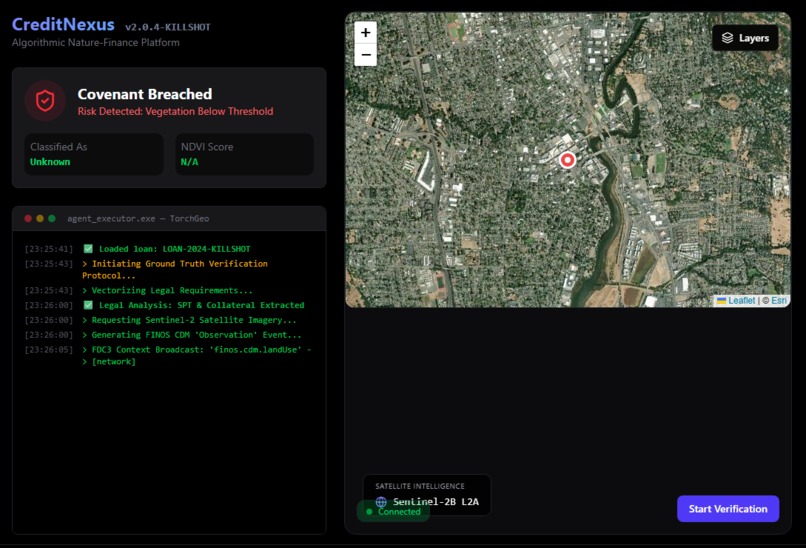
Verify claims against ground truth using locally trained ai for satelite image analysis
-
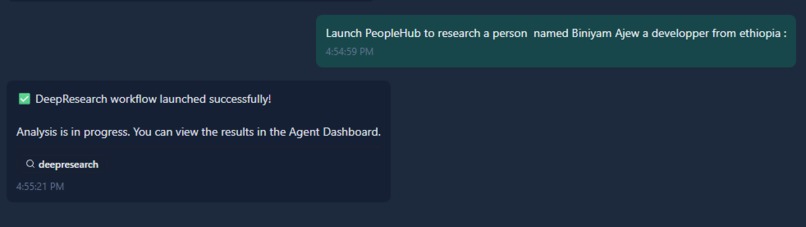
route to the right agent where you need it when you need it
-

ai-first workflows
-
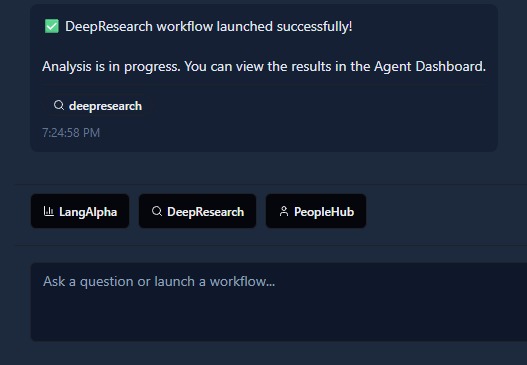
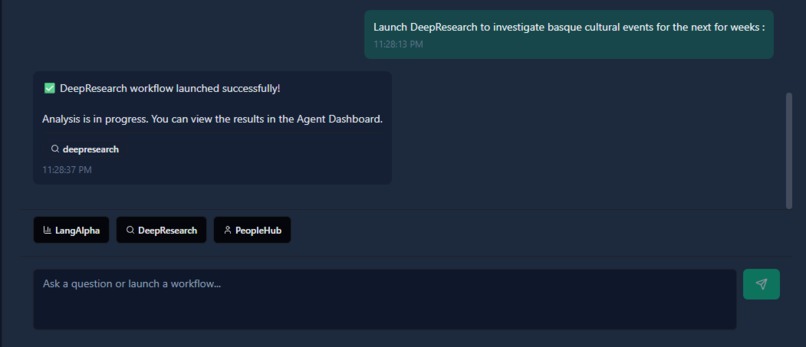
Deep Research Agents coordinate dozens of subagents
-
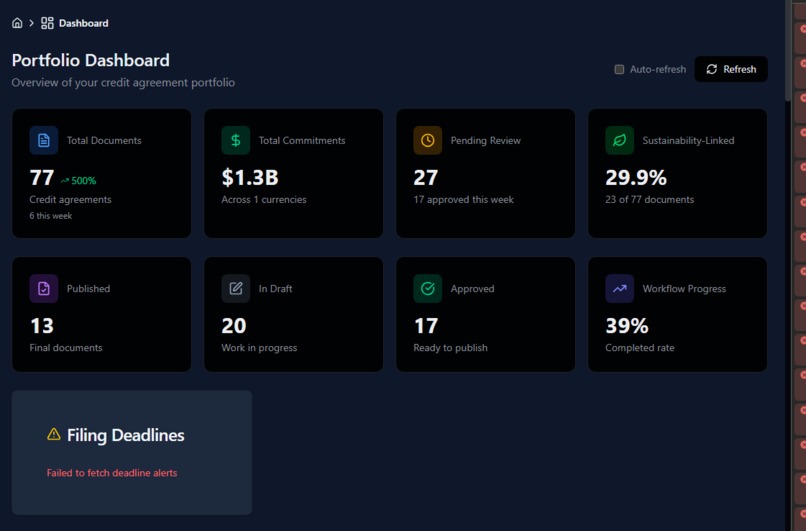
The Dashboard is where you can find all the apps you depend on
-
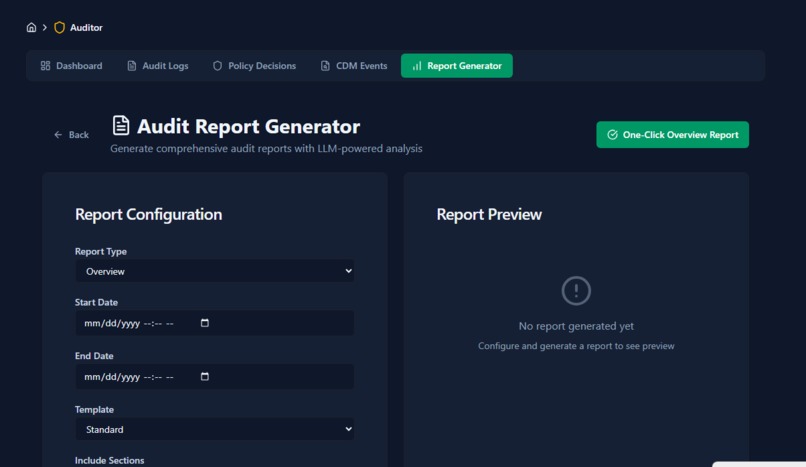
One-Click Audit Report
-
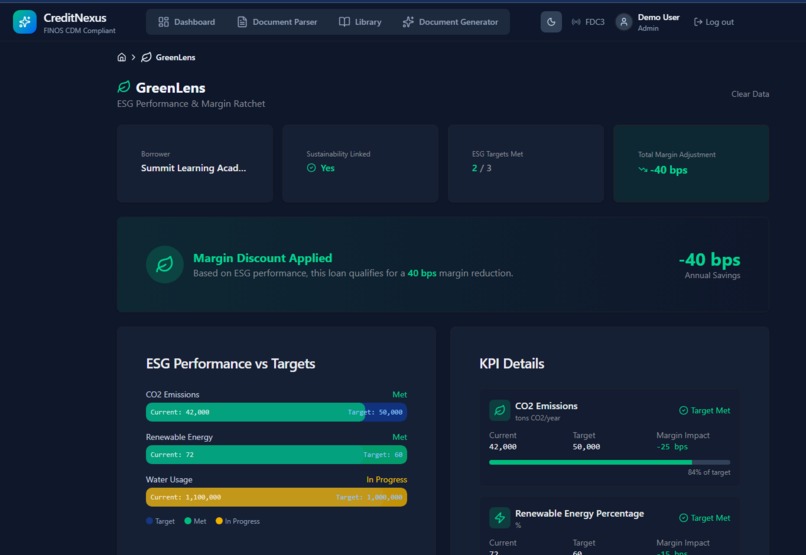
Green Finance Tracked and Valued
-
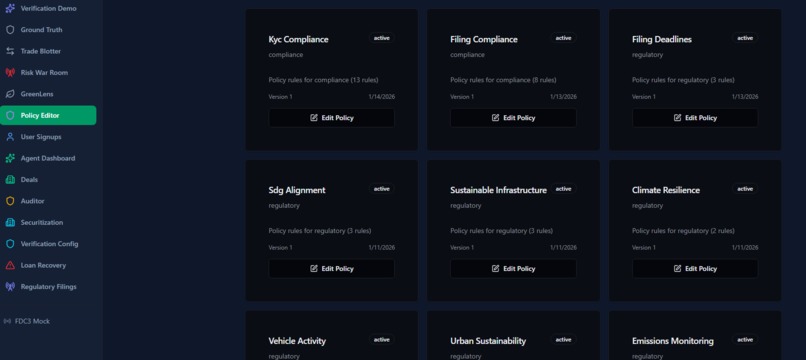
Compliance as Code
-
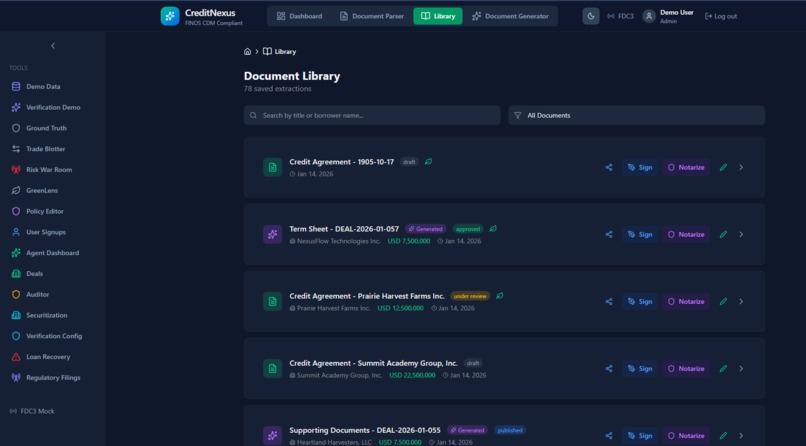
Track Loans
-


CreditNexus represents a comprehensive, commercially viable solution for the loan market. Our combination of AI-powered extraction, real-time compliance enforcement, satellite-based verification, and end-to-end loan management addresses critical pain points while enabling new capabilities like transparent secondary trading and objective sustainability verification.
With 20+ years of combined financial industry experience, our team understands the real-world challenges and has built a solution that is both technically excellent and commercially viable.
We are ready to transform the loan market.
Issuing debt and bonds is always such a back and forth between so many stakeholders , and it always comes at exactly the worst moment for the borrower. That's because the time spent idling by waiting for reviews and input on deals and loans can last weeks, nevermind days !
Creditnexus is a concept where internal credit risk models and external regulatory and compliance obligations (like ESG and Green Financial Targets) are codified a priori with AI-driven decision support to manage loan dealflows.
Our focus is on broadening access to green loan financing and easing the difficulty of securitizing bundles of bonds or loans. To do this we have paid an enormous attention to details , especially user experience with features you woud barely notice because the deal flow is so fluid.
Beware , this is a conceptual project , but also it's fullly functional and may bring consequences legal or otherwise to users under certain configurations !
That said , we do hope you'll read the documentation and even try to use our compliance first application. We're fully compliant with industry common domain models and extant regulations . We dont just programmatically incentivize green finance we're compliant from day 1 !
Commercial Viability
Value Proposition
- Efficiency Gains: Reduce document processing time from days to minutes
- Risk Mitigation: Real-time compliance enforcement prevents regulatory violations
- Cost Reduction: Automated workflows reduce operational overhead
- Transparency: Standardized CDM format enables transparent secondary trading
- Verification: Objective satellite-based verification for sustainability claims
Scalability Potential
- Cloud-Ready: Designed for cloud deployment with horizontal scaling
- On-Premise: Supports private network deployments
- Microservices: Modular architecture enables component-level scaling
- API-First: RESTful API enables integration with existing systems
Market Opportunity & Business Model
Total Addressable Market (TAM):
Global Market Sizes:
- Secured Loan Market: $12-15 trillion (originations, 2024), projected $14-18 trillion by 2026
- Secondary Loan Trading: $1.2 trillion (traded volume, 2023), projected $1.5-2.0 trillion by 2026
- Green Lending: $400 billion (2024), projected $1 trillion by 2030 (15-20% CAGR)
- Securitization Assets: $13 trillion (outstanding, 2024), projected $15-18 trillion by 2028
- Loan Recovery Market: $200-300 billion (2024), projected $300-400 billion by 2030
- Fintech Compliance Tools: $10 billion market, growing 15% annually
CreditNexus TAM Estimate: $2-25 Billion opportunity (1-5% of $200-500 billion fintech lending sub-market)
Target Customers:
- Loan Granting Companies: Small to large lenders seeking automation and compliance
- Investment Banks & Trading Desks: Secondary market participants requiring transparent trading
- Loan Servicers & Recovery Agencies: Organizations needing automated recovery workflows
- Legal & Compliance Teams: Regulatory compliance and audit reporting
- Sustainability-Linked Loan Originators: Green finance verification and ESG compliance
Business Model:
Open-Source Demo with Paid Services (Freemium Model):
- Core Platform: Open-source demo available for evaluation and small-scale use
- Enterprise Features: Paid subscriptions for production deployments
- Deployment Services: $50,000-200,000 per on-premise/cloud setup (includes customization)
- Subscription Tiers: $1,000-10,000/month for production access, premium APIs, and advanced features
- Consulting & Partnerships: 10-20% margins on integration services, insurer partnerships, securitization platform partnerships
Revenue Streams:
- Deployment & Setup: One-time fees for on-premise or cloud deployments
- Subscription Tiers: Monthly/annual subscriptions for production access
- API Access: Premium API access for high-volume users
- Consulting Services: Custom integrations, compliance consulting, training
- Partnership Revenue: Revenue sharing with insurers, securitization platforms, data providers
Scalability Strategy:
- Freemium Scaling: Free demo attracts small lenders; upsell to large enterprises for scalability
- Plugin Architecture: Embed CreditNexus in existing SaaS and Microsoft products
- API-First Design: RESTful API enables integration with existing systems
- Cloud & On-Premise: Flexible deployment options for different security requirements
Competitive Advantages:
- First-Mover in Satellite Verification: Unique ground truth verification for sustainability-linked loans
- 95% Paperwork Reduction: AI-driven automation reduces operational costs by 30-50%
- Deterministic Compliance: Policy-as-code engine ensures 100% auditability
- CDM Standardization: Industry-standard data format promotes interoperability
Potential Impact
- Industry-Wide Standardization: CDM compliance promotes interoperability across financial systems
- Regulatory Compliance: Automated enforcement reduces compliance risk and regulatory fines
- Operational Efficiency: Automation reduces processing time from weeks to days, costs by 30-50%
- Transparency: Real-time visibility improves secondary market liquidity and price discovery
- Sustainability: Objective verification enables credible green lending and prevents greenwashing
- Market Democratization: Small lenders gain access to securitization markets and advanced tools
Compliance & Standards
How CreditNexus Assures User Compliance
CreditNexus implements multiple layers of compliance assurance to ensure users remain compliant with financial regulations:
1. Ex-Ante Policy Enforcement:
- Pre-Settlement Screening: All transactions evaluated before execution (ex-ante enforcement)
- Deterministic Decisions: Policy engine provides mathematically provable decisions (no stochastic variability)
- Automatic Blocking: BLOCK decisions prevent non-compliant transactions from proceeding
- Flagged Review: FLAG decisions route transactions to compliance review workflows
2. Point-of-Creation Validation:
- Pydantic Model Validators: CDM models validate policy compliance at data creation
- Embedded Business Logic: Policy checks embedded in data models (CDM principle)
- Sanctioned Party Detection: Automatic screening against sanctions lists at extraction
- Regulatory Field Validation: Required fields validated against jurisdiction-specific requirements
3. Complete Audit Trails:
- 7-Year Retention: All audit logs retained for regulatory compliance (GDPR, DORA requirements)
- CDM Event Linking: All state changes linked via CDM event identifiers
- Evaluation Traces: Complete policy evaluation traces stored for audit
- User Action Logging: All state-changing operations logged with user, timestamp, and context
4. Automated Compliance Reporting:
- One-Click Audit Reports: Automated compliance reports for regulatory submissions
- LLM-Powered Analysis: Executive summaries and compliance analysis generated automatically
- Policy Decision Tracking: All policy decisions tracked with rule analysis
- Export Functionality: Reports exportable in multiple formats (PDF, CSV, JSON, XLSX)
5. Real-Time Monitoring:
- Policy Decision Dashboard: Real-time view of all policy decisions
- Anomaly Detection: Automatic detection of compliance anomalies
- Deadline Alerts: Automated alerts for regulatory filing deadlines
- Breach Notifications: Real-time notifications for sustainability breaches
6. Regulatory Compliance Features:
- DORA Awareness: Digital Operational Resilience Act compliance measures
- MiCA Compliance: Markets in Crypto-Assets regulation enforcement
- Basel III: Capital adequacy requirements and risk-weighted asset calculations
- FATF: Anti-money laundering and sanctions screening
- GDPR: Data protection and privacy compliance
Regulatory Compliance
- DORA: Digital Operational Resilience Act awareness with cybersecurity measures
- MiCA: Markets in Crypto-Assets regulation with policy enforcement
- Basel III: Capital adequacy requirements, risk-weighted assets, capital buffers
- FATF: Anti-money laundering compliance with sanctions screening
- GDPR: Data protection and privacy compliance with 7-year retention
Documentation: Compliance Documentation
Industry Standards
- FINOS CDM: Complete Common Domain Model compliance with event generation
- FDC3 2.0: Desktop interoperability standard with context broadcasting
- OpenFin: Native integration support for financial desktop applications
- ISO 8601: Date and time formatting for all temporal data
- x402 Protocol: Payment processing integration
Documentation:
Team
Joseph Pollack - Chief Information Officer
- Strategic technology leadership and architecture
Biniyam Ajew - Senior Developer
- Full-stack development and system architecture
Boris Li - Junior Developer
- 10 years of experience at Citibank and Mastercard
- Expertise in payment systems, banking operations, and financial technology
Combined Experience: 20+ years in the financial industry
Core Features & Live Implementation
1. Compliance Engine
Deterministic Policy-as-Code Engine with real-time enforcement:
CreditNexus implements a deterministic Abstract Syntax Tree (AST)-based policy engine inspired by ASPASIA (Protocol-Embedded Policy Engine), ensuring 100% mathematical provability and auditability. Unlike stochastic AI agents prone to hallucination, our engine compiles regulatory text into machine-executable logic with cryptographic-grade audit trails.
Architecture Highlights:
- AST-Based Evaluation: Recursive
CompositeConditionclass constructs a traversable Abstract Syntax Tree where complex rules decompose into atomic boolean predicates - Deterministic Decision Making: Every policy decision is mathematically provable with complete evaluation traces
- Explicit Conflict Resolution: Strict precedence hierarchy via tuple sort
(ActionSeverity, RulePriority):- Action Severity:
BLOCK(Rank 2) strictly overridesFLAG(Rank 1), regardless of priority - Rule Priority: Within same severity tier, higher integer priority rules take precedence
- Strict Liability Guarantee: Safety-critical rules cannot be bypassed by lower-severity business logic
- Action Severity:
Policy Coverage:
- 18+ Policy Rules across 5 categories:
- Compliance Policies: Sanctions screening, AML/KYC checks, regulatory compliance
- Credit Risk Policies: Basel III capital requirements, risk-weighted asset calculations, collateral requirements
- ESG Policies: Sustainability-linked loan compliance, green finance verification
- Green Finance Policies: NDVI threshold enforcement, air quality compliance, SDG alignment
- Filing Compliance: Regulatory filing deadlines, jurisdiction-specific requirements
Real-Time Enforcement:
- Sub-100ms Evaluation: Policy decisions in <100ms for live transaction enforcement (ex-ante screening)
- CDM-Compliant Process Model: Follows CDM process model (VALIDATION → CALCULATION → EVENT CREATION)
- Three Decision Types:
- ALLOW: Transaction proceeds normally
- BLOCK: Transaction blocked (highest priority, cannot be overridden)
- FLAG: Transaction flagged for review (automatic workflow routing)
Live Implementation:
- Policy rules loaded from YAML files (
app/policies/compliance/,app/policies/credit_risk/,app/policies/esg/,app/policies/green_finance/) - Real-time evaluation on document extraction, trade execution, loan asset verification, and terms changes
- Complete evaluation traces stored as JSON for audit
- CDM event generation for all policy decisions (
PolicyEvaluationevents) - Integration with workflow system for flagged transactions
Compliance Assurance Mechanisms:
- Point-of-Creation Validation: Pydantic model validators enforce policy compliance at data creation (CDM principle)
- Ex-Ante Enforcement: Policy evaluation occurs before transaction settlement, preventing violations
- Complete Audit Trails: Every policy decision includes full evaluation trace, matched rules, and transaction context
- CDM Event Linking: Policy decisions linked to related events (TradeExecution, Observation, TermsChange) via
relatedEventIdentifier - 7-Year Retention: All policy decisions and audit logs retained for regulatory compliance
Documentation: Compliance Documentation
2. Document Extraction & Processing
AI-Powered Extraction using multiple LLM providers:
- Multi-Provider Support: OpenAI GPT-4o, vLLM, HuggingFace
- Intelligent Extraction: Handles documents from 1k to 50k+ characters
- CDM Conversion: Automatic conversion to FINOS Common Domain Model
- Structured Output: Pydantic-validated data with embedded business logic
Live Implementation:
/api/extractendpoint with smart extraction (simple or map-reduce)- Support for PDF, DOCX, images, and OCR text
- Automatic field mapping and validation
- Integration with document library and version control
Documentation: Document Extraction Guide
3. Loan Recovery System
Automated Recovery Workflows with Twilio integration:
- Multi-Channel Communication: SMS, voice calls, email
- Intelligent Escalation: Based on days past due and severity
- Template-Based Messaging: Customizable recovery messages
- CDM Event Tracking: All recovery actions stored as CDM events
Live Implementation:
/api/recovery/send-smsendpoint for SMS notifications- Automated action triggers based on loan default status
- Integration with borrower contact management
- Scheduled recovery actions with business hours support
Documentation: Loan Recovery Implementation Plan
4. Digital Signing & Notarization
Blockchain-Based Notarization with MetaMask integration:
- MetaMask Hot Login: Automatic signup/login with authenticated wallet
- Cryptographic Signing: Ethereum signature verification
- Notarization Records: Immutable blockchain-based transaction signing
- Multi-Signer Support: Required signers with signature verification
Live Implementation:
/api/auth/wallet/nonceand/api/auth/walletendpoints- MetaMask frontend integration (
client/src/context/WalletContext.tsx) - Notarization service with signature verification
- CDM event generation for notarization events
Documentation: Remote Verification & Notarization Plan
5. Two-Way Workflow Distribution
Link-Based Workflow Delegation with State Synchronization:
CreditNexus enables secure, encrypted workflow distribution across users and organizations. Users can delegate verification, notarization, document review, and custom workflows to external parties via encrypted links, with real-time state synchronization and FDC3 context broadcasting.
Key Features:
- Encrypted Link Generation: Secure workflow links with encrypted payloads containing CDM data, deal information, and file references
- Multiple Workflow Types: Verification, notarization, document review, deal approval, custom workflows
- State Synchronization: Real-time state updates between sender and receiver via callback URLs
- FDC3 Integration: Workflow context broadcasting for desktop interoperability
- Whitelist Configuration: Dynamic whitelist updates for secure link processing
- Expiration Management: Configurable link expiration (default 72 hours)
- Status Tracking: PENDING, ACCEPTED, COMPLETED, DECLINED, EXPIRED, CANCELLED
Workflow Delegation Process:
- Sender Creates Delegation: User selects workflow type, recipient (email or user ID), and metadata
- Link Generation: System generates encrypted link with workflow payload
- Link Distribution: Link sent via email, FDC3 context, or direct sharing
- Receiver Processes Link: External user opens link, system decrypts payload and creates local workflow instance
- State Synchronization: Real-time updates sync between sender and receiver
- Completion Notification: Workflow completion triggers notifications and updates
Live Implementation:
/api/workflow-delegation/delegateendpoint for creating workflow delegations/api/workflow-delegation/processendpoint for processing workflow links/api/workflow-delegation/{workflow_id}/stateendpoint for state synchronization- Service:
app/services/workflow_delegation_service.py - Frontend: FDC3 context integration (
client/src/context/FDC3Context.tsx)
Use Cases:
- External Verification: Delegate loan verification to third-party auditors
- Multi-Party Signing: Distribute notarization workflows to required signers
- Document Review: Share document review workflows with legal teams
- Deal Approval: Route deal approval workflows to authorized parties
Documentation: Workflow Delegation Service
6. End-to-End Loan Management
Complete Lifecycle Management:
- Application Processing: Individual and business loan applications
- Deal Creation: Convert applications to deals with workflow management
- Document Generation: LMA template generation from CDM data
- Trade Execution: Secondary trading with policy enforcement
- Verification: Satellite-based ground truth verification
- Recovery: Automated recovery workflows
- Filing: Digital filing and notarization
Live Implementation:
- Full deal lifecycle: DRAFT → SUBMITTED → UNDER_REVIEW → APPROVED → ACTIVE → CLOSED
- Workflow system with role-based permissions
- Document versioning and audit trails
- Integration with all core features
Documentation: Architecture Overview
7. Chatbot Agents
A. Paperwork Filing Agent (Decision Support Chatbot)
Purpose: Assist with LMA template selection, field filling, and document generation
Capabilities:
- Template recommendations based on CDM data and deal type
- Interactive field filling assistance
- Knowledge base retrieval for LMA templates and CDM schema
- Context-aware assistance with deal and user profile integration
Live Implementation:
/api/chatbot/chatendpoint for general assistance/api/chatbot/suggest-templatesfor template recommendations/api/chatbot/fill-fieldsfor field filling assistance- RAG (Retrieval Augmented Generation) with ChromaDB knowledge base
Documentation: Decision Support Chain
B. Quantitative Operations Agent
Purpose: Calculate credit risk, perform loan verification through satellite imagery, and conduct geographic statistical analysis
Capabilities:
- Credit Risk Assessment: Basel III capital requirements, IRB ratings, stress testing
- Satellite Verification: NDVI calculation, land use classification, sustainability scoring
- Geographic Analysis: Air quality monitoring, pollution compliance, urban sustainability
- Statistical Modeling: Risk rating models, creditworthiness assessment
Live Implementation:
/api/credit-risk/assessfor credit risk assessment/api/green-finance/assessfor satellite verification/api/classifyfor land use classification- Integration with TorchGeo ResNet-50 for satellite analysis
Documentation:
8. Satellite Verification & Green Finance
Ground Truth Verification for Sustainability-Linked Loans:
CreditNexus provides objective, satellite-based verification for sustainability-linked loans, addressing the critical gap between legal claims and physical reality. Our multi-dimensional green finance assessment combines satellite imagery, geospatial analysis, and environmental monitoring to prevent greenwashing and ensure credible sustainability verification.
Core Verification Capabilities:
- Sentinel-2 Integration: High-resolution satellite imagery (10m resolution) from SentinelHub
- NDVI Calculation: Normalized Difference Vegetation Index (range: -1.0 to +1.0) for vegetation health assessment
- Dense forest: 0.6 to 1.0
- Sparse vegetation: 0.2 to 0.5
- Bare soil: 0.1 to 0.2
- Water: -0.3 to 0.0
- Burned/dead vegetation: -0.1 to 0.1
- TorchGeo ResNet-50: Deep learning land use classification (agricultural, forest, urban, water bodies)
- Automated Breach Detection: Real-time comparison of NDVI scores against Sustainability Performance Target (SPT) thresholds
- Automatic Rate Adjustment: Interest rate penalties applied automatically upon breach detection (CDM TermsChange events)
Enhanced Green Finance Metrics:
- OpenStreetMap Integration: Street map data for urban context and green infrastructure detection
- Air Quality Monitoring: Real-time Air Quality Index (AQI), PM2.5, PM10, NO2 measurements
- Pollution Compliance: Methane detection, pollution monitoring, emissions tracking
- Urban Sustainability: Green infrastructure coverage, urban heat island mitigation, sustainable development scoring
- SDG Alignment: UN Sustainable Development Goals alignment evaluation with individual SDG scores
Complete Verification Workflow:
- Legal Analysis: Extract SPT (Sustainability Performance Target) and collateral address from credit agreement
- Geocoding: Convert address to precise coordinates (lat/lon)
- Satellite Imagery: Fetch Sentinel-2 imagery for location
- NDVI Calculation: Calculate vegetation index from satellite bands
- Compliance Check: Compare NDVI against SPT threshold (typically 0.8 or 80%)
- Status Determination:
- COMPLIANT: NDVI ≥ threshold → No penalty
- BREACH: NDVI < threshold → Automatic interest rate penalty (e.g., +50 bps)
- WARNING: Approaching threshold → Alert for review
- CDM Event Generation: Create
ObservationandTermsChangeevents for audit trail
Green Finance Assessment API:
- Comprehensive Assessment:
/api/green-finance/assessendpoint performs complete multi-dimensional evaluation - Urban Sustainability:
/api/green-finance/urban-sustainabilityfor urban development projects - Emissions Compliance:
/api/green-finance/emissions-compliancefor air quality monitoring - SDG Alignment:
/api/green-finance/sdg-alignmentfor UN SDG compliance evaluation
Policy Integration:
- Green finance policies evaluate sustainability metrics against regulatory requirements
- Automatic policy evaluation on loan asset verification
- CDM-compliant policy decisions stored for audit
- Integration with green finance policy rules (
app/policies/green_finance/)
Live Implementation:
/api/green-finance/assessendpoint with lat/lon coordinates- Automatic satellite imagery fetching from SentinelHub (or synthetic data for demos)
- Real-time NDVI calculation and compliance checking
- Integration with loan asset verification workflow (
app/agents/audit_workflow.py) - Ground Truth Dashboard for portfolio monitoring (
client/src/components/GroundTruthDashboard.tsx) - Enhanced metrics support (OSM, air quality) when
ENHANCED_SATELLITE_ENABLED=true
Industry Impact:
- Greenwashing Prevention: Objective verification prevents false sustainability claims
- Regulatory Compliance: Supports EU Green Bond Standard, Paris Agreement goals
- Market Credibility: Enables credible green lending with verifiable metrics
- Risk Mitigation: Early breach detection prevents loan defaults
Documentation:
9. One-Click Audit Reports
Automated Compliance Reporting with LLM-Powered Analysis:
CreditNexus provides one-click audit report generation that automatically compiles comprehensive compliance reports with executive summaries, compliance analysis, and actionable recommendations. Reports can be exported in multiple formats (PDF, CSV, JSON, XLSX) for regulatory submissions and internal reviews.
Key Features:
- One-Click Overview Report: Generate comprehensive audit overview with single click
- Multiple Report Types: Overview, Deal, Loan, Filing, and Custom reports
- LLM-Powered Analysis: Executive summaries, compliance analysis, and recommendations generated using LangChain chains
- CDM Event Explorer: Browse and filter all CDM events (TradeExecution, PolicyEvaluation, Observation, TermsChange)
- Policy Decisions Explorer: Track all policy decisions with evaluation traces and rule analysis
- Export Functionality: Export in PDF, CSV, JSON, XLSX formats
- Date Range Filtering: Filter reports by date range for compliance periods
- Entity Selection: Generate reports for specific deals, loans, or filings
Report Components:
- Executive Summary: LLM-generated overview with key findings, risk assessment, and recommendations
- Compliance Analysis: Policy decision summary, violations, critical issues, and compliance status
- Detailed Audit Trail: Complete audit logs with user actions, timestamps, and context
- Policy Decisions: All policy evaluations with decision types (ALLOW/BLOCK/FLAG), rules applied, and traces
- CDM Events: All CDM events with transaction linking and related event navigation
- Statistics: Activity trends, top users, top actions, anomaly detection
Live Implementation:
/api/auditor/reports/generateendpoint for report generation/api/auditor/reports/{report_id}/exportfor format-specific exports/api/auditor/cdm-eventsfor CDM event browsing/api/auditor/policy-decisionsfor policy decision tracking- Frontend:
client/src/apps/auditor/AuditReportGenerator.tsxwith one-click button - Service:
app/services/audit_report_service.pywith LLM integration
Use Cases:
- Regulatory Submissions: Generate compliance reports for regulators (DORA, MiCA, Basel III)
- Internal Audits: Regular compliance reviews and risk assessments
- Due Diligence: Pre-transaction compliance verification
- Incident Investigation: Detailed audit trails for policy violations
Documentation: One-Click Audit Reports
10. Model Creation & Management
Dynamic Model Generation:
- CDM Models: Pydantic models for all financial data structures
- Policy Models: YAML-based policy rule definitions
- Template Models: LMA template structure and field mappings
- Event Models: CDM event generation for all state changes
Live Implementation:
- Policy rule creation and management (
/api/policiesendpoints) - Template management (
/api/templatesendpoints) - CDM model validation at point of creation
- Automatic event generation for audit trails
Documentation: CDM Compliance
Technical Architecture
Desktop Integration
- FDC3 2.0: Full desktop interoperability with context broadcasting
- OpenFin: Native integration with OpenFin Runtime
- Desktop App: Desktop-based application with FDC3 support
- Inter-App Communication: Seamless data flow between financial applications
Documentation:
Technology Stack
Backend:
- FastAPI (Python) with dependency injection
- SQLAlchemy 2.0 with PostgreSQL
- LangChain for LLM orchestration
- TorchGeo for satellite analysis
- Pydantic 2.0 for validation
Frontend:
- React 18 with TypeScript
- Vite for build tooling
- Tailwind CSS for styling
- FDC3 SDK for desktop integration
AI/ML:
- OpenAI GPT-4o (default)
- vLLM for local inference
- HuggingFace for alternative models
- TorchGeo ResNet-50 for satellite classification
Standards:
- FINOS CDM for financial data
- FDC3 2.0 for desktop interoperability
- ISO 8601 for dates
- x402 Protocol for payments
Documentation: Architecture Overview
Built With
- cdm
- css
- fastapi
- fdc-3
- fdc3
- finos
- huggingface
- java
- javascript
- langchain
- openai
- postgresql
- pydantic
- python
- react
- resnet-50
- rosetta
- scalla
- sql
- sqlalchemy
- tailwind
- torchgeo
- typescript
- uv
- vite
- vllm
- x402


Log in or sign up for Devpost to join the conversation.