-
-
Logo
-
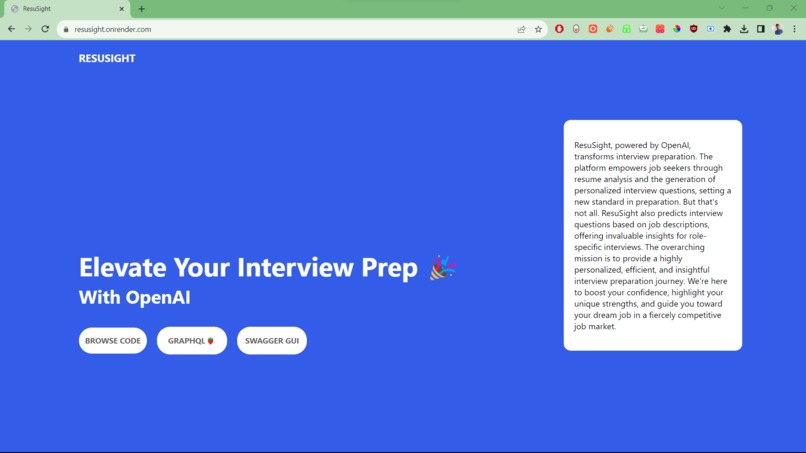
Landing Page
-
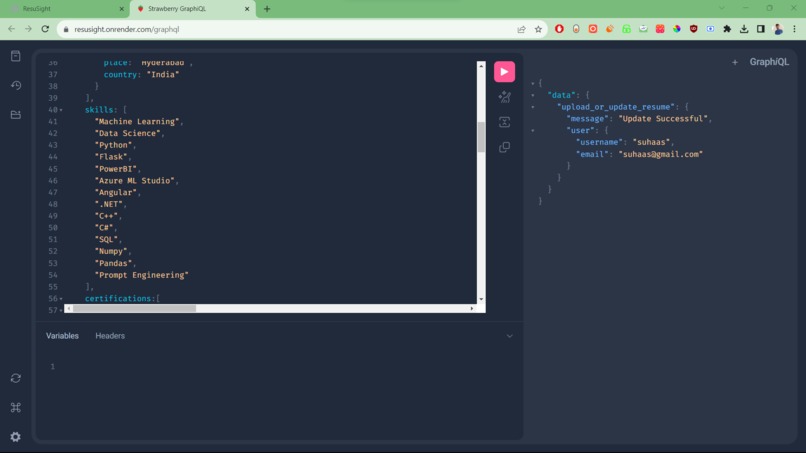
GraphiQL
-
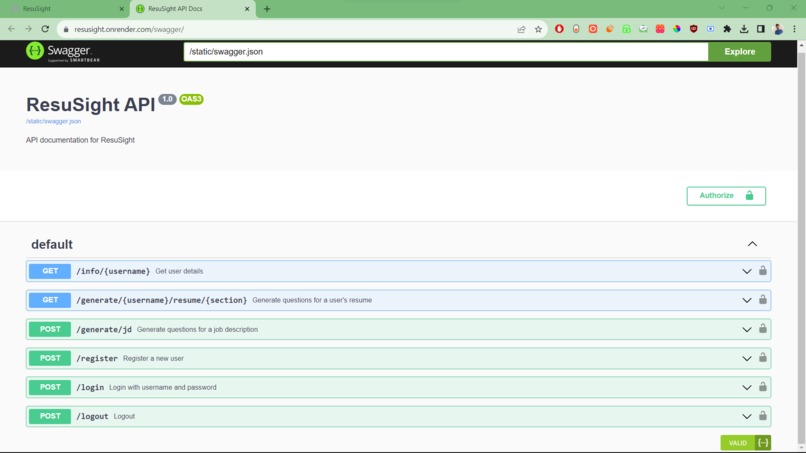
Swagger endpoints documentation


Inspiration
The inspiration behind ResuSight is deeply rooted in personal experience. Recognizing that the information contained within one's resume is not always at the forefront of their mind, the need for a centralized and efficient solution became evident. The daily challenges faced by job seekers in organizing their experiences and skills led to the conceptualization of ResuSight. It seeks to streamline and redefine the interview preparation process, providing a centralized space for users to consolidate their data, making it readily accessible for review and interview readiness.
What it does
ResuSight is an innovative platform that empowers job seekers by analyzing their resumes and generating tailored interview questions. It streamlines the interview preparation process, offering a personalized and efficient way for candidates to excel in interviews. Not only that, ResuSight also generates interview questions based on job descriptions, helping candidates anticipate and succeed in interviews related to specific roles.
How I built it
ResuSight was built using Flask for the REST APIs, MongoDB for robust and scalable data management, Strawberry GraphQL for efficient data querying, and integration with the advanced OpenAI and Langchain APIs to generate the interview questions.
Challenges I ran into
- Enabling Swagger support in Flask for easier API testing, a critical element for user-friendliness during the evaluation of the submission.
- Successfully implementing a mechanism to pass Swagger headers for user authentication, enhancing security and reliability.
- Effectively mapping MongoDB GET responses to the Strawberry GraphQL schema to ensure smooth data flow.
- Dealing with an outdated MongoEngine library, which led to transitioning to PyMongo for better support and maintenance.
Accomplishments that I am proud of
I'm proud of the valuable skills I acquired during this project. Learning and implementing GraphQL was a significant achievement. Moreover, I explored the capabilities of advanced technologies like OpenAI and Langchain and successfully integrated them into the platform. This integration with Flask and MongoDB resulted in a robust and user-friendly APIs that was deployed to be tested. These accomplishments not only expanded my technical knowledge but also demonstrated the practical use of cutting-edge tools in real-world applications.
What I learnt
The journey of developing ResuSight offered significant learning opportunities. I gained a better understanding of GraphQL, its practical applications, and its advantages compared to REST APIs. Additionally, I acquired knowledge in seamlessly integrating GraphQL with Flask and MongoDB. Exploring the potential of large language models and utilizing their APIs to generate customized prompts for application development was another valuable aspect of this project. Overall, this experience has broadened my skill set and knowledge base
What's next for ResuSight
- Develop a comprehensive user portal featuring individualized dashboards, dedicated to providing question-generation services.
- Enable users to contribute job experiences and questions, creating a virtual interview emulation platform open to a broader user base.
- Establish a Software as a Service (SaaS) model with structured pricing, ensuring sustainable growth and scalability.
- Implement seamless integration with user accounts on platforms like GitHub, LeetCode, Kaggle, and similar websites to track and analyze data, motivating users throughout their job preparation journey.
- Integrate an Applicant Tracking System (ATS) scorer, aligning with specific job descriptions and simplifying the CV and resume editing process, ultimately reducing manual efforts.
- Long-term expansion plans include offering job listings within the platform, enabling users to apply directly and receive recommendations for the best-matched jobs while comparing their qualifications with other candidates.


Log in or sign up for Devpost to join the conversation.