-
-
roboball

Inspiration
Our inspiration struck from the intersection of nostalgia and the future—reimagining the classic foosball table through the lens of AI technology. We envisioned a space where the Fraser Group's clientele could connect with their favourite pastimes while engaging with the advancements of the digital age. We aimed to blend the physicality of traditional gameplay with the insights and enhancements that AI could offer, turning a game of foosball into an experiential retail masterpiece. The goal? To draw in a crowd with the charm of the familiar, then keep them enthralled with the novelty of AI-enhanced play.
In our developmental journey, we've initiated the integration of Intel's Dev Cloud, exploring the possibilities that their AI/ML technology presents. This isn't just about modernising a game—it's about setting a precedent for innovation in customer interaction within retail spaces like Game, Sports Direct, and Belong. Our project may be in its infancy regarding fully utilising Intel's technology. Still, it stands as a testament to the potential that AI has in transforming the entertainment and retail industries. We are inspired to pave the way for a new era of in-store experience, where AI doesn't replace the old but rather elevates it, creating a harmonious blend of the past and future.
What it does
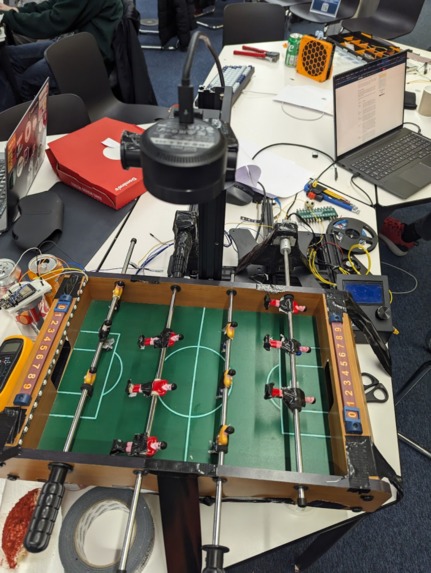
Our project transforms the traditional foosball experience by repurposing a 3D printer's precise movement capabilities to control one side of the table, creating an AI opponent to challenge human players. With a camera strategically mounted above, our system uses real-time visual tracking to monitor the ball's position on the field. This setup enables the AI to not just react to the ball's current location but also to analyse the game's flow, predicting and executing strategic moves to engage its human counterpart.
What results is a dynamic interaction between human intuition and AI prediction, taking a fun, retro game and elevating it into a cutting-edge, entertaining duel of wits and reflexes. This innovation is more than a match for individual players—it’s a showcase of human-machine collaboration, a new form of entertainment that could redefine competitive play in gaming spaces.
As AI becomes an increasingly integral part of our daily lives, our project aims to demystify and showcase the potential of this technology in a fun and engaging way. By pairing human skill with AI's analytical prowess in a familiar game, we're not only providing a unique interactive experience but also inspiring new audiences to become involved with technology. This isn't just about playing foosball; it's about sparking curiosity and inviting players to think about the underlying mechanics of AI.
Through this approachable and entertaining platform, we hope to ignite a passion for innovation and technological exploration. It’s an invitation to gamers and customers alike to consider the possibilities that AI can bring—not only to entertainment but to a wide array of future applications. We're excited about the potential to inspire the next generation of technologists, thinkers, and innovators through a simple yet profound interaction with our AI-enhanced foosball table.
How we built it
We embraced a hands-on approach to blending hardware hacking with software ingenuity in building our AI-powered foosball table. Utilising OpenCV, we crafted a visual tracking system that captures the ball's position with precision, acting as the eyes for our AI.
The muscle behind the operation comes from repurposed 3D printer hardware. We programmed it to interpret gcode via a Python interface, which manipulates the printer's motors—now the rods and players of the foosball table—to engage with the ball in real time. This reimagining of 3D printer capabilities demonstrates a novel application beyond their traditional use.
To amplify the excitement, we integrated LED lights that react to the game's events, such as scoring, bringing an extra layer of interaction and spectacle to the human versus machine matchup.
Our journey into Intel's Dev Cloud opened up new frontiers. We deployed a machine learning model, tapping into the power of Intel's optimised PyTorch package to maximise the performance of the underlying hardware. We also experimented with OpenVINO to accelerate the predictions of the ball's trajectory. Although challenges arose with accurate ball detection—reminding us of the iterative nature of machine learning—we laid the foundation for further refinement.
Utilising Intel's oneAPI highlights the strength of a unified programming model, ensuring our application can seamlessly transition across various forms of Intel architecture, thereby future-proofing our innovation and demonstrating the versatile power of Intel's AI toolkit.
Challenges we ran into
While bringing our AI foosball table to life, we encountered a series of challenges that tested our problem-solving skills and technical acumen.
One of the primary hurdles was ball detection. Using machine learning models and OpenCV, we strove to track the ball's position accurately. However, external variables such as inconsistent lighting conditions and complex patterns on the ball's surface led to detection inaccuracies. This issue highlighted the importance of a controlled environment and the potential need for more robust training data for the AI to improve its recognition capabilities.
Another technical challenge was programming the motion of the foosball rods using Python to send gcode to the 3D printer motors. We had to define the movement carefully to mimic human-like responses and to ensure that the AI could effectively 'kick' the ball without damaging the equipment. Fine-tuning these parameters required a delicate balance between responsiveness and mechanical safety.
The LED lighting system, designed to enhance player feedback, also presented obstacles. While programming the lights to sequence from left-to-right was achieved, reversing this direction for right-to-left animations introduced unexpected difficulties. The desired effect was for the LEDs to indicate scoring events, and achieving this with symmetry proved more complex than anticipated.
Lastly, we grappled with the integration of Intel's Dev Cloud. Initial setup complexities, understanding the constraints around real-time data analysis, and limitations related to server access were all points of contention. Although we couldn't utilize web sockets or web applications on the server as we had hoped, we pivoted to exploring the platform's capacity for training and repurposing existing models—like those used in traffic camera object detection—for our ball tracking needs.
Each challenge brought with it a valuable lesson in the realities of integrating AI with physical hardware and the iterative nature of machine learning projects
Accomplishments that we're proud of
We're proud of several key achievements:
- Creating a functional AI-powered foosball prototype against all odds.
- Fostering a strong team dynamic where each member's contribution was pivotal.
- Expanding our network, meeting new people, and exchanging ideas.
- Learning and applying new technologies, including Intel's Dev Cloud and machine learning concepts.
What we learned
Our hackathon journey has been incredibly enlightening, offering us a wealth of learning opportunities:
- We've gained familiarity with new technologies, such as Intel's Dev Cloud and the principles of machine learning, which will be invaluable for future projects.
- Understanding the limitations and constraints within technology, mainly when interfacing software with physical components, has given us a realistic perspective on development and innovation.
- Effective time management was crucial as we navigated tight deadlines and had to prioritize tasks to turn our concept into a working prototype.
- We also learned the importance of adaptability—being able to pivot and troubleshoot when things didn't go as planned was key to our progress.
- The project honed our problem-solving skills as we tackled issues ranging from hardware-software integration to real-time data processing.
What's next for RoboBall
As we look to the future of RoboBall, our roadmap is focused on several exciting enhancements and explorations:
- Intel's Dev Cloud Integration: We plan to delve deeper into Intel's cloud technology to enhance ball tracking and leverage machine learning models. This will involve refining our AI to create a more challenging and interactive gameplay experience, potentially enabling the AI to learn and adapt from each game.
- Hardware Optimisation: Moving beyond the repurposed 3D printer setup, we aim to explore more robust and precise alternatives for the mechanical aspects of our design. This could involve custom-built components or commercial-grade hardware to improve stability and durability.
- Commercial Viability: We're also looking at how RoboBall can benefit businesses. This includes analysing market needs and exploring potential partnerships. We see opportunities for RoboBall in entertainment venues, retail spaces, and educational settings, where it can serve not just as entertainment but also as a tool for engaging and educating on the potential of AI and robotics.
- Scalability and Customisation: There's potential to create scalable versions of RoboBall that can be customised for different environments or purposes. This may involve software updates that allow for personalised difficulty levels or themed gameplay to align with specific brands or events.
- User Experience Improvements: Feedback from users will be invaluable. We'll be looking at ways to enhance the user interface and the overall experience to make sure RoboBall is not just technologically advanced but also user-friendly and enjoyable for all players.


Log in or sign up for Devpost to join the conversation.