-
-
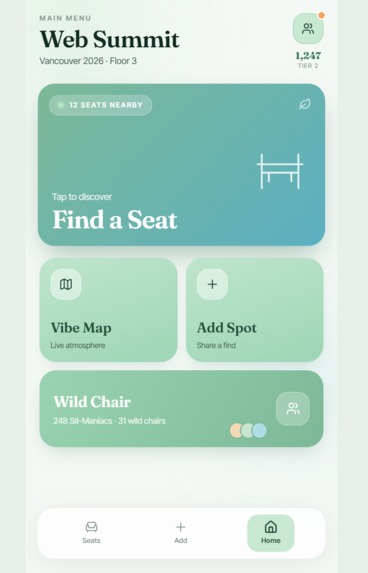
Main Menu
-
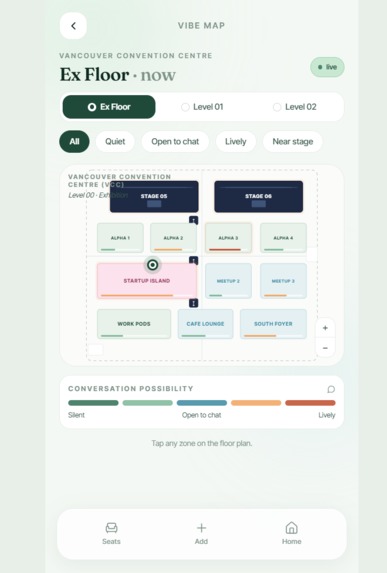
Dynamic heat map and conversation chance


SitMeDown
Recovery Infrastructure for Human Energy at Conferences
Inspiration
SitMeDown was inspired by a very real and physical pain we experienced during Vancouver Web Summit.
After hours of walking through massive convention halls, standing in crowded networking areas, attending talks, and moving between booths, one thought kept repeating itself:
“I just want to sit down.”
What surprised us was how universal this feeling became. Friends, strangers, founders, students — almost everyone eventually complained about foot strain, leg pain, exhaustion, or the inability to find a place to properly rest.
At the same time, we noticed something strange:
Despite seating being one of the most essential resources at a conference, it was almost completely unmanaged.
People never knew:
- where seats were
- whether they were available
- whether they were reserved
- or whether there were hidden seating spots nearby
Large conventions started feeling like deserts for human energy.
And in a desert, water becomes survival.
To us, seating felt exactly the same.
That intense desire to sit became the north star of the project.
What it does
SitMeDown is a real-time seating and recovery platform designed for conferences and large-scale events.
The app helps attendees quickly discover suitable seating based on their current needs:
- quiet recharge
- networking-friendly seating
- temporary rest areas
- hidden community-discovered spots
The core experience revolves around a giant emergency button:
“SIT ME DOWN NOW”
With one tap, users are guided toward the nearest available seating area through a dynamic live map.
The platform also includes:
- real-time seat atmosphere updates
- occupancy-aware seating categories
- autonomous check-in/check-out
- community-discovered “Wild Chairs”
- playful social interactions and badges
Instead of treating seating as static furniture, SitMeDown treats it as:
$$ \text{Recovery Infrastructure} $$
for exhausted attendees trying to survive long conventions.
How we built it
We approached SitMeDown by combining lightweight interaction design, behavioral assumptions, and playful UX thinking. By using LLMs to generate Claude Prompts and having Claude building interactive prototype.
One major realization shaped the system:
When people finally sit down to rest, they naturally start using their phones.
Instead of relying on expensive hardware infrastructure or complicated sensors, we designed the seating system around lightweight user interaction.
The flow works like this:
- User presses the emergency seating button
- System recommends nearby seating
- User arrives and confirms seating through a simple interaction
- System marks the seat as occupied
- Auto check-out occurs when the user leaves the area
This creates a low-friction occupancy system that feels intuitive rather than invasive.
We also designed:
- a dynamic seating map
- real-time seating atmosphere changes
- community-posted “Wild Chairs”
- playful emotional microcopy
- gamified seat discovery
The project was heavily shaped through rapid prototyping, storytelling, and emotionally-driven UX design.
Challenges we ran into
The biggest challenge was figuring out:
How do we realistically track seat availability without requiring expensive infrastructure?
Accurate indoor tracking is difficult, especially inside crowded convention spaces.
We initially explored more complicated approaches involving:
- sensors
- hardware tracking
- passive occupancy systems
But these approaches quickly became unrealistic for a hackathon-scale implementation.
Another challenge was balancing:
- utility
- humor
- and legitimacy
We wanted SitMeDown to feel playful and memorable without becoming a joke product.
Finally, we had to rethink the problem itself.
At first, the project sounded like:
“a seat finder app”
But we eventually realized the real problem was:
$$ \text{Human Energy Management} $$
That reframing completely changed the direction of the product.
Accomplishments that we're proud of
We are proud that SitMeDown solves a pain point almost every conference attendee immediately understands.
We are especially proud of:
- reframing seating as recovery infrastructure
- designing emotionally-aware UX
- creating the “SIT ME DOWN NOW” emergency interaction
- building a dynamic seating atmosphere system
- turning hidden seating into a playful community culture through “Wild Chairs”
We also believe the product stands out because it focuses on something most event technology ignores:
$$ \text{Physical exhaustion} $$
instead of only optimizing digital productivity.
Most importantly, the project feels deeply human.
It came directly from lived experience instead of hypothetical user problems.
What we learned
The biggest lesson we learned is that meaningful products often come from genuine shared frustration.
Good ideas are not always futuristic or complicated.
Sometimes they come from noticing something painfully obvious that everyone silently accepts.
We also learned that playful creativity can strengthen utility instead of weakening it.
Features like:
- Wild Chairs
- Goblin-approved seating
- chaotic hidden spots
made the product feel more relatable and memorable.
The project reinforced our belief that:
$$ \text{Empathy} + \text{Creativity} + \text{Execution} = \text{Meaningful Experiences} $$
AI helped us accelerate brainstorming, iteration, and UX exploration, but the emotional core of the project came from real human experience.
What's next for SitMeDown
In the future, we want SitMeDown to evolve beyond hackathons into a real conference infrastructure layer.
Possible next steps include:
- integration with official event apps
- lightweight BLE occupancy systems
- smarter crowd flow analysis
- personalized recovery recommendations
- accessibility-focused seating support
- temporary reservation logic
- social energy preference matching
- AR navigation for large venues
We also want to explore how conferences can better support:
- physical recovery
- cognitive fatigue
- social burnout
- overstimulation
Ultimately, SitMeDown is not just about chairs.
It is about designing conferences around human energy instead of endless movement.
Built With
- claudecode
- gemini
- google-docs
- stitch


Log in or sign up for Devpost to join the conversation.