-
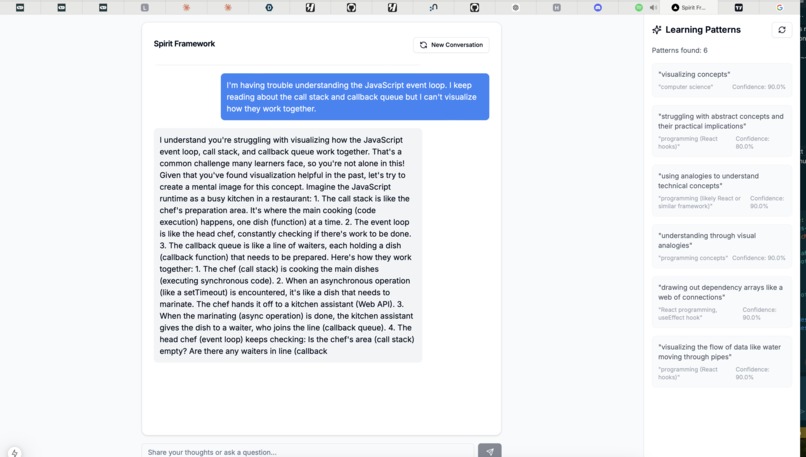
Intelligent conversations and pattern recognition

Inspiration
The Spirit Framework was born from a fundamental observation: traditional educational software tries to force learning into standardized patterns, but real understanding flows naturally like wind through leaves - unique to each person, impossible to control, yet possible to nurture. Inspired by The Spirit of Complexity, we set out to build an educational system that aligns with how minds actually work - not forcing standardization, but recognizing and nurturing each person's natural way of understanding.
What it does
Spirit Framework is an AI-powered conversation system that constructs a living knowledge graph of human learning patterns. Through natural dialogue, it observes and maps how different minds process and connect information, without forcing them into predetermined paths. This creates a growing network of learning patterns that becomes more valuable with each interaction.
Key features:
- Pattern detection that preserves individual learning styles
- Evolution tracking showing how understanding naturally grows
- Pattern resonance detection finding organic connections
- Contextual memory that maintains learning history
How we built it
We architected a system combining multiple cutting-edge technologies:
- Knowledge Graph: Neo4j database storing learning patterns and their natural evolution
- AI Integration:
- Claude 3.5 Sonnet for nuanced conversation and pattern analysis
- Sentence transformers for semantic pattern matching
- Pattern resonance detection finding natural learning connections
- Memory System: Conversational context tracking that preserves learning journeys
- Pattern Evolution: System for tracking how understanding naturally grows and connects
Challenges we ran into
Building the Spirit Framework wasn't just a technical journey, but a navigation through intricate development complexities:
Authentication and Deployment Nuances
- Discovered subtle differences between local development and production environments
- Resolved authentication challenges with API keys
- Learned that development environments have more flexible authentication compared to production
Neo4j Connection Configuration
- Encountered strict URI validation preventing deployment
- Discovered limitations in regular expression checks for database connection strings
- Worked around restrictions by directly inputting connection URI
- Highlighted the need for more flexible connection string validation
Frontend-Backend Integration
- Experienced challenges connecting Next.js frontend with Modus API in production
- Debugging CORS and authentication issues across different deployment environments
- Navigated the complexities of secure API communication
Philosophical and Technical Balancing Act
- Core challenge was maintaining the framework's philosophical integrity
- Designing a system that observes learning patterns without forcing categorization
- Creating flexible knowledge graph structures that preserve individual learning uniqueness
Pattern Detection Complexity
- Developed pattern recognition that doesn't standardize or oversimplify learning
- Created algorithms that find natural connections without imposing rigid frameworks
- Implemented evolution tracking that respects individual cognitive diversity
The challenges reinforced our core belief: technological solutions in education must prioritize human complexity over simplistic standardization.
Accomplishments that we're proud of
- Successfully implemented pattern detection that preserves individual learning styles
- Created a knowledge graph structure that grows organically with each interaction
- Developed pattern resonance detection finding natural learning connections
- Built a foundation for truly adaptive educational technology
- Maintained the spirit of natural learning throughout the technical implementation
What we learned
Building Spirit Framework taught us that AI in education doesn't need to control learning to be effective. The key insights:
- Learning patterns emerge naturally when given space
- Different minds connect knowledge in unique but valid ways
- Understanding grows through organic connections
- Technology should nurture rather than standardize learning
What's Next for Spirit Framework
Our current chat interface is just the beginning of a larger vision. Here's what we're planning next:
Near-term Goals
Expand Pattern Recognition
- Visual learning pattern detection (images/videos)
- Voice interaction for auditory learning patterns
- Multimodal pattern recognition (combining text, voice, visual)
Enhanced Cognitive Mapping
- Develop sophisticated methods for tracking learning patterns:
- Interaction temporal analysis
- Contextual comprehension tracking
- Cognitive complexity assessment
- Spontaneous understanding moment detection
Behavioral Analysis
- Infer cognitive processes through carefully designed behavioral proxies:
- Interaction timing dynamics
- Problem-solving approach tracking
Adaptive AI Models
- Implement adaptive inference models that:
- Learn from each interaction
- Continuously refine understanding mechanisms
- Respect individual cognitive diversity
- Minimize presumptive categorizations
Ethical Enhancements
- Ensure the system:
- Preserves individual cognitive privacy
- Generates insights without external manipulation
- Provides agency to the learner
- Offers transparent, interpretable results
Open Ecosystem
- Release open APIs for educational software integration
- Encourage community contributions and collaboration
Long-term Vision
Comprehensive Knowledge Graph
- Build a vast, interconnected map of human understanding
- Represent the diversity and complexity of learning patterns
Universal Adaptive Learning
- Enable any educational software to naturally adapt to individual learning styles
- Provide seamless integration and real-time recommendations
Global Learning Community
- Foster a worldwide network of learners, educators, and researchers
- Facilitate knowledge sharing and collaborative discovery
Continuous Evolution
- Maintain the spirit of natural learning as the system grows
- Adapt to emerging learning patterns and technologies
Societal Impact
- Transform educational practices and policies
- Promote inclusive, personalized learning on a global scale
The ultimate goal is to transform educational technology from a system that forces standardization to one that celebrates and nurtures the beautiful complexity of human understanding.
Built With
- assemblyscript
- claude-3.5-sonnet
- distilbert
- git/github
- graphql-api
- graphql-explorer
- hyp-cli
- hypermode-platform
- modus-cli
- modus-framework
- neo4j
- neo4j-auradb
- next.js-14
- sentence-transformers-(all-minilm-l6-v2)
- shadcn-ui
- tailwind-css
- typescript
- vercel
- visual-studio-code


Log in or sign up for Devpost to join the conversation.