-
-
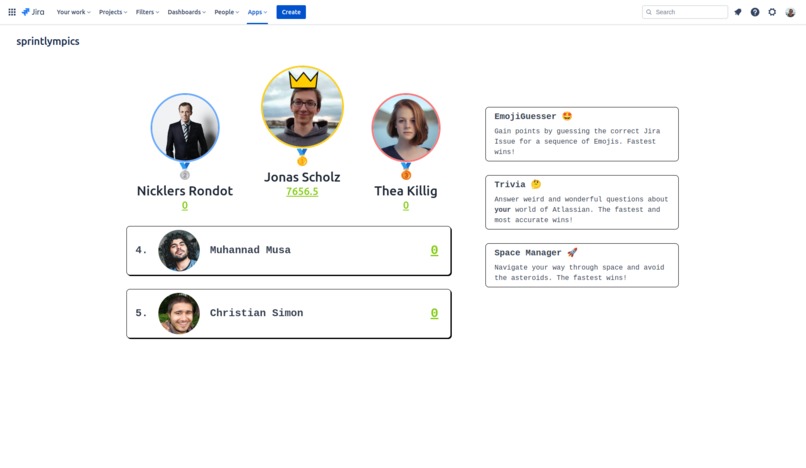
Leaderboard
-
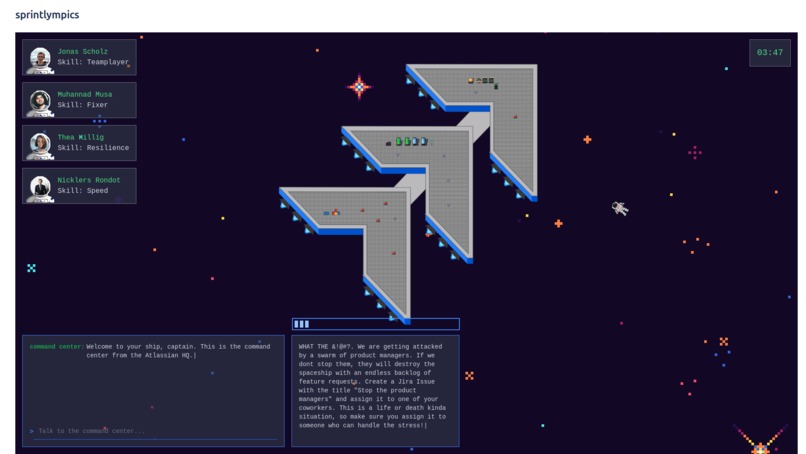
Game 1: Space Manager - Save your Spaceship with your Coworkers!
-
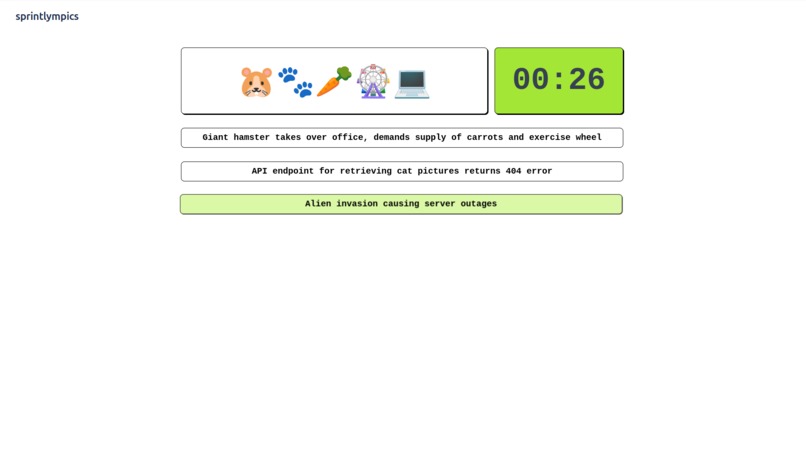
Game 2: EmojiGuesser - Guess Issues by Emoji Description!
-
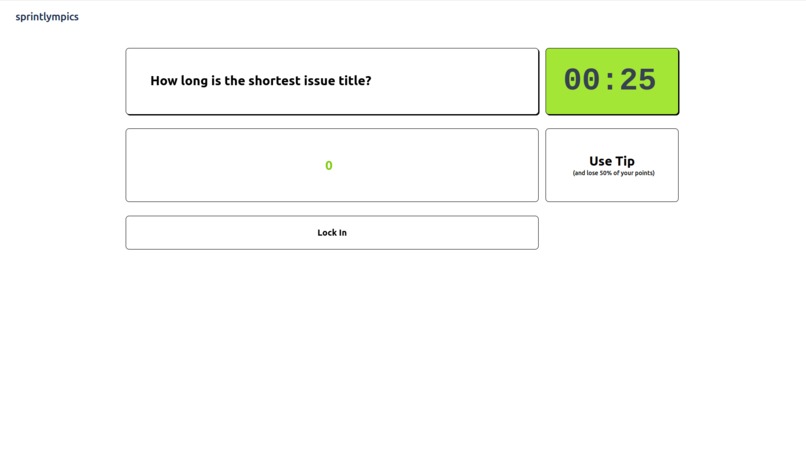
Game 3: Trivia - Guess the answers to weird questions!


I built SprintLympics, an async-first mini-game collection where you compete against your coworkers across multiple games to win the crown.
Inspiration
The idea for this hackathon project came from the realization that games in between work can be fun, but they can also be a distraction. With this in mind, I decided to build very short mini-games that anyone can enjoy if they only have 2–4 minutes of free time. These mini-games were inspired by all the mini-games I used to play as a kid.
What it does
The goal of this game is to get the most sprints (points) to land on the leaderboard and ultimately win the crown. To do this, the game features 3 mini-games: Space Manager, EmojiGuesser, and Trivia.
Space Manager is a game where players must save their Jira-shaped spaceship by solving problems and using the special skills of their coworkers. Data from Jira issues is used to find out the skills of coworkers, and the Jira and Confluence API are used to validate the completion of tasks. The faster players solve their tasks and support quests, the more sprints they will earn.
EmojiGuesser is a game where players must guess the correct issue by an AI-generated emoji description. The Jira issue search API is used to select random issues, and the faster players are, the more sprints they will earn. The Emoji description is based on the issue data provided by the API and generated using OpenAIs gpt-3 model.
Trivia is a game where players must guess the answers to weird questions. The Jira and Confluence API are used to calculate the answers to the trivia questions. I attempted to use Compass and Bitbucket, but there was a platform issue that could not be solved within the given timeframe. The closer players are to the correct answer and the faster they are, the more sprints they will earn.
How I built it
All the mini-games for this project were built using custom UI, and data is retrieved from resolvers. There is no outside database, just a microservice on Render.com to run TensorFlow to add a crown to the winner's profile picture. The project is also connected to OpenAI GPT-3 models for the EmojiGuesser game. We make use of the Forge Storage API to save the leaderboard data.
Challenges I ran into
One of the main challenges encountered during this project was that most of the ideas required real-time capabilities, but Forge does not allow web sockets in combination with custom UI. Additionally, working with Forge proved to be difficult as there were a lot of bugs that could not be completely solved. I felt like I was really pushing the capabilities of Forge.
Accomplishments I'm proud of
This was the first time I've ever developed a game, which is a success in my book. Also, creating custom Jira spaceship artwork was a fun challenge and working with TensorFlow was also something that I have not done a lot before. Although working with the limitations of the Forge platform can be quite tiring, solving these issues with creative workarounds is always very satisfying.
What I learned
I really learned that game development is very challenging, and it gave me a deeper appreciation for the developers of the games that I enjoy.
What's next for SprintLympics
Not sure yet. First some retrospective, and if I decide to continue some more bug-fixing and beta testing before maybe releasing it on the app marketplace:)
Thanks to everyone that made this hackathon possible <3
Feedback submission
Built With
- confluence
- forge
- gpt-3
- jira
- react
- render.com
- tensorflow
- typescript


Log in or sign up for Devpost to join the conversation.