-
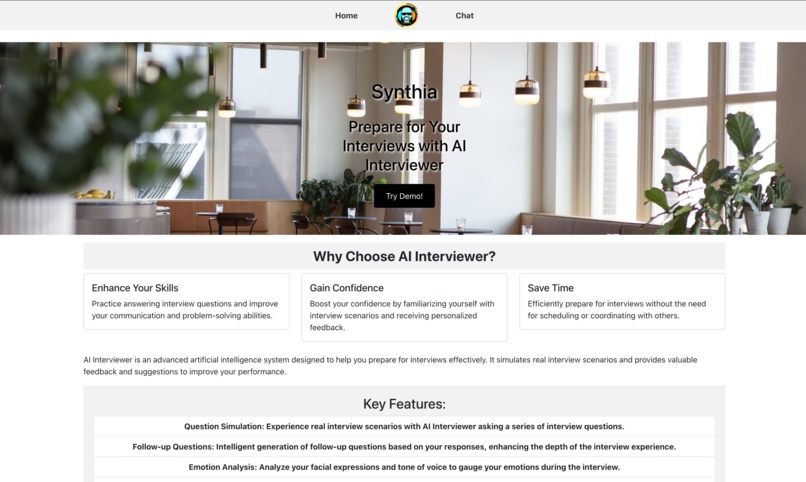
Home Page
-
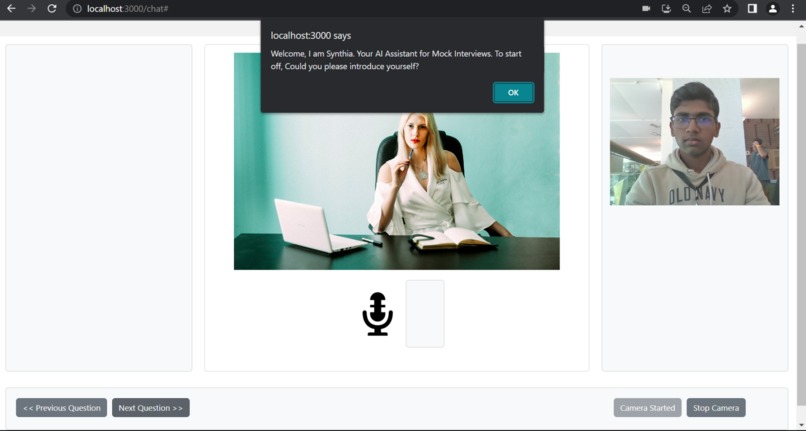
Introduction from Synthia
-
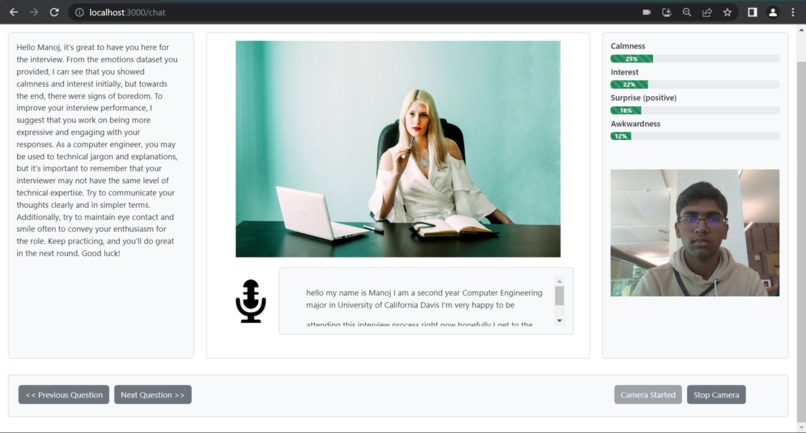
Response by Synthia
-
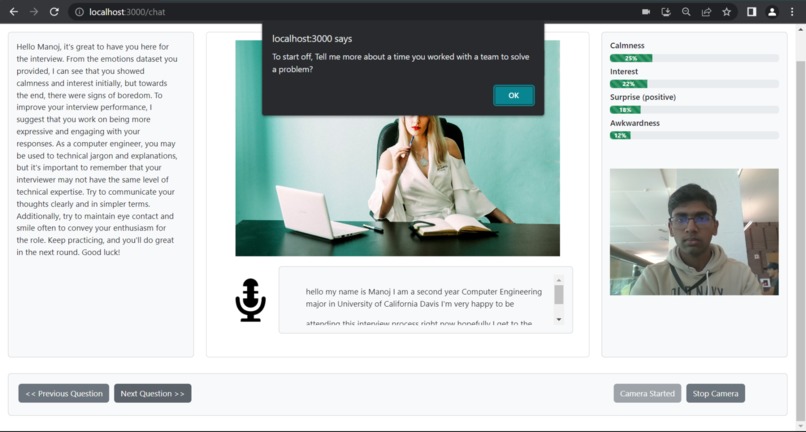
Question asked by Synthia


Inspiration
- Our project was inspired by the struggles encountered during the job hunt, particularly the challenges arising from social anxiety and a lack of experience. We wanted to empower individuals facing these obstacles and break the cycle of failure many find themselves in when searching for a position. SynthiaAI aims to provide a supportive environment where people can practice and build confidence in interview scenarios, offering feedback and resources to enhance their skills. By doing so, we aim to increase their chances of success and alleviate some of the burdens associated with the job search process.
What it does
- Our AI-powered chatbot, SynthiaAI, is an interviewer to assist users in preparing for job interviews. It generates interview questions for users to respond to and provides valuable feedback on the content of their responses and their emotional expression during the process. The primary goal of SynthiaAI is to help users enhance their interview-taking abilities, allowing them to improve their skills and increase their chances of success in authentic job interviews.
How we built it
- Our project was built using a combination of JavaScript and React for the front-end, while Python and Flask were utilized for the back-end. We selected these languages and libraries because of their ease of use, making the development process more streamlined. We integrated the OpenAI API and the Hume AI to power our AI interviewer. This combination allowed our system to generate appropriate responses, guide users during interviews, and improve its feedback through learning. The Hume AI component was instrumental in analyzing the users' emotions during their responses, enhancing the overall user experience and feedback provided by our AI interviewer. Utilizing the OpenAI API, we generated contextually relevant and coherent responses aligned with the user's inputs and interview scenarios, making the interview experience more realistic and practical.
Challenges we ran into
Throughout the development process, we encountered a range of challenges, both non-technical and technical. On the non-technical side, there were issues with miscommunication regarding meeting locations and task assignments, leading to confusion and delays. Over-clarification became necessary to ensure everyone was on the same page and tasks were properly aligned.
From a technical perspective, working with new technologies posed a learning curve as we had to familiarize ourselves while simultaneously developing the project. We faced difficulties with the Hume AI documentation, given our team's relative unfamiliarity with the technology. Additionally, deployment presented challenges as most team members had limited experience in this aspect, resulting in obstacles and setbacks. Despite these challenges, we actively addressed and overcame them, leveraging effective communication and seeking guidance to ensure the project's progress.
What we have learned
- Throughout the development process, we learned valuable lessons, including the adoption of new technologies like React and Flask, understanding the capabilities of large language models and generative AI, staying up to date with AI trends, and the importance of effective planning and task allocation. These insights enabled us to expand our skills, leverage cutting-edge technologies, remain relevant in the field, and optimize our workflow for increased efficiency.
What's next for SynthiaAI
- In our upcoming plans for SynthiaAI project, we will introduce a 3D model for a more immersive user experience. Additionally, we aim to integrate facial emotion detection to enhance context understanding based on users' expressions. Lastly, we will enable company-specific question configurations, streamlining candidate evaluation for optimized hiring processes. These advancements collectively aim to enhance engagement, provide personalized feedback, and optimize the efficiency of the hiring process.
Built With
- flask
- humeai
- javascript
- openai
- python
- react
- whispir


Log in or sign up for Devpost to join the conversation.